China's Xi arrives in Saudi Arabia for energy-focused visit
The trip will feature bilateral meetings with Crown Prince Mohammed bin Salman, a summit with six-member GCC and wider China-Arab summit
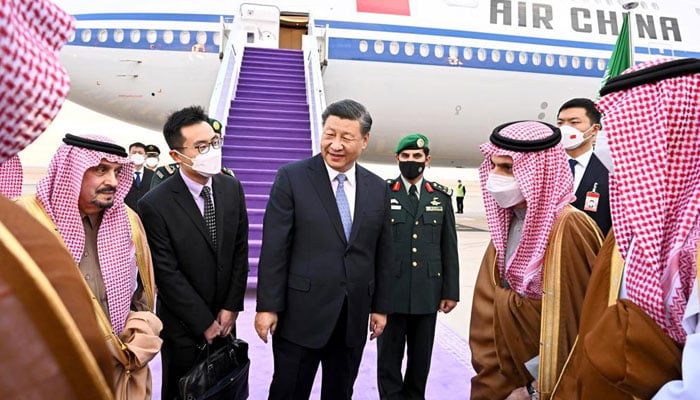
Chinese President Xi Jinping touched down in Saudi Arabia on Wednesday for a visit that is likely to focus on energy ties as Washington warned of Beijing's growing influence.
Xi, recently reanointed as leader of the world's second-biggest economy, arrived in the capital Riyadh, Chinese and Saudi state media said, for a three-day visit that will include talks with Saudi and other Arab leaders.
Saudi Foreign Minister Prince Faisal bin Farhan and Riyadh Governor Prince Faisal bin Bandar were among those who welcomed Xi at the airport, where a ceremonial purple carpet was laid out from the steps of the plane.
China is Saudi Arabia's top oil customer, and both sides appear keen to expand their relationship at a time of economic turmoil and geopolitical realignment.
The trip — only Xi's third overseas since the coronavirus pandemic began, and his first to the world's top oil exporter since 2016 — comes after US President Joe Biden's visit in July, when he pleaded in vain for higher oil production.
It will feature bilateral meetings with Saudi King Salman and Crown Prince Mohammed bin Salman, the de facto ruler, as well as a summit with the six-member Gulf Cooperation Council and a wider China-Arab summit.
Asked about the Xi visit, White House National Security Council spokesman John Kirby told reporters on Wednesday that Saudi Arabia remains a crucial US ally, but warned of "the influence that China is trying to grow around the world."
"We believe that many of the things they're trying to pursue and the manner in which they're trying to pursue it are not conducive to preserving the international rules-based order," Kirby said, adding that Washington did not expect nations to choose between the two powers.
Washington tensions
Saudi Energy Minister Prince Abdulaziz bin Salman on Wednesday said that "Saudi Arabia will remain China's credible and reliable partner" in the global oil market.
Bilateral "relations... are witnessing a qualitative leap," the official Saudi Press Agency (SPA) quoted him as saying.
He said the two countries will endeavour to boost cooperation in energy supply chains by establishing a "regional centre" in Saudi Arabia for Chinese factories, according to SPA.
SPA said the kingdom accounted for more than 20% of Chinese investment in the Arab world between 2005 and 2020, the largest share of any nation in the region.
Oil markets are key to the bilateral talks, especially given the substantial market turbulence seen since Russia invaded Ukraine in February.
The G7 and European Union on Friday agreed to a $60-per-barrel price cap on Russian oil in an attempt to deny the Kremlin war resources, injecting further market uncertainty.
On Sunday, the OPEC+ oil cartel led jointly by Saudi Arabia and Russia opted to keep in place production cuts of two million barrels per day approved in October.
Washington said those cuts amounted to "aligning with Russia" on the war in Ukraine.
The US has been engaged in what is often described as an oil-for-security partnership with Saudi Arabia since the tail-end of World War II.
While the Biden administration has smarted over the production cuts, Riyadh has at times accused the US of failing to hold up the security end of the bargain, notably after strikes in September 2019 claimed by Yemen's Huthi rebels temporarily halved the kingdom's crude output.
Deals in pipeline
Saudi and Chinese officials have provided scant information about the agenda of the bilateral talks, although Ali Shihabi, a Saudi analyst close to the government, said he expected "a number of agreements to be signed".
Chinese foreign ministry spokeswoman Mao Ning said on Wednesday that Xi's programme represents the "largest-scale diplomatic activity between China and the Arab world" since the People's Republic of China was founded.
Analysts say potential deals seeing Chinese firms become more deeply involved in mega-projects central to Prince Mohammed's vision of economic diversification will likely be key talking points.
Key Saudi projects include the futuristic $500 billion megacity NEOM, a so-called cognitive city that will depend heavily on facial recognition and surveillance technology.
If the Saudis are "looking to extract more security guarantees from the US... signalling that they have the opportunity of strengthening ties with China is something that suits them well," said Torbjorn Soltvedt, of the risk intelligence firm Verisk Maplecroft.


-
 Zelenskyy signals new Russian refinery strikes after feeling ‘betrayed’ by Trump
 -
 Anthropic to add official US voting information to Claude ahead of midterms
 -
 University of Chicago investigates reported sexual assault at off-campus fraternity house
 -
 Tumbler Ridge school shooting: US grand jury indicts alleged accomplice indicted
 -
 Trump targets Canada again with 51st state remarks at Arizona rally
 -
 Alberta separation referendum draws massive early turnout as 174,532 cast ballots
 -
 Jared Kushner sued over government role and alleged conflicts of interest
 -
 Brazil ends six-day workweek in historic labour reform affecting 30 million workers
-
 Zelenskyy says Ukraine is losing a strong US partner amid Starlink restrictions
 -
Did Katie Zacharia pass the bar? Trump's new press secretary faces scrutiny
-
Ilhan Omar's phone seized by federal authorities weeks before US midterm elections
-
Nancy Mace's ex-fiancé Brendan Bryant charged with voyeurism after 2025 allegations