NASA Orion spacecraft enters lunar orbit: officials
"The orbit is distant in that Orion will fly about 40,000 miles above the moon," NASA said
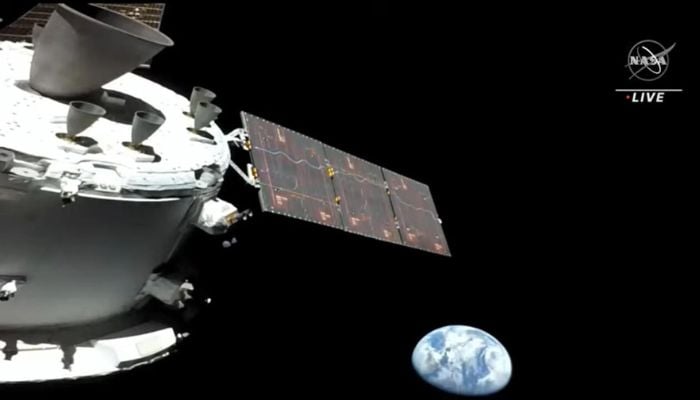
WASHINGTON: NASA's Orion spacecraft was placed in lunar orbit Friday, officials said, as the much-delayed moon mission proceeded successfully.
A little over a week after the spacecraft blasted off from Florida bound for the moon, flight controllers "successfully performed a burn to insert Orion into a distant retrograde orbit," the US space agency said on its website.
The spacecraft is to take astronauts to the moon in the coming years — the first to set foot on its surface since the last Apollo mission in 1972.
This first test flight, without a crew on board, aims to ensure that the vehicle is safe.
"The orbit is distant in that Orion will fly about 40,000 miles above the moon," NASA said.
While in lunar orbit, flight controllers will monitor key systems and perform checkouts while in the environment of deep space, the agency said.
It will take Orion about a week to complete half an orbit around the moon. It will then exit the orbit for the return journey home, according to NASA.
On Saturday, the ship is expected to go up to 40,000 miles beyond the moon, a record for a habitable capsule. The current record is held by the Apollo 13 spacecraft at 248,655 miles (400,171km) from Earth.
It will then begin the journey back to Earth, with a landing in the Pacific Ocean scheduled for December 11, after just over 25 days of flight.
The success of this mission will determine the future of the Artemis 2 mission, which will take astronauts around the moon without landing, then Artemis 3, which will finally mark the return of humans to the lunar surface.
Those missions are scheduled to take place in 2024 and 2025, respectively.


-
 Can cancer drugs be made in space? Here’s what the new mission aims to find out
 -
 SpaceX Falcon 9 successfully launches Bandwagon-5 mission with 32 payloads
 -
 Europe launched 8 orbital rockets last year, can it rival Starlink?
 -
 Japan launches world’s first mission to bring sample back from phobos
 -
 Orionid meteor shower 2026: Peak date, viewing tips and what to expect
 -
 Why Mars looks blue in NASA’s unedited curiosity panorama?
 -
 Blue Origin upgrades new Glenn rocket launch infrastructure to take on SpaceX
 -
 NASA’s next Mars mission targets Phobos and Deimos, not Red Planet