NASA Moon mission 'exceeding' expectations
This first test flight since the last Apollo mission in 1972, without a crew on board, aims to ensure that the vehicle is safe
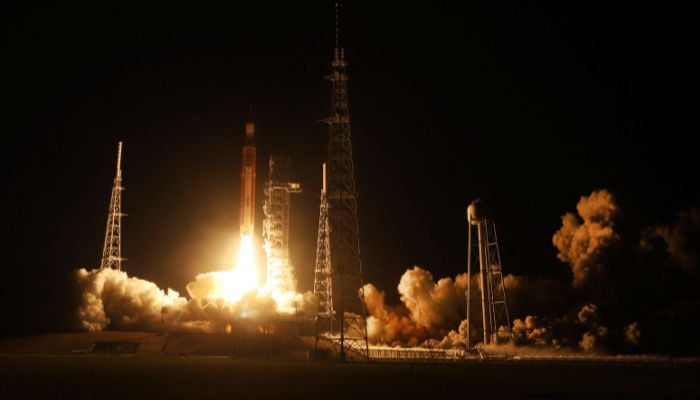
WASHINGTON: On the third day after lifting off from Florida bound for the Moon, the Orion spacecraft is "exceeding performance expectations," NASA officials said on Friday.
The spacecraft is to take astronauts to the Moon in the coming years — the first to set foot on its surface since the last Apollo mission in 1972.
This first test flight, without a crew on board, aims to ensure that the vehicle is safe.
"Today we met to review the Orion spacecraft performance... it is exceeding performance expectations," said Mike Sarafin, head of the Artemis 1 mission.
The spacecraft's four solar panels, about 13 feet (four meters) long, deployed correctly and are providing more energy than expected, said Jim Geffre, the Orion manager at the Johnson Space Center in Houston.
It is from that control centre in Texas that the spacecraft is being piloted.
Orion is already some 200,000 miles (320,000 kilometres) from Earth and preparing to perform the first of four main thrusts scheduled during the mission using its engines.
This manoeuvre, which will take place early Monday morning, will bring the spacecraft as close as 80 miles (130 kilometres) from the lunar surface, in order to take advantage of the Moon's gravitational force.
Since this will take place on the far side of the Moon, NASA is expected to lose contact with the spacecraft for approximately 35 minutes.
"We will be passing over some of the Apollo landing sites," said flight director Jeff Radigan, although they will be in darkness. Footage of the flyover will be released by NASA.
Four days later, a second thrust from the engines will place Orion in a distant orbit around the Moon.
The ship will go up to 40,000 miles beyond the Moon, a record for a habitable capsule.
It will then begin the journey back to Earth, with a landing in the Pacific Ocean scheduled for December 11, after just over 25 days of flight.
The success of this mission will determine the future of the Artemis 2 mission, which will take astronauts around the Moon without landing, then Artemis 3, which will finally mark the return of humans to the lunar surface.
Those missions are scheduled to take place in 2024 and 2025, respectively.
Sarafin also said Friday that 10 scientific micro-satellites had been deployed when the rocket took off, but that half of them were experiencing technical or communication problems.
Those experiments, carried out separately by independent teams, will have no impact on the main mission, however.


-
 Can cancer drugs be made in space? Here’s what the new mission aims to find out
 -
 SpaceX Falcon 9 successfully launches Bandwagon-5 mission with 32 payloads
 -
 Europe launched 8 orbital rockets last year, can it rival Starlink?
 -
 Japan launches world’s first mission to bring sample back from phobos
 -
 Orionid meteor shower 2026: Peak date, viewing tips and what to expect
 -
 Why Mars looks blue in NASA’s unedited curiosity panorama?
 -
 Blue Origin upgrades new Glenn rocket launch infrastructure to take on SpaceX
 -
 NASA’s next Mars mission targets Phobos and Deimos, not Red Planet