
‘We’ve gone back 50 years’
The farmers are still counting their losses from the devastating floods that have put a third of the country under water, but the long-term impact is already clear
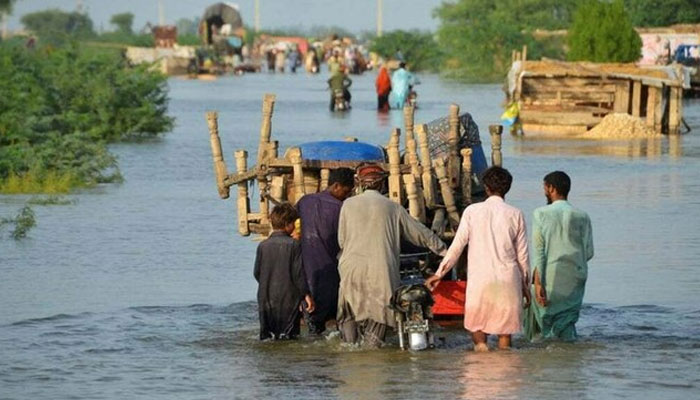
SAMMU KHAN BHANBRO, Pakistan: The farmers are still counting their losses from the devastating floods that have put a third of the country under water, but the long-term impact is already clear.
“We have gone back 50 years,” said Ashraf Ali Bhanbro, a farmer in Sindh province whose 2,500 acres of cotton and sugarcane — on the verge of being harvested — have now been wiped out.
More than 33 million people have been affected by the floods caused by record monsoon rains, and one of the worst-hit areas is Sindh. The province is bisected by the mighty Indus River, along whose banks farming has flourished for millennia with records of irrigation systems dating back to 4,000 BC.
Sindh’s problems are two-fold. The province was drenched by record rains locally, but that water has nowhere to drain because the Indus is already at full flow, swollen by tributaries in the north, and has burst its banks in several places. “At one stage it rained continuously for 72 hours,” said Bhanbro, adding he has lost at least 270 million rupees on inputs alone. “That was the cost incurred on fertilisers and pesticides, we don’t include profit, which might have been much higher as it was a bumper crop.”
Unless flooded farmlands can be drained, farmers like Bhanbro will not be able to plant a winter wheat crop — vital for the country’s food security. “We have one month. If water is not discharged in that period, there will be no wheat,” he said at his farm in Sammu Khan village, around 40 kilometres northeast of Sukkur. Driving along an elevated highway from Sukkur to Sammu Khan provides a shocking view of the devastation wrought by the floods. In some places there is water as far as the eye can see; where cotton crops are visible in flooded fields, their leaves have turned brown, with hardly a boll to be seen. “Let’s forget the cotton,” said Latif Dinno, a farmer in Saleh Pat, 30 kilometres northeast of Sukkur. “There is nothing left to pick,” said Saeed Baloch, who labours every season with members of his extended family, pooling their earnings. It’s not just the farmers that are affected, but every link in the supply chain is feeling the strain. “We are doomed,” said Waseem Ahmed, a cotton trader in Saleh Pat, who like many in the industry paid advances to fix purchase prices and hedge against inflation and market fluctuation.







-
 Tyler Rogers And Taylor Rogers Show How Twin Brothers Can Dominate MLB In Completely Different Ways
 -
 OpenAI Reports Security Issue In Third-party Tool Axios, Assures User Data Protection
 -
 Finneas O'Connell Shares Insight Into Wedding Planning With Fiancée Claudia Sulewski
 -
 Raptors Vs Knicks: OG Anunoby Leaves Game Early With Left Ankle Injury
 -
 Teddi Mellencamp Confirms She's Dating 'older' Man Amid Cancer Battle
 -
 Olivia Dean Gives Reason To Why She Still ‘can’t Believe Her Grammy Win
 -
 Eric Swalwell Campaign Rocked By Assault Allegations As Top Democrats Urge Him To Drop Out
 -
 NASA Chief Jared Isaacman Backs Billionaire Space Ventures As Artemis II Lands
 -
 Winter Storm Warning Issued As Sierra Nevada Braces For Heavy Snow And Travel Disruptions
 -
 Artemis II Launch Photo Shows Birds Startled By Rocket As Remote Camera Captures Historic Liftoff
 -
 Khloe Kardashian Recalls How She Was ‘conned’ For ‘The Kardashians’
 -
 Jennifer Lopez Teases Return To Her 'rom-com Era' With New Film
 -
 What’s Next For NASA? Artemis III Set For 2027 As NASA Prepares For Human Landing
 -
 Artemis II Mission Ends As Astronauts Safely Return To Earth After Record-breaking Lunar Journey
 -
 New Book Reveals How Queen Elizabeth Favored Prince William Over Prince Harry
 -
 Cardi B Takes Legal Action Against Blogger Tasha K: Here's Why