
National, provincial health emergency operation centres set up
PHEOC has already been established at NIH Islamabad with mandate to declare
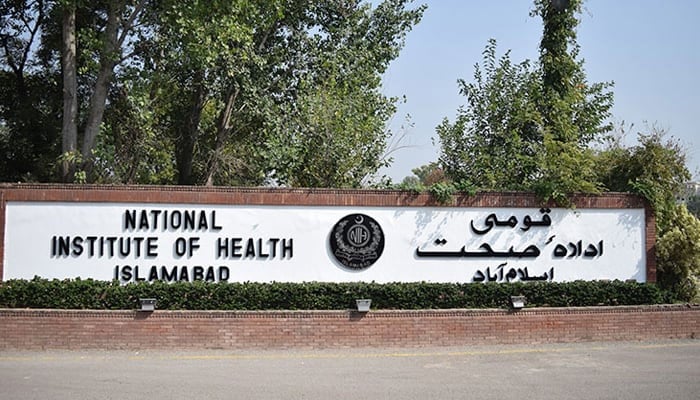
ISLAMABAD: On the directives from National Institute of Health (NIH) Islamabad, Provincial Disease Surveillance and Response Units (PDSRUs) of Sindh, Punjab, Khyber Pakhtunkhwa (KP), Balochistan, Azad Kashmir and Kashmir (AJK) and Gilgit-Baltistan (GB) have been declared and notified as provincial Public Health Emergency Operation Centers (PHEOCs) to deal with any health emergency in the country, officials said on Tuesday.
The National Public Health Emergency Operations Center (PHEOC) has already been established at the NIH Islamabad with the mandate to declare ‘public health emergency’ in the country in case of any natural or manmade disaster, officials said, adding that the national PHEOC also has the authority to call off the health emergency in entire or any part of the country.
According to NIH officials, the world is facing multiple challenges and threats due to the pressing global health security issues as the frequent travel, trade and threats posed in the context of one health are of eminent importance. These factors have significantly contributed to escalate the emergence and re-emergence of infectious diseases.
“During last two decade Aavian Influenza, MERS-COV, Covid-19 and mPOX have not only challenged the health system but have realized the contribution of other sectors to effectively respond to infectious diseases. During Covid-19, Pakistan has established National Command and Operation Center (NCOC) for coordination and response activities for the better management of pandemic”, the NIH official added.
But now, the NIH official maintained, there is a dire need to establish the formal network of Public Health Emergency operations centers (PHEOCs) across the country. During a consultative workshop for the development of National Public Health Emergency Management Roadmap as per WHO guidelines, it was unanimously proposed that provincial disease surveillance and response units are the best suitable structures to be notified as Provincial PHEOCs to support the future public health emergencies in coordination with the NIH, the official added.
“As the provincial governments has notified the conversion of their disease surveillance units as public health emergency operation centers, NIH will support these centers for the development of operational SOPs, surge planning, capacity building and implementation of incident command management systems”, Chief Executive Officer (NIH) Dr. Muhammad Salman said in letter to provincial health departments.
Dr. Salman maintained that there is a dire need to establish functional public health Emergency Operations Centers (EOCs) at all levels to fulfill the International Health Regulations-2005 (IHR) obligations. “PHEOCs play critical roles to prepare for and respond to public health emergencies. A public health EOC serves as a hub for coordinating the preparation for, response to, and recovery from public health emergencies”, he added.
“The preparation includes planning, such as risk and resource mapping, development of plans and procedures, training and exercising. The response includes all activities related to investigation, response and recovery. The PHEOC also serves as a hub for coordinating resources and information to support response actions during a public health emergency and enhances communication and collaboration among relevant stakeholders”, he further informed.
Chief CDC at NIH Dr. Mumtaz Ali Khan said in addition to public health emergency operation centers, NIH has also prepared and adopted National Public Health Emergency Management (NPHEM) Roadmap for the next five years, adding that several international health organizations including WHO, US Center for Disease Control and Prevention (CDC) and UKHSA have supported them in this regard.
“This document has been developed through collaborative expert consultations, evidence findings, technical meetings and several reviews from national and provincial stakeholders. The public health emergency management 5-year roadmap will provide the guidance about the priority areas and innervations which need to execute on urgent basis”, he informed.







-
 5 Celebrities You Didn't Know Have Experienced Depression
 -
 Trump Considers Scaling Back Trade Levies On Steel, Aluminium In Response To Rising Costs
 -
 Claude AI Shutdown Simulation Sparks Fresh AI Safety Concerns
 -
 King Charles Vows Not To Let Andrew Scandal Overshadow His Special Project
 -
 Spotify Says Its Best Engineers No Longer Write Code As AI Takes Over
 -
 Michelle Yeoh Addresses 'Wicked For Good' Snub At 2026 Oscars
 -
 Trump Revokes Legal Basis For US Climate Regulation, Curb Vehicle Emission Standards
 -
 DOJ Blocks Trump Administration From Cutting $600M In Public Health Funds
 -
 2026 Winter Olympics Men Figure Skating: Malinin Eyes Quadruple Axel, After Banned Backflip
 -
 Meghan Markle Rallies Behind Brooklyn Beckham Amid Explosive Family Drama
 -
 Scientists Find Strange Solar System That Breaks Planet Formation Rules
 -
 Backstreet Boys Voice Desire To Headline 2027's Super Bowl Halftime Show
 -
 OpenAI Accuses China’s DeepSeek Of Replicating US Models To Train Its AI
 -
 Woman Calls Press ‘vultures’ Outside Nancy Guthrie’s Home After Tense Standoff
 -
 Allison Holker Gets Engaged To Adam Edmunds After Two Years Of Dating
 -
 Prince William Prioritises Monarchy’s Future Over Family Ties In Andrew Crisis