
Big crime if contents of published cipher true: PM Shehbaz
PM Shehbaz said that Pakistan Muslim League-Nawaz (PMLN) supremo Nawaz Sharif will return to the country next month and face the law
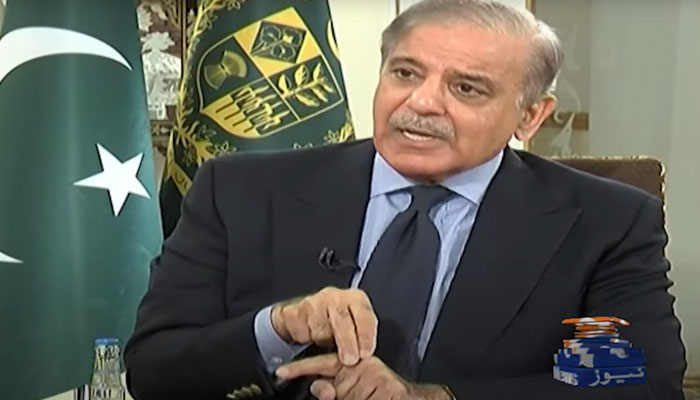
ISLAMABAD: In a major development as the nation is heading towards the general elections, Prime Minister Shehbaz Sharif said on Thursday that Pakistan Muslim League-Nawaz (PMLN) supremo Nawaz Sharif will return to the country next month and face the law.
In an interview with Geo News Capital Talk programme host Hamid Mir, the outgoing premier said he will travel to London to meet his elder brother Nawaz Sharif as soon as the caretaker government takes charge.
“Nawaz Sharif will come to Pakistan next month and will face the law and lead the election campaign,” the incumbent prime minister said without giving the exact date of Nawaz’s homecoming. The ex-premier has been in self-imposed exile in London since November 2019 owing to health reasons.
Nawaz went to London in November 2019 for medical treatment after he was convicted by an accountability court in graft cases and he has been living there since then.
“He [Nawaz] will neither wear a hat nor a bucket,” PM Shehbaz said in Thursday’s interview while taking a thinly-veiled jibe at Pakistan Tehreek-e-Insaf (PTI) chief Imran Khan, who dons a bulletproof helmet while appearing for court hearings.
The PM also hoped that his party will win the next elections and he will work as an activist of the party under the Nawaz-led government.
His statement comes as the process to appoint the caretaker setup formally kicked off with the dissolution of the National Assembly prematurely a day earlier on August 9.
Speaking about his meeting with NA Opposition Leader Raja Riaz to deliberate on the interim PM’s name, the PM said: “It is hoped that the name of caretaker prime minister will be agreed upon before three days.”
Under the Constitution, the PM and the opposition leader have three days to finalise the caretaker PM’s name. In the first round of consultation earlier Thursday, they failed to reach a consensus on the caretaker PM’s name. PM Shehbaz said he will also consult his brother Nawaz on the appointment of caretaker prime minister.
Amid concerns that polls might be delayed, Shehbaz said general elections should be held as soon as possible, adding the ECP is responsible for holding elections in the country, not the caretaker setup.
Meanwhile, Prime Minister Shehbaz Sharif once again denied claims of Chairman of Tehreek-e-Insaf about his government’s removal under a US conspiracy.
“Had there been any conspiracy, neither Pakistan would have bought cheaper oil from Russia nor it could improve relations with China,” the prime minister said in an interview with WE News. The statement came in response to a foreign media report about the US cipher which claimed to substantiate former prime minister Imran Khan’s allegations that he was removed under the American pressure after his Russia visit.
During an interview with WE News, Shehbaz was asked whether the publication of this news story authenticated the PTI chief’s narrative. The prime minister said that he chaired two meetings of the National Security Committee (NSC) on the cipher, and in one of them the current foreign secretary Asad Majeed Khan, who was Pakistan’s ambassador to the US in March 2022, was also present who said no such issue with US official Donald Lu was discussed.
Shehbaz said that then Army chief General Bajwa and services chiefs also supported the view that there was no US conspiracy behind the removal of the previous regime. “It should have been a matter of shame for the present government had it come into being through a US conspiracy,” he said.
Terming the PTI chief’s narrative that his (Shehbaz’s) government was brought in power under an American conspiracy, a pack of lies, the prime minister said if the contents of the cipher, which was published, were true, then it was a very big crime.
Shehbaz recalled the instance when Khan retracted his “US conspiracy” statement by saying that America had not conspired. Would you declare Imran Niazi’s first statement authentic or the second, he questioned.
Regarding the delay in installment of the caretaker government, he said it should be understood that the consultation process constitutionally starts once the assemblies are dissolved.
Meanwhile, the prime minister in his tweet said that “At the end of government’s tenure, it is apt for me to take stock of the last sixteen months since the coalition government assumed office through the constitutional process of no-confidence and share my perspective with the nation.
“1: An exercise in democratic evolution. The political parties that formed the government have different political manifestos & agendas. Despite being political rivals, we chose to come together on a national agenda shared and owned by us all. The last sixteen months saw how decision-making by consensus became the norm. I consider it a major step forward in our democratic evolution.
“2: Challenges among the crises that challenged me personally, giving me many sleepless nights was saving the country from the threat of default in particular and stabilizing the economy in general. I would never have forgiven myself had such a scenario (God forbid) came to pass during my time in office. We have yet to fully grasp the consequences of the country defaulting on its international obligations. Secondly, restoring Pakistan’s prestige, honour and credibility as a reliable partner, and friend in the comity of nations was another challenge that we dealt with collectively. Thanks to our collective efforts, Pakistan has largely repaired the damage and emerged as a responsible member of the international community. We have revived our trust with our brotherly countries including China, Turkiye, Saudi Arabia, Qatar and UAE, etc. CPEC has not only been put back on track but the second phase is also underway. The most devastating floods in our history posed significant challenges to our struggling economy in terms of losses in man and material. As part of its climate diplomacy, the government undertook a massive international effort to project Pakistan as a victim of climate change. We also mobilised gigantic rescue, relief and rehabilitation through our own resources.”
“As Chair of G-77 plus China, Pakistan led a global effort to demand climate justice. Our leading role also galvanised international response and led to the establishment of the Loss and Damage Fund at COP27. Millions of dollars of international aid was spent most transparently.
3: SIFC - The way forward SIFC established under a collaborative approach has prioritised five key areas of national economy, namely agriculture, information technology, mine and minerals, defence production and energy. This institutional arrangement that has representation of all stakeholders, offers One-Window facility to fetch foreign investment to unlock the potential in the select areas. SIFC is an economic revival plan that has been carefully thought through and is being implemented under the-whole-of-the-government approach. What has kept me under tremendous stress during these sixteen months is the heavy cost a combination of factors such as the conditionalities of the IMF programme, skyrocketing commodity prices in international markets and geopolitical upheavals has placed on the poor people of Pakistan, the PM said.
“While the government has tried to lessen their burden, I feel their pain and anguish. Coupled with extreme polarisation in society and emerging security threats, the odds couldn’t be heavier for any government. Time has come for Pakistan to end the ‘boom and bust’ cycle of the economy by focusing on structural reforms. I am convinced that no quick-fixes will work anymore. If the people of Pakistan elect the PMLN, we will make sure that the country follows the people-led growth model, one where their welfare is the be-all and end-all of public policy. Our economic revolution will be rooted in harnessing the youth potential by providing them cutting-edge tech education leading to massive job creation; and promoting modern agro industry. Work, work and work alone shows us the way forward,” he concluded.
Also, Prime Minister Shehbaz Sharif on Thursday expressed his gratitude to the bureaucracy for their support and guidance throughout the 16-month tenure, enabling the coalition government to sail through tough circumstances.
The prime minister, in his farewell interaction with the federal secretaries, said despite being hugely diverse, the 13-party coalition government ran the affairs smoothly with utmost cooperation and prudence, also setting an example of the practicability of the coalition government. He said during the 16 months, the bureaucracy also faced some difficult scenarios but the will to do something productive for the people of Pakistan paved the way.
The prime minister lamented the past practice of unnecessarily criticizing and victimising competent officers which adversely impacted public service. Just like the politicians, the officers were also victimised and their families harassed. He said the civil service faced a severe blow during the devolution as due to the very reason, some of the youngsters also opted to join other services.
Mentioning systemic delays in the execution of 10,000 MW solar energy project, Prime Minister Shehbaz called for establishing robust systems to ensure smooth execution of projects.
He said the incumbent government ensured completion of various public welfare projects, which had been halted by the previous government.
Recounting the achievements of his government, the prime minister said the signing of the IMF agreement was a great success, otherwise, the situation could have been disastrous for the country. He said the credit for all the successes achieved by the government also went to the federal secretaries as they had been serving diligently during the challenging circumstances, particularly floods.
The prime minister said that his government played a constructive role to mend the ties with friendly countries, which were undermined by the previous government through the “worst strategy”. He said the previous government even hurled baseless allegations of corruption in the CPEC projects. He said the projects being funded by foreign grants were also impeded by the previous government as they never wanted the respective government to claim the credit.
The prime minister appreciated his Special Assistants Tariq Fatemi, Ahad Cheema and Jahanzeb Khan for their hard work and cooperation.
Regarding his Press Secretary Abdul Akbar, the prime minister said he was a very committed officer with a great personality. He also appreciated his Speech Writer Arshad Malik and Public Relations Officer Umar Faran as well as the official media team and expressed good wishes for them.






-
 Google Disrupts Chinese-linked Hacking Groups Behind Global Cyber Attacks
 -
 Four People Killed In Stabbing Rampage At Washington Home
 -
 Meghan Pushes Prince Harry Into Territory That’s Dangerous To His Brand: ‘She Isn’t Hearing A Word Of It’
 -
 Christina Applegate Reflects On Lasting Impact Of Being Molested In Childhood
 -
 Martin Short Makes Big Decision Following Tragic Death Of Daughter
 -
 Antarctica’s Mysterious ‘gravity Hole’: What’s Behind The Evolution Of Earth’s Deep Interior?
 -
 Hilary Duff Addresses Ashley Tisdale's 'toxic Mom Group' Claims And Matthew Koma's Firey Response
 -
 Jack Hughes's Proximity To Trump Angers Tate McRae Fans
 -
 Neve Campbell Opens Up About Her 'difficult Decision' To Not Sign 'Scream 6'
 -
 Nobel-winning Scientist Resigns From Columbia University After Epstein Links Revealed
 -
 Prince William Remarks At BAFTAs 'indicative' Of King Charles Physical, Mental Health Too
 -
 Kanye West's Last Measure To Save Bianca Censori Marriage As He Tries To Salvage Image
 -
 Kim Kardashian Finally Takes 'clear Stand' On Meghan Markle, Prince Harry
 -
 Christina Applegate Makes Rare Confession About What Inspires Her To Keep Going In Life
 -
 Patrick J. Adams Shares The Moment That Changed His Life
 -
 Selena Gomez Getting Divorce From Benny Blanco Over His Unhygienic Antics?