US approves Pfizer and Moderna vaccines for youngest children
US authorises Moderna’s two-dose vaccine for children aged six months to five years, and three doses of Pfizer’s shots for those between six months and four years old
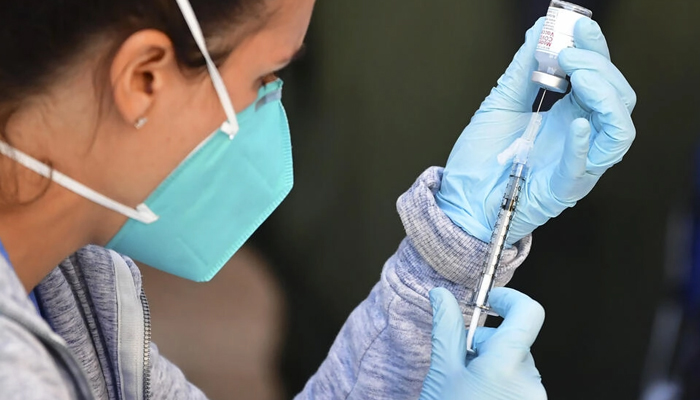
WASHINGTON: The US Food and Drug Administration granted emergency authorisation Friday for the use of Pfizer and Moderna COVID-19 vaccines in the youngest children, the final age group awaiting immunisation in most countries.
The agency authorised Moderna’s two-dose vaccine for children aged six months to five years, and three doses of Pfizer’s shots for those between six months and four years old.
"Many parents, caregivers and clinicians have been waiting for a vaccine for younger children and this action will help protect those down to six months of age," Food and Drug Administration chief Robert Califf said in a statement.
"We expect that the vaccines for younger children will provide protection from the most severe outcomes of COVID-19, such as hospitalisation and death."
The Centers for Disease Control and Prevention (CDC) must now also recommend the vaccines before they are put into use — a final green light that will be given after a meeting of an advisory committee of experts that is expected to be held shortly.
But the US government has said that as soon as the FDA decision is made, 10 million doses could immediately be sent around the country, followed by millions more in subsequent weeks.
Both vaccines are based on messenger RNA, which delivers genetic code for the coronavirus spike protein to human cells that then grow it on their surface, training the immune system to be ready. The technology is now considered the leading COVID vaccination platform.
The vaccines were tested in trials of thousands of children. They were found to cause similar levels of mild side effects as in older age groups and triggered similar levels of antibodies.
Efficacy against infection was higher for Pfizer, with the company placing it at 80 percent, compared to Moderna’s estimates of 51 percent for children aged six-months to two years old and 37 percent for those aged two to five years.
But the Pfizer figure is based on very few cases and is thus considered preliminary. It also takes three doses to achieve its protection, with the third shot given eight weeks after the second, which is given three weeks after the first.
Moderna’s vaccine should provide strong protection against severe disease after two doses, given four weeks apart, and the company is studying adding a booster that would raise efficacy levels against mild disease.
However, Moderna’s decision to go with a higher dose is associated with higher levels of fevers in reaction to the vaccine compared to Pfizer.
There are some 20 million children aged four years and under in the United States.


-
 Russia and Ukraine agree to ceasefire, plan November peace talks: What we know so far
 -
 Donald Trump lashes out on 'horrible' reporter, defends viral campaign ad
 -
 Kim Jong Un’s China visit puts North Korea-China ties in focus
 -
 Trump announces new 50 percent tariffs on Canadian goods as Maine Senate race heats up
 -
 Barack Obama joins Sherrod Brown and Abdul El-Sayed in crucial Senate election battles
 -
 New personalized cancer vaccine cuts Melanoma recurrence risk by 42%, trial shows
 -
 Trump demands Rep. Ilhan Omar resign after DOJ court filing references over 'fake' name
 -
 Carney rejects Trump administration’s accusation of Canada interfering in US midterm elections
-
 Ukraine, Russia and US set to hold key talks in Abu Dhabi in early November
 -
Australia lawmaker Hannah Beazley’s staff threatened days after Helen Haines attack
-
New York AG Letitia James challenges attempt to disqualify her from Cornell investigation
-
Trump administration targets Alaska Senate race over fears of ballot confusion