
Malaysian scientists invent 'Medibot' to do rounds in coronavirus hospital wards
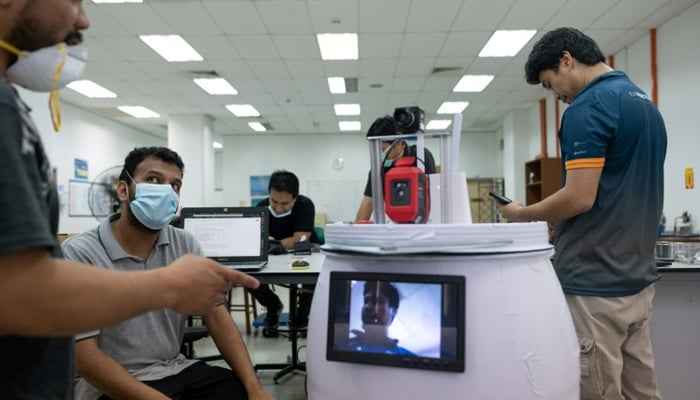
The robot is a 1.5 metre tall white robot, equipped with a camera, screen via which patients can communicate remotely with medics

Malaysian scientists have created a robot that they hope will make the rounds on hospital wards to check on coronavirus patients, reducing health workers' risk of infection.
"Medibot" is a 1.5 metre tall (five-foot) white robot, equipped with a camera and screen via which patients can communicate remotely with medics.
The invention, built by scientists at the International Islamic University Malaysia, is also fitted with a device to check patients' temperatures remotely.
It is aimed at helping nurses and doctors working on the wards with social distancing, Zulkifli Zainal Abidin, a member of the team behind the invention, told AFP.
It cost about 15,000 ringgit ($3,500) to develop, and the university plans to trial it soon in their own private hospital, which does not treat virus patients, said Zulkifli.
If that proves a success, the scientists hope it can be used in government hospitals where people with COVID-19 are sent.
Malaysia has reported 4,683 coronavirus cases, including 76 deaths.
From Thailand to Israel, robots are being used in the fight against the coronavirus, which has killed over 110,000 people worldwide.
They are being increasingly relied on as fast, efficient, contagion-proof champions in the war against the virus.




-
 ‘Smiling electrons’ discovered in Earth’s magnetosphere in rare space breakthrough
 -
 Archaeologists unearthed possible fragments of Hannibal’s war elephant in Spain
 -
 NASA's Hubble Space Telescope discovers ‘Dracula Disk', 40 times bigger than solar system
 -
 Annular solar eclipse 2026: Where and how to watch ‘ring of fire’
 -
 Scientists discover rare form of 'magnets' that might surprise you
 -
 Humans may have 33 senses, not 5: New study challenges long-held science
 -
 Northern Lights: Calm conditions persist amid low space weather activity
 -
 SpaceX pivots from Mars plans to prioritize 2027 Moon landing