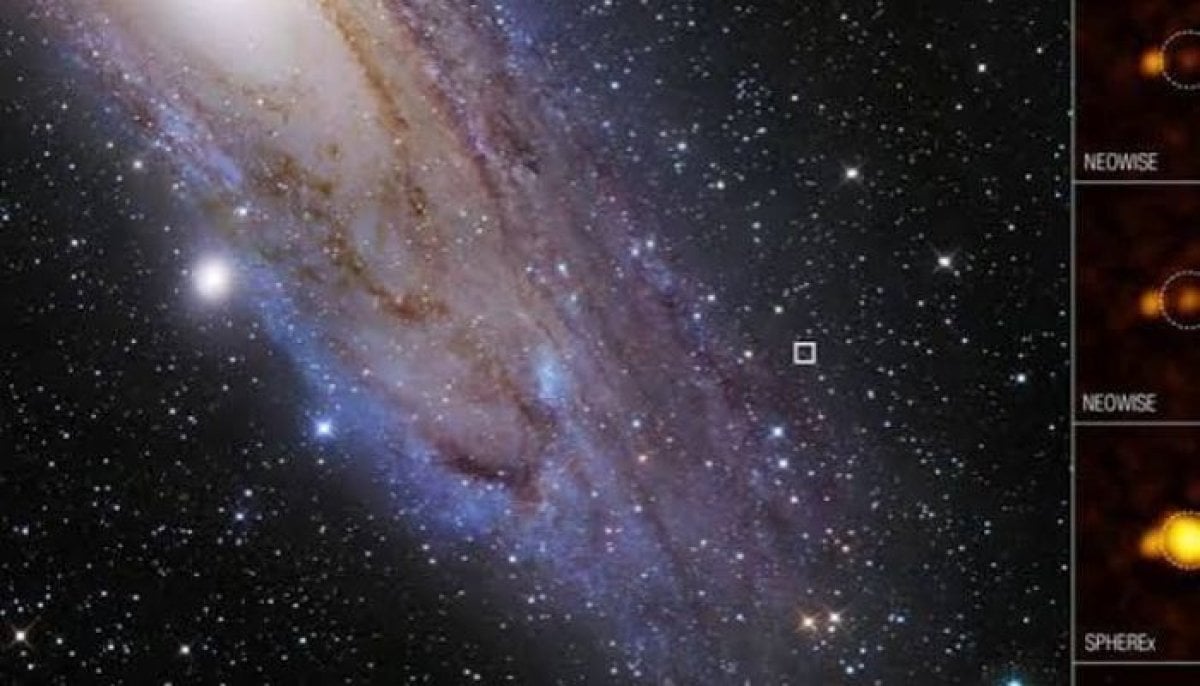
Scientists discover quasar that shone when the Universe was still young
This discovery pushes the cosmic record back by nearly 40 million years
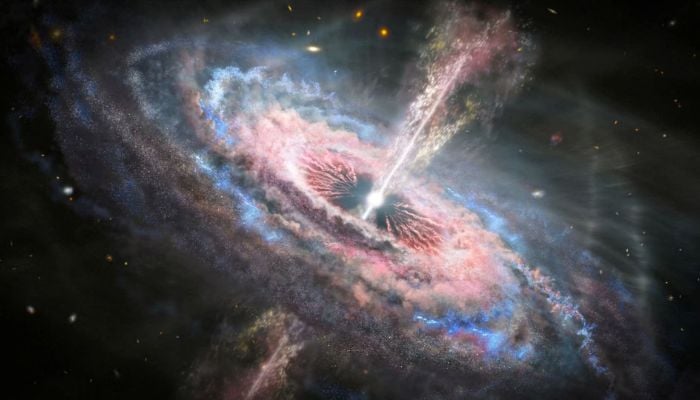
Scientists in a recent breakthrough have made a discovery that sets a cosmic record.
A German-led team headed by Julien Wolf of the European Southern Observatory spotted the quasar using data from the European Space Agency’s Euclid telescope.
The findings were confirmed by the Hubble and James Webb space telescopes and published in Astronomy & Astrophysics.
As per the findings, the researchers spotted the most distant quasar ever observed formed within 630 million years of the Big Bang, which occurred 13.1 billion years ago especially when the universe was less than 5 percent of its current age.
As a result, this pushes the cosmic record back by nearly 40 million years, the largest leap in almost a decade.
Named Dun Aonghasa, after a prehistoric stone fort in Ireland, the quasar is powered by a supermassive black hole weighing 360 million times the mass of our sun.
Scientists are perplexed by how it grew so large so quickly while consuming surrounding matter relatively slowly.
The discovery sets a "new deadline" for understanding early cosmic evolution, challenging current models of how supermassive black holes form and grow at the dawn of the universe.
Discovering a quasar from the early universe matters because it reveals supermassive black holes that grew far bigger, faster than standard astrophysical models predict.
Light takes billions of years to travel across space, a distant quasar acts as a time capsule showing how galaxies and black holes formed within the first billion years after the Big Bang.


-
 China reveals launch date & plans for Shenzhou-24 spaceship
-
 Earth 2.0? astronomers spot mysterious signs beyond Neptune
-
 Beaver Moon 2026: When and where to see a full supermoon rise this week
-
 Physicist discovers new solution to Einstein's equations for 'Black Saturn'
-
 Thailand makes prepares to stop exporting rare earth mining chemicals to Myanmar
-
 Inside COP31 climate deal: COP31 President speaks out
-
 NASA reveals mysterious 'ghost forest' on Mars: Everything to know about it
-
 COP31 talks reach deadlock amid growing fossil fuel dispute
-
 Astronomers observe massive puffy star merging with smaller companion
-
NASA confirms Voyager 1 is now a ‘light-day’ away from Earth
-
Google partners with Bezos’ Blue Origin to launch AI computing satellites in 2029
-
‘Craziest is definitely still yet to come’: HEO unveils advanced space intelligence platform in major new launch