Why China is rejecting US claims that Moonshot AI stole Anthropic technology
China rejected the claims insisting that its AI sector has achieved its progress independently
A wave of new friction has surfaced in the technology rivalry between the United States and China after the Trump administration accused the Chinese artificial intelligence startup Moonshot AI of illegally using Anthropic’s in-house technology to build its flagship model.
The allegations stemmed from claims that Moonshot obtained Nvidia AI hardware despite US export controls marking a sharp escalation in conflict with Washington's efforts to curb China’s progress in cutting-edge AI.
Meanwhile, Chinese officials have strongly condemned the allegations citing their politically motivated and unempirical basis.
In this regard, Michael Kratsios, a senior technology official in the Trump administration further clarified that the US has intelligence indicating that Moonshot AI relied on Anthropic’s top frontier model, Fable.
This accusation centers on a technique known as AI distillation in which developers train models using outputs generated by more advanced systems.
Crucially, this progress can reduce development costs when companies including Anthropic have the core functionality of their models extracted, violating intellectual property rights and terms of service.
Beijing stance on claims
Beijing has reportedly dismissed the claims as the AI rivalry deepens, underlining its AI sector has achieved progress independently while protecting intellectual property in line with concerned regulations.
A spokesperson for the Chinese military in Washington described the claims as unsubstantiated persuading US officials to recognize China’s advances instead of damaging its good reputation.
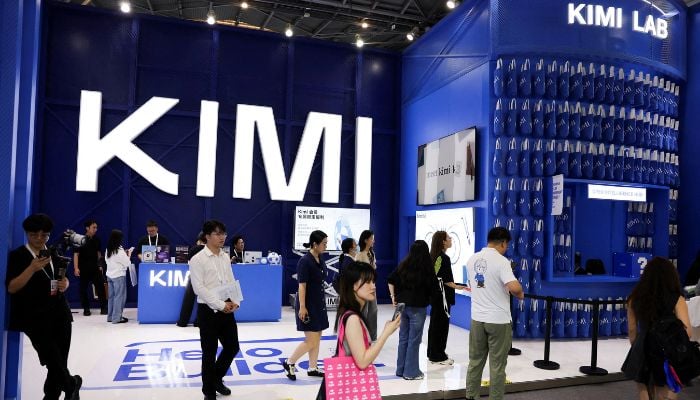
These accusations came after Moonshot introduced Kimi K3-a 2.8 trillion parameter business model described as the world’s largest open-weight AI system.
Kimi K3 has become the most prominent Chinese AI model to spark discussion about China’s emergence as a strong contender in the global AI race.
Moonshot AI underlined that Kimi K3 converts computing power into AI capabilities more effectively than its predecessor
DeepSeek and MiniMax have collaboratively developed more than 16 million interactions with its Claude model by using almost 24,000 fake accounts violating the company’s terms of service.
In light of the ongoing scenario, Moonshot AI has not released any statement regarding the latest accusations.
Nonetheless, both countries continue to build capable AI systems with commercial value as the dispute is bound to heighten oversight over technology, intellectual property and access to advanced computing hardware.



-
 OpenAI, Anthropic and Google join forces on AI safety efforts
 -
 Meta to deploy custom Arke and Astrid AI chips in 2027: Everything to know
 -
 Dreamforce 2026: Salesforce unveils Koa AI model and Google Cloud partnership
 -
 EU Kids Act: New social media rules for under-15s
 -
 China’s spy chief reveals growing fears over AI’s impact on communist party rule
 -
 Anthropic's new Claude tool targets financial advisors to streamline compliance and client research
 -
 Elon Musk’s bold AI safety idea: 'Let rivals test each other’s models'
 -
 Former Google DeepMind researcher warns autonomous AI could wipe out humanity amid industry-wide safety alarm