Species under threat: Viral 'squeaky frog' faces extinction risk
Mining and the exotic pet trade are increasing conservation concerns for many species, including the internet-famous desert rain frog
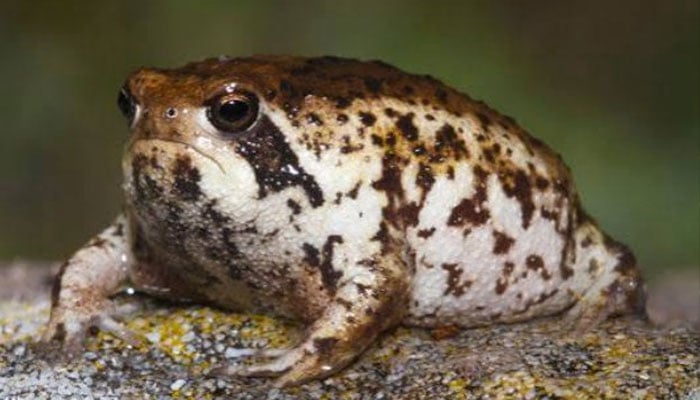
Mining for diamonds has put another extraordinary creature at risk of disappearing such as "the desert rain frog."
A frog that became an internet sensation because of its trademark squeaky defensive call has been added to a global list of species at high risk of extinction.
The desert rain frog—the adorable, round creature that became a massive internet sensation for making a fierce-yet-comical squeak like a dog toy—has officially been moved closer to extinction on the IUCN Red List.
Most frogs rely on water for survival but the bulbous desert rain frog has evolved to need almost none.It hides from the southern African sun by burying itself deep in the sand, coming out only at night to hunt insects.
"If the habitat was transformed, there's no room for this species to move further up the coast or further down the coast," said Alex Lawrence, a scientist with the conservation group Anura Africa.
Governments and mining companies are increasingly interested in mining the deep ocean for minerals needed for green technologies such as batteries.
Supporters say deep-sea mining could be less environmentally damaging than mining on land, but many scientists warn it could harm fragile and poorly understood marine ecosystems, and are calling for a pause until more research is carried out.
The International Union for Conservation of Nature (IUCN), which tracks the status of the world's plants and animals, warns that species adapted to extreme environments, like the desert rain frog, are increasingly coming under pressure as nature loss accelerates across the planet.
Life has colonized every corner of the planet by evolving ingenious survival strategies but these are increasingly being overwhelmed by destructive human activities, this year’s red list of endangered species has revealed.
Many snails, limpets and clams have adapted to life at crushing depths in the oceans on hydrothermal vents where water temperatures can reach 450C (842F).
But an assessment for the red list found that two-thirds of the hundreds of mollusc species found only on deep sea vents were at risk of extinction because of deep-sea mining.
Mining for diamonds has put another extraordinary creature at risk of disappearing – the desert rain frog. Most frogs rely on water for survival but the bulbous desert rain frog has evolved to need almost none. It hides from the southern African sun by burying itself deep in the sand, coming out only at night to hunt insects.
However, dwindling species can be saved, the International Union for Conservation of Nature (IUCN), which produces the red list, said.
The new list shows the numbat, a stripy, termite-eating marsupial from Australia, has come back from the brink thanks to protection from feral cats and foxes.
The warning signs are not confined to animals.
The IUCN has now assessed 175,909 species of plants, animals and fungi, of which 49,505 are threatened with extinction.


-
 A ‘neglected’ neutrino may hold the key to why the Universe exists
 -
 Can cancer drugs be made in space? Here’s what the new mission aims to find out
 -
 SpaceX Falcon 9 successfully launches Bandwagon-5 mission with 32 payloads
 -
 Europe launched 8 orbital rockets last year, can it rival Starlink?
 -
 Japan launches world’s first mission to bring sample back from phobos
 -
 Orionid meteor shower 2026: Peak date, viewing tips and what to expect
 -
 Why Mars looks blue in NASA’s unedited curiosity panorama?
 -
 Blue Origin upgrades new Glenn rocket launch infrastructure to take on SpaceX