NASA’s Hubble at US 250th Anniversary: Blue and white dazzling stars spotted in crimson stellar nursery
The Hubble Space Telescope reveals thousands of young stars in the Large Magellanic Cloud, offering new insights into how stars form and evolve
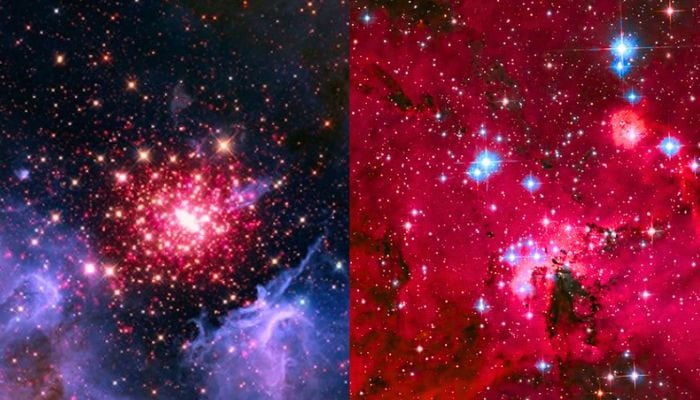
NASA's Hubble telescope released new images to commemorate the 250th anniversary of the United States, celebrating the nation's long history of exploration while showcasing one of the oldest collections of stars in our galaxy.
It spotted a brilliant field of white, and blue stars sparkles across a new image from NASA's Hubble Space Telescope, resembling a sparkler glowing against the reddish night sky.
A glowing landscape of gas and dust is heated and illuminated by a thriving population of young stars in the LH 95 region of the Large Magellanic Cloud.
Astronomers reveal the vivid colors are not simply for visual appeal. They represent different wavelengths of light collected through Hubble's filters and processed using standard scientific techniques.
Blue highlights shorter wavelengths of visible light, while red represents longer visible wavelengths as well as some near infrared light.
Because a star's color is closely linked to its temperature, the blue stars are hotter and the red stars are cooler.
Hubble has captured a spectacular view where about 2,500 young stars are still on their journey to becoming full-fledged stars.
In addition to that scientists discovered these growing stars can keep pulling in gas and dust for millions of years, extending an important stage of stellar development.
The region also contains multiple generations of stars living side by side, offering fresh clues about how star formation unfolds over time.
Studying this enormous population of young stars has given astronomers new insight into how stars mature.
Hubble's observations reveal thousands of developing stars that are still drawing in material from the surrounding disks of gas and dust that gave birth to them.
The observations confirmed that a young star's speed at which it gathers material, naturally slows as it ages.
Scientists have also found evidence that the cluster contains two chemically distinct populations of stars. This discovery suggests that the slightly younger stars formed after an earlier generation of massive stars ended their lives in powerful supernova explosions.
The process gradually filled the universe with the ingredients needed to create planets and many of the elements found throughout the cosmos today.
At the same time, the research showed that this process can continue for several million years, lasting longer than some earlier assumptions suggested.


-
 US EPA unveils sweeping power plant carbon limit rollbacks at G20 meeting to prioritize grid reliability
 -
 Study reveals why some babies are born with heart defects
 -
 Italian Senate clears PM Giorgia Meloni electoral reform bill to overhaul voting system and establish majority bonus thresholds
 -
 US Senate advances landmark crypto bill to set new digital asset boundaries
-
 US finally confirms weapons in orbit: What it means for space warfare
 -
 How China's FAST telescope is mapping the cosmic gas behind star birth
 -
 Did Sun eat super-Earth? New study says maybe
 -
 Did Sun swallow a super-Earth? Scientists search for its ‘fingerprints’
 -
 Blue Origin sets sights on Mars with new NASA network
 -
 NASA, IBM launch open-source lunar foundation AI model to help map ice, craters on moon
 -
 Bacteria can remember without brain, new study finds
 -
 Fast radio bursts may unlock secrets of dark matter, energy and neutrinos