How an exoplanet survived its star’s death is baffling astronomers
The researchers try to comprehend why WD 1856 b is so close to the white dwarf
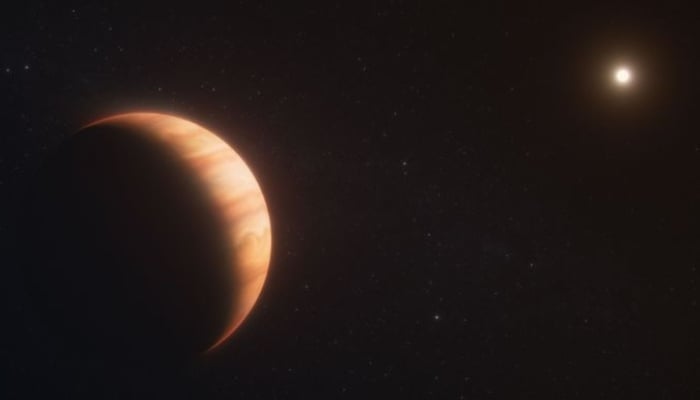
In a groundbreaking discovery, astronomers have made meticulous inspection of a Jupiter-like exoplanet, showing that planets beyond our solar system can live on for billions of years after the death of its Sun-like stars.
The planet is located 81 light-years from Earth in the constellation Draco-a light year approximately covers 5.9 trillion miles.
According to researchers, its atmospheric temperature of about 260 degrees Fahrenheit is pleasantly surprisingly warm. Moreover, its orbit varies adjacent to the white dwarf after converging inward over time, and it is 50 times closer to the white dwarf than Earth is to the sun.
The illustration of WD 1856 b further indicated that some planets can retain following their host star’s death as some of the solar system’s planets may after the Sun’s extinction.
At present, researchers are trying to understand why WD 1856 b is so close to the white dwarf.
According to current predictions, the planet experienced a destructive astronomical event triggered by its host star during its death throes but managed to survive. On the other hand, the planet originally was far enough from the star to avoid engulfment but that the gravitational attraction of nearby objects like the red dwarfs later launched it into its current orbit.
The researchers attribute the planet’s intriguing warmth to its interactions with the white dwarf’s strong gravitational forces as its orbit became closer with time.
Astrophysicist Christopher O’Conor of Northwestern University in Illinois said: “ The rest of the planets beyond Earth will be well beyond the sun's maximum size, so they will most likely just continue to orbit the white dwarf left behind by the sun,"
“We cannot predict Earth's future orbit well enough to know whether it will be inside or outside the 'danger zone' when the sun reaches the end of its life, " O'Conor continued.


-
 Elon Musk’s Mars colonization dream faces reality check from Nobel laureate
 -
 NASA competition model 2.0 cuts mission selection by 45%
 -
 A ‘neglected’ neutrino may hold the key to why the Universe exists
 -
 Can cancer drugs be made in space? Here’s what the new mission aims to find out
 -
 SpaceX Falcon 9 successfully launches Bandwagon-5 mission with 32 payloads
 -
 Europe launched 8 orbital rockets last year, can it rival Starlink?
 -
 Japan launches world’s first mission to bring sample back from phobos
 -
 Orionid meteor shower 2026: Peak date, viewing tips and what to expect