Beyond solar system: Astronomers discover magnetic fields on seven ‘hot Jupiter’ exoplanets
These exoplanets are tidally locked gas giants similar in composition and size to Jupiter
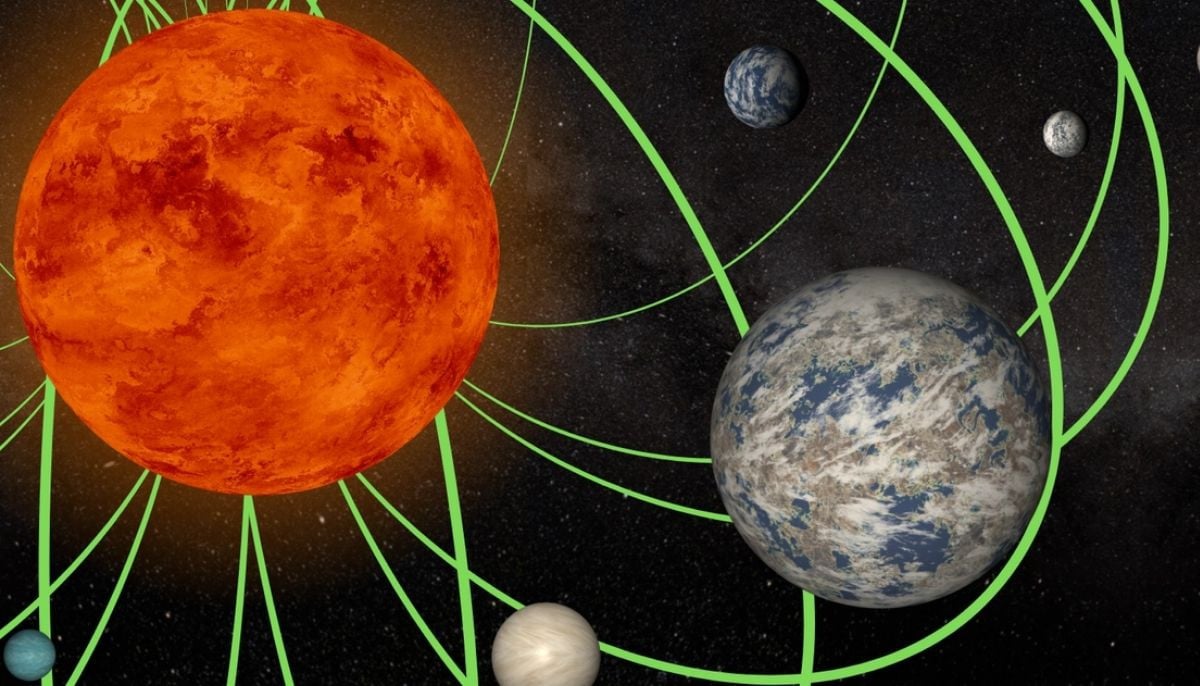
Astronomers in a recent breakthrough have found seven exoplanets, potentially harbouring magnetic fields, similar to Earth and five other planets, including Jupiter, Mercury, Saturn, Uranus, and Neptune in our solar system.
The recent findings are one of the most compelling pieces of evidence that show the existence of magnetic fields beyond the solar system.
In this research study, the researchers rather than assessing a single planet have analyzed a group of seven “hot Jupiters”. As a result, they find a consistent trend across the population, indicating the existence of magnetic fields.
According to astronomer Julia Seidel of the Observatoire de la Côte d'Azur's Lagrange Laboratory in Nice, France, lead author of the study, “What you would expect is that the planets with hotter temperatures would have stronger winds. The more energy you put into the system, the more violent the winds become. But we see the opposite.”
As per the study findings published in the journal Nature Astronomy, the hottest planet unexpectedly had the weakest winds, concluding that another force must be barking the atmosphere.
“And the only possibility to brake the atmosphere that much that fast is via the magnetic field and its interaction with the moving charged particles of the atmosphere,” the study added.
However, despite atmospheric braking, wind speed on these exoplanets can reach up to 15,500 mph.
These exoplanets are tidally locked gas giants similar in composition and size to Jupiter. But they show higher temperatures due to their extreme proximity to hot stars.
Astronomer and study co-author Bibiana Prinoth of the European Southern Observatory in Germany, said, "Although it's a common misconception that magnetic fields directly determine whether a planet is habitable, they can play an important role in how a planet evolves over time.”
But in reality, habitability is defined by the presence of atmosphere as the “atmosphere helps maintain surface pressure, regulate temperature and, on Earth, allows liquid water to exist at the surface."


-
 SpaceX Falcon 9 launches 21 military satellites into orbit
 -
 Could a newly engineered microbe help humanity survive on Mars?
 -
 Astronomers find most distant fast radio burst ever recorded
 -
 Draconid meteor shower tonight: Best time and places to see it
 -
 ‘A dream for 50 years’: Why world’s first nuclear clock could change timekeeping
 -
 NASA Curiosity captures strange ‘wind-carved’ Mars landscape in dawn image
 -
 NASA's Crew-12 Dragon begins return trip from space station
 -
 Mysterious ‘phoenix planet’ found around the remains of a dying star