Hidden magma beneath Mars? Scientists' 'unexpected' discovery raises new questions about alien life
Mars is often described as a 'stagnant lid' planet, lacking moving tectonic plates
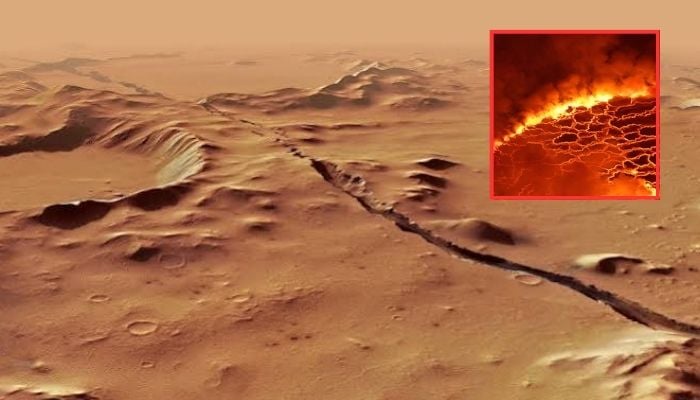
Scientists in a recent breakthrough have discovered vast hidden magma systems beneath the surface of Mars, marking an “unexpected discovery” leading the researchers closer to finding the clues of alien life.
The research study published in Nature Astronomy utilized seismic data from NASA’s InSight mission, which measures "marsquakes" and impacts.
By analyzing a mysterious boundary located 24 kilometers beneath the surface, researchers determined that the rock composition shifts from "mafic", which is silica-rich, above the boundary to "ultramafic", made up of iron and magnesium-rich ingredients below it.
Tobermory Mackay-Champion, from Oxford University, the lead author on the new work, said, “We have traditionally assumed that volcanism on Mars was relatively simple compared to that on Earth.”
“But this discovery suggests Mars could sustain large, long-lived systems where molten rock evolved and reprocessed itself throughout the entire crust. It raises exciting possibilities for how common such systems might be on rocky planets beyond our solar system.”
The recent discovery also challenges Mars “stagnant lid” theory as previously, it was thought that such massive magma systems required plate tectonics like Earth to form which the Red Planet lacks.
But this study suggests that the Martian planet possessed a highly evolved and complex crust produced through different mechanisms than Earth.
The findings also reinforce the idea that Mars could sustain long-lived systems where molten rock reprocesses itself through the crust. The discovery increases the chance of finding clues regarding alien life on Earth as a number of rocky planets considered habitable.
“One of the big questions in planetary science is whether Earth is unique,” said Jon Wade, also from Oxford, and co-author on the new work.
“If Mars could develop this kind of complex crust without plate tectonics, then maybe the conditions needed for habitability can emerge on more planets than we realised, including those previously dismissed based on size or their apparent lack of tectonic activity.”


-
 Draconid meteor shower tonight: Best time and places to see it
 -
 ‘A dream for 50 years’: Why world’s first nuclear clock could change timekeeping
 -
 NASA Curiosity captures strange ‘wind-carved’ Mars landscape in dawn image
 -
 NASA's Crew-12 Dragon begins return trip from space station
 -
 Mysterious ‘phoenix planet’ found around the remains of a dying star
 -
 First possible evidence of Planet Nine found in infrared data
 -
 Elon Musk announces SpaceXAI rebrand to SpaceXSI following presidential order on 'Super Intelligence'
 -
 ISS Command changes hands in emotional ceremony