Interstellar comet 3I/ATLAS reaches sun on Oct.30: Here’s how spacecraft will get best view
The interstellar comet reaches perihelion today, when it should be at its most active
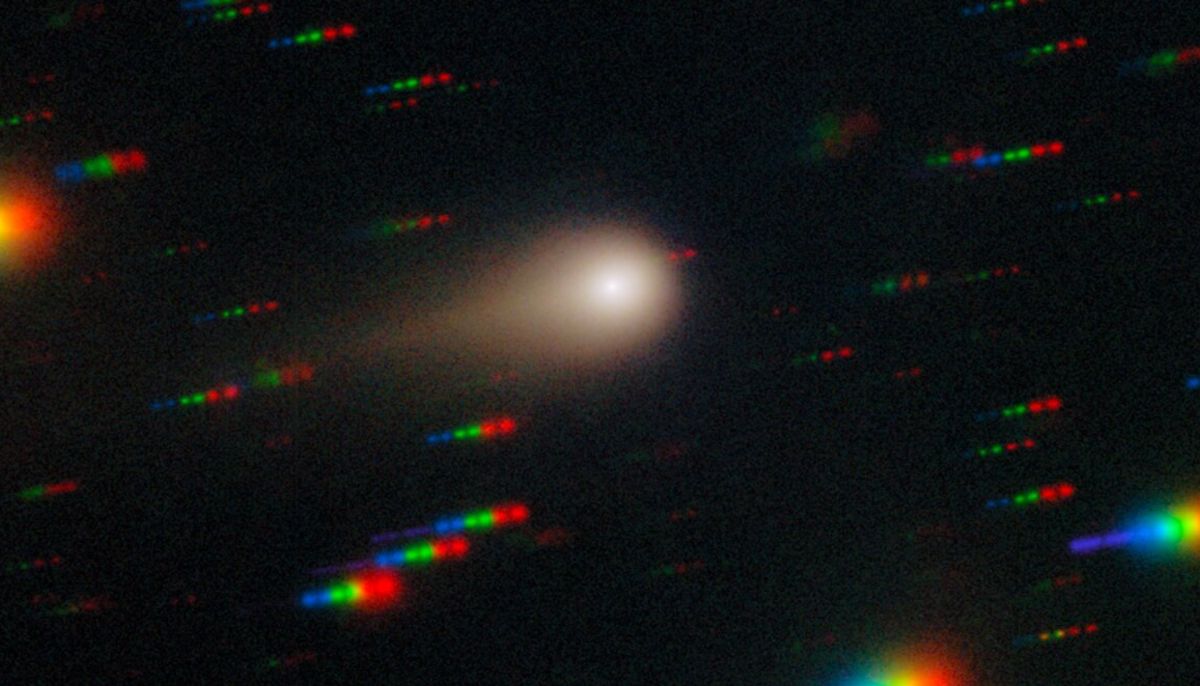
The interstellar comet 3I/ATLAS reached its perihelion, the closest point to the sun, and is expected to be most active on Thursday, October 30.
Primarily, 3I/ATLAS currently seems to be hidden from Earth, flying behind the Sun, but several other spacecraft in the solar system still have the comet in their sights.
Perihelion is the pivotal point in an object’s orbit where it is closest to the sun.
Meanwhile, the effect of perihelion can be very dramatic for comets on elongated orbits, as opposed to planets on near-circular orbits.
Perihelion for 3I/ATLAS will take place on October 30, when the interstellar interloper will be 1.35 astronomical units from the sun.
The other spacecraft that will be able to watch 3I/ATLAS at perihelion include NASA’s Psyche mission to the asteroid of the same name and the Lucy mission, which is continuing to Jupiter’s Trojan asteroids.
Scientists are intrigued to study the fascinating chemistry of the comet at perihelion because the gases and dust that comes off the comet will reveal its composition.
Even so, astronomers have found that 3I/ATLAS contains more carbon dioxide and a greater concentration of nickel than periodic comets in the solar system.
These variations uncover the chemistry of the molecular cloud of gas that formed the comet and its home star system over seven billion years ago.
The discovery prompted astronomers to make a direct comparison between the chemistry of the solar system and that of the original home of 3I/ATLAS.
Comets are commonly unpredictable, and it is uncertain when 3I/ATLAS will re-emerge from the sun at the end of November or whether it will remain active.
A faint view is expected of magnitude 12. The comet can be captured by Astro-imagers and users of smart telescopes, with further scientific data provided by the Hubble and James Webb space telescopes.
Nonetheless, the combined efforts would help scientists gather distinctive data on the highly active phase and the composition of this prominent interstellar visitor.


-
 Jennifer Eckhart, former Fox News producer, dies at 36
 -
 Pope Leo urges tech leaders to build AI systems that unite rather than devide
 -
 Will Taylor Swift attend 2026 MTV VMAs to receive new Artist Director award?
 -
 Prince Harry to tell Princess Diana's story again in new documentary?
 -
 Presley Gerber death: Drug overdose emerges as suspected cause
 -
 Brad Pitt is back as Cliff Booth in ‘The Further Mis-Adventures of Cliff Booth’
 -
 Kit Harington wanted 'Harry Potter' TV series before joining the cast
 -
 Halle Berry eyes future role with ‘sweetest’ Zendaya