Who won 2025 Nobel Prize in Physiology or Medicine?
Their findings were crucial to understanding immune system function and autoimmune disease prevention, said Olle Kampe, Chair of the Nobel Committee
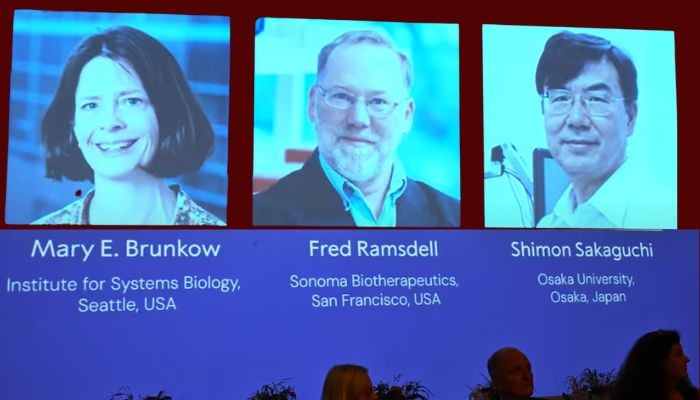
The Nobel Assembly announced the Nobel Prize winners for 2025 at an annual event held at the Karolinska Institute in Stockholm, Sweden, on October 6, 2025.
This year’s coveted Nobel Prize in medicine has been awarded to Mary E. Brunkow, Fred Ramsdell, and Shimon Sakaguchi for their revolutionary work on the immune system.
The chair of the Nobel Committee, Olle Kampe, said, ”Their discoveries have been decisive for our understanding of how the immune system functions and why we do not all develop serious autoimmune diseases.”
What does the discovery say?
The human body’s powerful immune system must be regulated, or it may attack our organs.
The Nobel committee asserted that Brunkow, Ramsdell, and Sakaguchi made groundbreaking discoveries related to peripheral immune tolerance, which prevents the immune system from damaging the body.
Their discoveries may pave the way for potential new cancer treatments and therapies for autoimmune diseases.
The winners for medicine were elected by the Nobel Assembly of Sweden’s Karolinska Institute medical university and receive money worth 11 million Swedish crowns ($1.2 million), as well as a gold medal presented by Sweden’s monarch.
The laureates discovered regulatory T-cells, which function as the immune system’s gatekeepers, preventing immune cells from attacking the body.
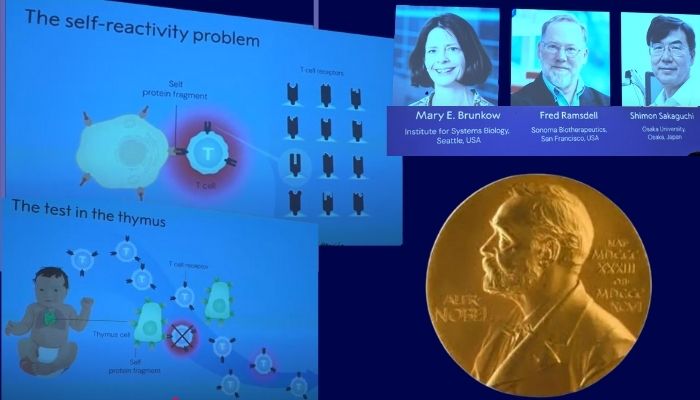
Every detail about the 2025 Nobel Laureates in Medicine
Brunkow serves as a senior program manager at the Institute for Systems Biology in Seattle, while Ramsdell is a scientific advisor and co-founder of Sonoma Biotherapeutics in San Francisco. Sakaguchi is a professor at Osaka University in Japan.
In line with tradition, the Nobel Prize in Medicine launched the annual Nobel awards, widely considered the most prestigious honors in science, literature, peace, and economics, with the remaining prizes to be revealed in the days to come.
The previous year’s Nobel Prize in Medicine was given to U.S. scientists Victor Ambros and Gary Ruvkun for their discovery of microRNA and its critical role in the growth and survival of multicellular organisms, shedding light on how cells differentiate into various types.
Over a century since their establishment, the Nobel Prizes remain rich in tradition.
The Nobel Prizes were created through the will of Alfred Nobel, a wealthy Swedish businessman and the inventor of dynamite.
Since 1901, they have been awarded for exceptional achievements in science, literature, and peace, with pauses primarily during the World Wars.
The awards conclude with ceremonies attended by the royal families of Sweden and Norway, followed by grand banquets on December 10, marking the anniversary of Alfred Nobel’s death.






-
 World’s oldest tortoise targeted in viral crypto death scam
 -
 'A Good Girl's Guide to Murder' season 2: Release date, cast, and more
 -
 Kanye West leaves fans speechless with floating Earth and mind-bending visuals
 -
 Is alien hybrid breeding program real? Matt Gaetz’s shocking claims spark debate
 -
 Zendaya expresses her true feelings about Tom Holland: 'My Person'
 -
 Why Howie Mandel regrets apologizing to Kelly Ripa for tense on-air exchange
 -
 Comment: I’m panicking that I’m obsessed with 'Harry Potter' AI videos
 -
 Kanye West hit with wild warnings by mystery man as video explodes on April Fool's Day