'Blood moon' total lunar eclipse on Sept 7: Here's what you need to know
The September 7 total lunar eclipse will take place between 15:28 and 20:55 GMT, with the moon fully immersed in Earth’s dark inner shadow
Buckle up, everyone!
Celestial delight is coming up on September 7, 2025, as a dramatic “blood moon” will rise and the Earth will experience its second total lunar eclipse of the year.
The September 7 total lunar eclipse will be visible from Asia and Western Australia, where viewers can see the entire event.
Meanwhile, parts of Europe, Africa, Eastern Australia, and New Zealand will catch partial views, including the totality phase.
The September 7 total lunar eclipse will take place between 15:28 and 20:55 GMT, with the moon fully immersed in Earth’s dark inner shadow—known as the umbra—for a stunning 82 minutes of totality between 17:30 and 18:52 GMT.
The total and partial phases will be observed by 5.8 billion people, about 71 percent of the world’s population.
Although a total lunar eclipse is visible from anywhere on Earth’s night side, North America will miss this particular eclipse since it’ll be daytime there.
Here’s where the celestial spectacle will be visible:
- Perth, Australia: 1:30 to 2:52 a.m. AWST on Monday, September 8, 2025
- Mumbai, India: 11:00 p.m. on Sunday, September 7, 2025, to 12:22 a.m. IST on Monday, September 8, 2025
- Cairo: 8:30 to 9:52 p.m. EEST on Sunday, September 7, 2025
- Cape Town, South Africa: 7:30 to 8:52 p.m. SAST on Sunday, September 7, 2025
However, these timings are for totality only—the most dramatic part of the eclipse.
It's worth watching the eclipse start earlier (about 75 minutes before totality) to see the Earth's shadow gradually darken the moon and staying after totality to witness the moon's gradual return to full brightness.
Where will the lunar eclipse be visible?
Roughly, around 77 percent of the world’s population, about 6.2 billion people, will be able to spot all of the total phase of the lunar eclipse, with almost 88 percent (7.1 billion people) seeing at least some of the penumbral phase, according to an online portal that calculates the calendar year, Time and Date.

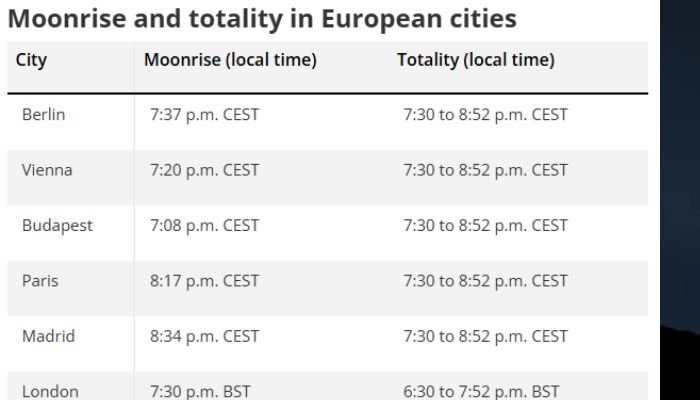
In Europe, the eclipse will already be underway when the moon rises, so viewers will need a clear eastern horizon to spot it.
Here’s a look at when moonrise and the totality line up in a few European cities:
What will happen during the eclipse?
In these locations, the moon will emerge as a deep red, low on the horizon, creating a hauntingly beautiful celestial sight.
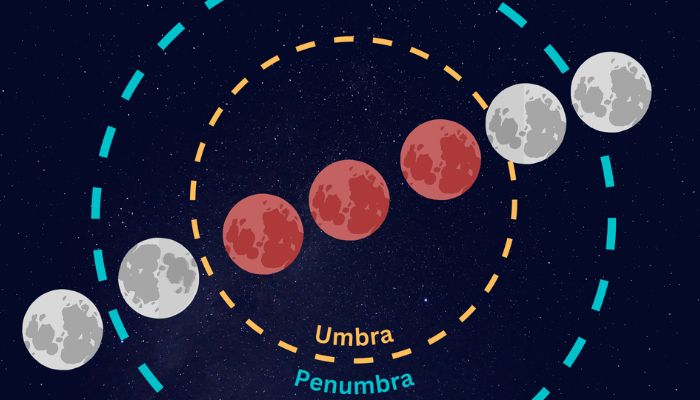
Total lunar eclipses always occur during the full moon, when the moon, Earth, and the sun line up in a row.
Once aligned, the innermost and darkest part of Earth’s shadow—the umbra—falls across the visible surface of the moon, blotting out the sun’s light.
For all those stargazers interested in spotting a Blood Moon, a livestream of the total eclipse will be available from Cyprus by Time and Date and from Italy by The Virtual Telescope Project YouTube channel.


-
 Blake Lively, Justin Baldoni's legal case receives latest update
 -
 Olivia Munn raves about her 'Your Friends & Neighbors' costar James Marsden
 -
 Brian Cox launches savage attack on Johnny Depp
 -
 Misua, 'Drag Race: Philippines,' breathes her last at 27
 -
 Kelly Osbourne finds new love after Sid Wilson split
 -
 GTA 6 Trailer 3 may drop soon as fans count down
 -
 Kelly Osbourne, Sid Wilson 'unsurprising' breakup reason unveiled
 -
 Sharon Stone names 'best kisser' in Hollywood
-
 Todd Bridges divorces wife Bettijo B. Hirschi 3 months after announcing split
 -
Anna Faris breaks silence on doing 'dumb thing' ahead of 'Scary Movie' release: 'I'm shocked'
-
Britney Spears' 'completely inexcusable' DUI arrest becomes blessing in disguise?
-
Kristi Noem claims she was ‘blindsided by ‘crossdressing’ news: Insider talks suspicion