Scientists discover bizarre ancient shark species in World’s longest cave
The extinct shark is found deep within the labyrinth of Mammoth Cave in Kentucky

In a remarkable discovery, researchers have identified an unknown species of shark that is labelled as extinct.
The species were found within Kentucky’s Mammoth Cave, which is marked as the longest cave system in the world.
Now named as Macadens olsoni, this small but peculiar predator of about 1ft long once prowled ancient seas over 335 million years ago.
The species name honours Mammoth Cave and Richard Olson, a retired Mammoth Cave National Park scientist who played a significant role in cataloging fossils during a recent inventory.
The sea creature is highly unique due to its unprecedented dental structure. It has a single row of teeth along each side of the jaw, with three prominent hook-like teeth at the front.
This dental structure has never been observed in sharks before.
Scientists believe that such tooth structures support the idea that these predators fed on soft-bodied prey like mollusks and worms.
The fossil was discovered in the Ste. Genevieve Formation. This limestone layer dates back to the Carboniferous Period, when most of North America was submerged under shallow seas.
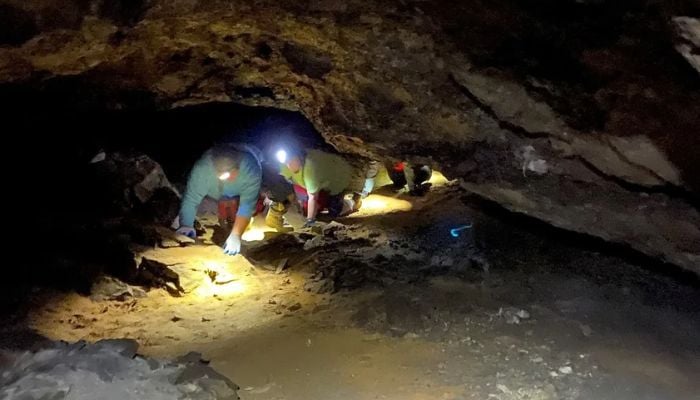
A team from the National Park Service, Mammoth Cave National Park, and the Smithsonian Institution made this discovery as part of an ongoing paleontological survey.
Superintendent Barclay Trimble said: “This finding not only enhances our knowledge of ancient marine ecosystems but also emphasises the critical role of paleontological research in our national parks.”
He further added: “Every discovery connects the past with the present and offers invaluable educational opportunities for students and the public.”
The study underscores how even well-explored sites are still hiding astonishing secrets providing new clues about evolution and biodiversity millions of years ago.
In addition to Macadens olsoni, researchers also reassessed another ancient shark species, formerly known as Helodus coxanus. It was later renamed as Rotuladens.
Both species share a notable dental structure offering latest update on the rich variety of prehistoric marine life that once thrived in the region.


-
 Sabrina Carpenter and Margaret Qualley old moment resurfaces as 'House Tour' video releases
 -
 'The Boys' season 5: Critics get real about series ahead of dark final chapter
 -
 Olivia Munn, Hoda Kotb welcome Savannah Guthrie's return as her mother remains missing
 -
 Science reveals the most painful ways to die
 -
 ‘Brainless human clones’: Inside controversial startup building bodies for brain transfers
 -
 Candace Cameron Bure recalls 'demonic' memory with husband Valeri
 -
 Spanish police recover 17th-century velvet guild manuscript online
 -
 Halle Bailey opens up about Beyonce's impact on her career