'Bright' rapidly spinning neutron star discovered by US Navy research intern
Millisecond pulsar spins hundreds of times per second, is first of its kind found in Glimpse-C01 star cluster
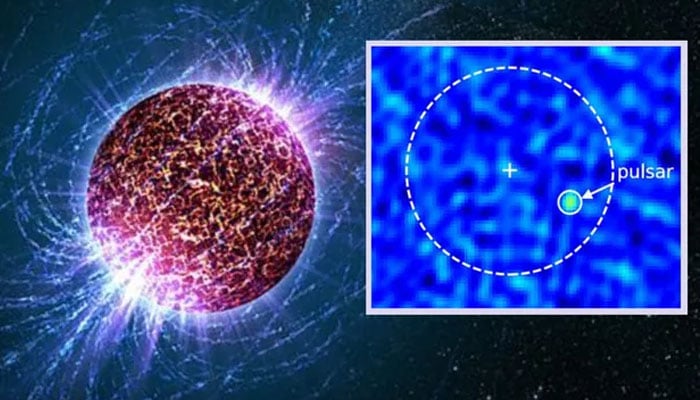
A rapidly spinning neutron star that sweeps beams of radiation like a cosmic lighthouse, across the universe has been discovered by a US Naval Research Laboratory (NRL) Remote Sensing Division intern Amaris McCarver and a team of astronomers.
Within the dense star cluster Glimpse-C01, the rapidly spinning neutron star or "pulsar" is located. This star cluster sits in the galactic plane of the Milky Way around 10,700 light-years from Earth, reported Space.
Moreover, this millisecond pulsar is the first of its kind found in the Glimpse-C01 star cluster and it spins hundreds of times per second. On February 27, 2021, the pulsar designated as GLIMPSE-C01A was spotted by the very large Array (VLA). However, it remained buried in a vast amount of data until in the summer of 2023, McCarver and colleagues found it.
While investigating images from the VLA's Low-band Ionosphere and Transient Experiment (VLITE) to hunt for new pulsars in 97 star clusters, McCarver and her team found the object.
"It was exciting so early in my career to see a speculative project work out so successfully," McCarver, one of 16 interns in the Radio, Infrared, Optical Sensors Branch at NRL DC, said in a statement.


-
 Scientists found 'super-puff' planets 1,110 light-years away
 -
 Scientists find ancient microbial life in places it shouldn't exist
 -
 Why Marijuana is suddenly sending thousands of dogs to hospitals in US?
 -
 36 years on, Hubble shows how stars actually change over time
 -
 Hidden magma beneath Mars? Scientists' 'unexpected' discovery raises new questions about alien life
 -
 Rare 3,200-year-old coral blue hole discovered in South China Sea
 -
 What happens at black hole’s event horizon? Scientists find the first-ever clue
 -
 Scientists discover evidence of fires used by humans 1.8 million years ago
-
 Did NASA just uncover evidence of ancient life on Mars? Key discoveries explained
 -
Four powerful earthquakes strike three continents within hours: Scientific link or coincidence?
-
Mysterious interstellar comet passing our solar system may be 12 billion years old, scientists say
-
When do we really become adults? Science has an answer