Nasa releases image of protostar creating red, white, blue fireworks
James Webb Space Telescope captures star's fireworks as its nebula is located 460 light-years from Earth
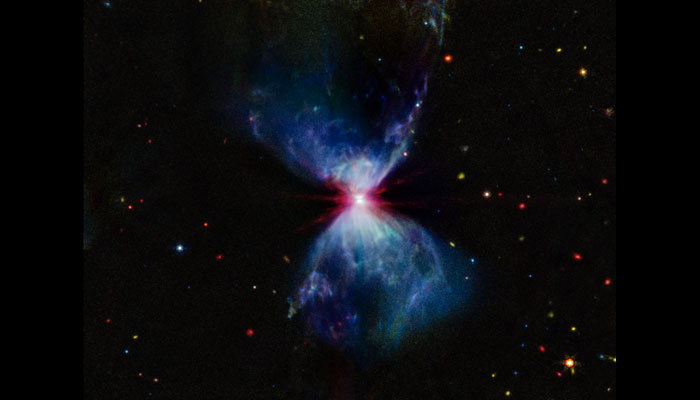
Nasa has released a stunning image that shows incredible red, white and blue fireworks erupting in the cosmos captured by the James Webb Space Telescope (JWST).
At the heart of the blue and white gas and dust cloud, or nebula, that birthed it, this cosmic’s “rocket’s red glare” is actually the violent eruption of an infant star. L1527 is the nebula in question. It is located around 460 light-years from Earth in the constellation Taurus, reported Space.
The nebula’s central “body” is a glowing protostar resembling a cosmic butterfly and is estimated to be around 100,000 years old. However, if that seems ancient, it is to remember that our star, the Sun, and the solar system around it are over 4.5 billion years old.
In actuality, the stellar object, which is at the heart of this nebula, isn't even a fully-fledged star yet. The process by which the protostar is transforming into a main sequence star like the Sun is marked by these cosmic fireworks.
When overdense patches gather more and more mass, eventually collapsing under their own gravity, stars are born from vast molecular clouds. This makes a protostar, which then continues to harvest material from the postnatal cloud of gas and dust that remains from the molecular cloud that birthed it.


-
 SpaceX ‘Space Junk’ is on a collision course with the Moon, scientists say
 -
 Do you know what happened on May 10, 1967? NASA's M2-F2 disaster explained
 -
 Why the Southern Ocean is melting: Antarctica’s sea ice resilience reaches a breaking point
 -
 Giant black holes are cosmic ‘Frankensteins’ built by mergers, new study reveals
 -
 NASA’s Artemis 2 moon launch becomes the largest event in Space Coast history
 -
 Is success written in your DNA? New study reignites nature vs nurture debate
 -
 Researchers found 240-million-year-old giant mysterious 'sand creeper'
 -
 New solar-powered process turns plastic waste into clean hydrogen
-
 Giant squid detected off Western Australia coast as deep-sea study reveals hidden species
 -
Astronomers discover unexpected atmosphere beyond Pluto on tiny solar system object
-
‘Evolution is not always random’: Study finds same gene reused for 120 million years
-
Real-life Tatooine moment: Astronomers discover 27 ‘Star Wars’ like planets orbiting two suns