Cosmic jewellery: James Webb Telescope reveals remarkable supernova
This supernova in Southern hemisphere of sky is most observed celestial object in space, exploded in 1987
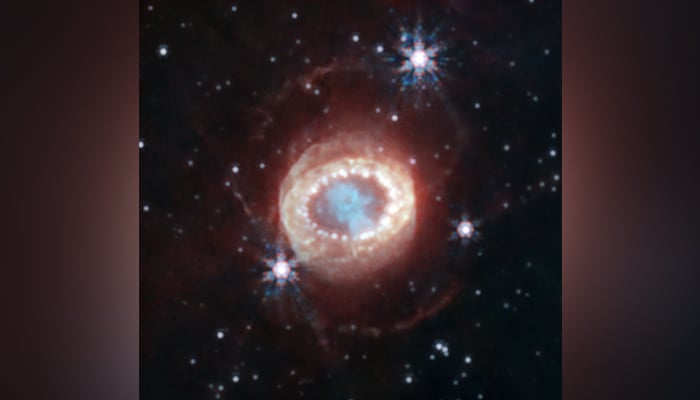
In yet another remarkable image released by the iconic James Webb Space Telescope (JWST) from deep space, an exploded star SN1987A was captured — which appeared to be a necklace — providing scientists with new details about the life cycles of stars and the pattern of their death.
This supernova in the Southern hemisphere of the sky is the most observed celestial object in space, which exploded in 1987.
It was the nearest and brightest explosion of a star from Earth located at a distance of 170,000 light-years. This new image allowed scientists to dive deep into the star when it was on its deathbed.
The image shows a series of luminous rings that represent bands of gas and dust pushed out by SN1987A in its various stages of death since it was excited and illuminated by the expanding shockwaves emanating in the last moment of the collapse and going supernova.
According to the scientists, one of these rings is a string of pearls, which comprises material ejected about 20,000 years before the final occurrence.
It became possible through the James Webb Space Telescope which provided a clear view till date of the necklace and the diffusing brightness surrounding the star.
The JWST also made prominent the two pearls that were not visible by the Hubble Space Telescope.
"We're able to see new hotspots emerging outside the ring that has previously been illuminated," Dr Roger Wesson from Cardiff University, UK told BBC News.
"In addition, we see emission from molecular hydrogen in the ring that was not necessarily expected and something only JWST could have revealed with its superior sensitivity and resolution," he added.
New features that came to the fore by James Webb are the crescents or arcs of emission inside the cosmic jewellery necklace but just outside the dense inner area that looks a little like a keyhole.
"We don't really understand the crescents yet," lead analyst Dr Mikako Matsuura said, adding that "this material could be being illuminated by some kind of reverse shock - a shock coming back towards the keyhole."
Despite its potency, JWST cannot see the remnants of the dying star that are buried somewhere in the dense dust field. Those remnants should be compact objects made up of neutron particles and measuring just a few tens of kilometres across.
Since the star went supernova, every large telescope that can see SN1987A has observed and studied its evolution and other features.
While tracing the causes, astronomers believe that the star was a hot, relatively young, probably 20 to 30 times as massive as our Sun.
Dr Wesson said: "One of the mysteries of this star is that it exploded when it was a blue supergiant when at the time all the theories said only red supergiant stars could explode. So unravelling that mystery has been one of the great quests."
"The indications are that Webb will be operational much longer than originally envisaged — maybe 20 years — and that will give us a very powerful tool to keep on monitoring SN1987A to see how it is changing."


-
 New report warns of record ocean warming and rising seas
 -
 Why NASA scientists believe Scotland holds clues to Mars’ ancient past
 -
 China’s bold Mars plan: Map entire Red Planet by 2028
 -
 Swiss drought reveals Roman secrets that could redraw ancient maps
 -
 SpaceX’s Starship engine failure raises questions over NASA’s moon mission
 -
 SpaceX Starship Flight 14 reaches orbit after successful insertion burn
 -
 Asteroid Bennu: NASA samples reveal how it was born from fire and ice
 -
 Harvard scientists detect mysterious radio signal from planet outside our solar system