
Mesmerising: James Webb Telescope releases images of star tossing on its death bed
Recently James Webb Telescope images provide a crucial opportunity for researchers to gain further insight about stars
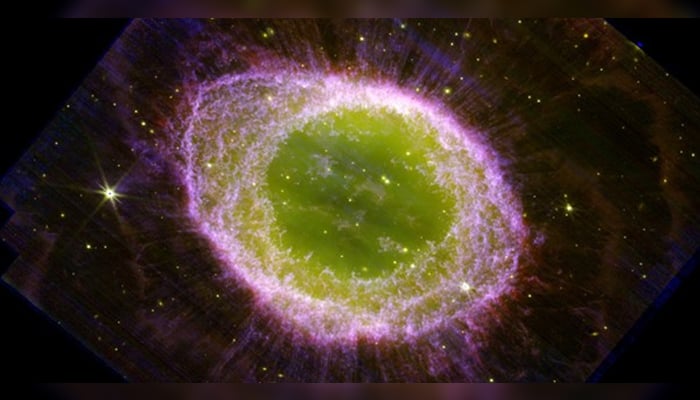
In yet another remarkable revelation, Nasa's James Webb Space Telescope (JWST) has detected the lifecycle of a star 2,600 light years away, allowing scientists to further unravel the mysteries of objects in deep space.
The doughnut-like object called a ring Nebula originated from a star which has completed its life cycle and is on its death bed that expelled its outer layers into the cosmos, according to BBC.
The recently captured images by James Webb Telescope provide a crucial opportunity for researchers to gain further understanding of the cycles of stars.
Dr Mike Barlow, co-leader of the team of astronomers who released the images, said: "Along with the intricate details of the nebula's expanding colourful shell, the images also reveal the inner region around the central white dwarf in exquisite clarity."

"We are witnessing the final chapters of a star's life, a preview of the sun's distant future so to speak, and JWST's observations have opened a new window into understanding these awe-inspiring cosmic events," Dr Barlow stated.
"We can use the Ring Nebula as our laboratory to study how planetary nebulae form and evolve."
The Ring Nebula, also called planetary nebulae — though a historical misnomer — is located within the constellation Lyra and can be observed throughout the summer.
It comes into being when a star completes its life and starts to emanate material, giving rise to a captivating array of patterns, luminous rings, and wispy clouds that ripple outward.
"We are amazed by the details in the images, better than we have ever seen before," Albert Zijlstra, professor in astrophysics at the University of Manchester, said.
"We always knew planetary nebulae were pretty. What we see now is spectacular."



-
 EU strengthens space autonomy by signing Ariane 6 launch contract for Galileo satellites
 -
 Black Moon: When the next one occurs and why it happens
 -
 Moon soil rewrites how Earth got its water, Nasa reports
 -
 From Earth to Moon: US startup opens bookings for inflatable lunar hotel
 -
 NASA’s detailed dark matter map reveals how ‘elusive force’ shapes cosmos
 -
 Oman signs deal for first dedicated MicroGEO satellite to launch by 2027
 -
 Is humanity facing its final hour? Doomsday Clock update raises existential fears
 -
 NASA plans historic lunar flyby for upcoming crewed mission