Supernova explosion in distant spiral galaxy leaves stargazers stunned
Studying such supernova explosions enable scientists to gain invaluable knowledge about star systems
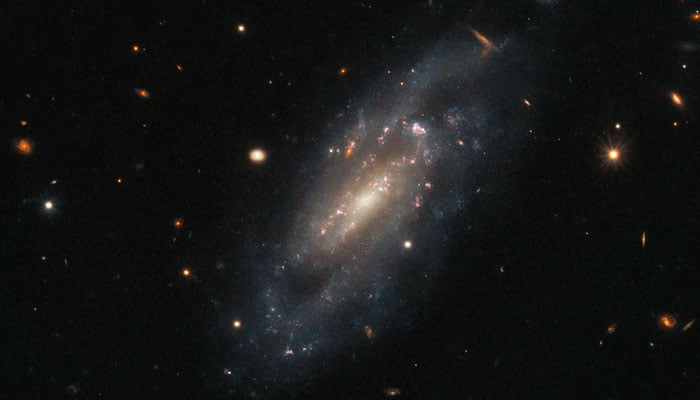
Nasa's Hubble Space Telescope recently captured a stunning and captivating image that showcases a distant galaxy that experienced a powerful supernova event not long ago.
According to Space.com, the captivating UGC 11860 galaxy, which has lovely spiral arms that gracefully curve out from its bright, densely packed central core, is similar to our own Milky Way.
According to a new Hubble image released by the American space agency Nasa on July 7, UGC 11860, a spiral universe that is located about 184 million light-years away in the constellation Pegasus, appears to drift peacefully in the vastness of space.
However, Nasa reports that beneath this serene exterior, the galaxy has served as the location for a stellar explosion known as a supernova that has been unbelievably energetic.
A large star that had run out of fuel and reached the end of its life caused the explosion. Supernova explosions release enormous amounts of material into space with great luminosity and force, creating expanding shells of gas and dust that remain as supernova remnants.
"The hugely energetic processes during supernova explosions are predominantly responsible for forging the elements between silicon and nickel on the periodic table," Nasa said in a statement. "This means that understanding the influence of the masses and compositions of the progenitor star systems is vital to explaining how many of the chemical elements here on Earth originated."
In 2014, the Hubble Space Telescope used its potent Wide Field Camera 3 to observe UGC 11860, and astronomers have since been able to study the galaxy's enduring remnants and investigate the effects of the dramatic stellar explosion thanks to this data, NDTV reported.
Astronomers study supernova remnants like UGC 11860, which produce cosmic explosions. This information helps understand the universe's elements and genesis.
Despite appearing trouble-free from a distance of 184 million light-years, UGC 11860 recently witnessed a massive explosion with high energy.
The 2014 supernova explosion in UGC 11860 marked the end of a massive star's life. Astronomers used Hubble's Wide Field Camera 3 to investigate the aftermath and effects of the cosmic explosion.
Supernova explosions are responsible for forging elements between silicon and nickel on the periodic table, making understanding the masses and compositions of progenitor star systems crucial for explaining Earth's chemical elements.


-
 Scientists found 'super-puff' planets 1,110 light-years away
 -
 Scientists find ancient microbial life in places it shouldn't exist
 -
 Why Marijuana is suddenly sending thousands of dogs to hospitals in US?
 -
 36 years on, Hubble shows how stars actually change over time
 -
 Hidden magma beneath Mars? Scientists' 'unexpected' discovery raises new questions about alien life
 -
 Rare 3,200-year-old coral blue hole discovered in South China Sea
 -
 What happens at black hole’s event horizon? Scientists find the first-ever clue
 -
 Scientists discover evidence of fires used by humans 1.8 million years ago
-
 Did NASA just uncover evidence of ancient life on Mars? Key discoveries explained
 -
Four powerful earthquakes strike three continents within hours: Scientific link or coincidence?
-
Mysterious interstellar comet passing our solar system may be 12 billion years old, scientists say
-
When do we really become adults? Science has an answer