
Pak doctor successfully implants animal heart in man
Doctors say that the heart transplant recipient has been doing well for three days
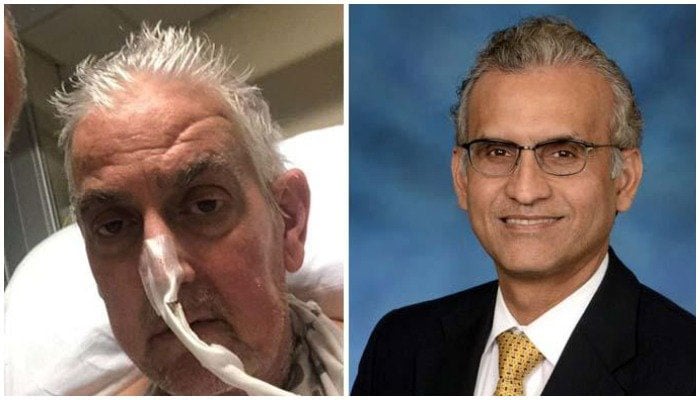
MARYLAND: For the first time in the world, a pig's heart has been implanted in a human in the United States.
The successful surgery, being considered a landmark in the field of medical science, was performed by a Pakistani doctor, Dr Mansoor Mohiuddin, along with a team of other surgeons from the University of Maryland.
A report published by BBC stated that implanting a pig's heart in a human became inevitable when there was no other hope left to save David Bennet's life. Since then, Bennett, 57, who is an American citizen, became the first person in the world to get a genetically modified pig-heart transplant.
Speaking to Geo News, Dr Mohiuddin, who hails from Karachi and is a graduate of the Dow University of Health Sciences, said: "We researched about the genetic makeup of a pig's heart and learned to genetically modify it in any way through different genetic techniques. "Experiments have been done on a monkey's heart for heart transplants for humans in the past, but they did not work out. However, the experiment on a pig's heart did.”
“We examined all animals to find out which of them is closest to humans and found a pig suitable for the experiment," he added. Talking about a pig's genetics, Dr Mohiuddin said that pigs grow very fast and the heart of just a months' old pig is near to the size of a human heart. Besides that, there were other reasons for which the doctors conducted research on a pig.
Talking about the survival of the patient who got the heart transplant, Dr Mohiuddin said that both the patient and the implanted heart need to be monitored closely after the transplant. "We have to see whether the human body accepts a foreign organ or not because sometimes it happens that the implanted organ works fine but it is the body that doesn't get along," Dr Mohiuddin said.
When asked about the cost of a pig heart transplant, the doctor said since such medical procedures are insured in America and other foreign countries, the cost of the transplant is not a big deal.
"However, the main expenditure was made on genetically modifying a pig's heart because it is a very lengthy procedure and we took genes from different pigs to do the job so it cost around $500,000," he said.
Doctors say that the heart transplant recipient has been doing well for three days since the "experimental seven-hour procedure." BBC quoted Bennet as saying "it was either die or do this transplant," a day before the surgery.
"I know it's a shot in the dark, but it's my last choice," he said. According to the report, the US medical regulator had granted the doctors at the University of Maryland a special dispensation to carry out the procedure as a life-saving effort because Bennet was declared ineligible for a human transplant due to his poor health.







-
 Maxwell Seeks To Block Further Release Of Epstein Files, Calls Law ‘unconstitutional’
 -
 Prince William Issues 'ultimatum' To Queen Camilla As Monarchy Is In 'delicate Phase'
 -
 Winter Olympics 2026: Remembering The Most Unforgettable, Heartwarming Stories
 -
 King Charles Hands All Of Andrew Mountbatten-Windsor’s Records And Files To Police: Report
 -
 Eric Dane's Family Shares Heartbreaking Statement After His Death
 -
 Samsung Brings Perplexity AI To Galaxy S26 With ‘Hey Plex’ Voice Command
 -
 Fergie’s Spent £13,000 A Day Since Andrew’s Troubles Started: Here’s Where She Fled
 -
 Eric Dane's Death Becomes Symbol Of ALS Awareness
 -
 Michael B. Jordan Gives Credit To 'All My Children' For Shaping His Career: 'That Was My Education'
 -
 Sun Appears Spotless For First Time In Four Years, Scientists Report
 -
 Bella Hadid Opens Up About 'invisible Illness'
 -
 Lawyer Of Epstein Victims Speaks Out Directly To King Charles, Prince William, Kate Middleton
 -
 Microsoft CEO Shares How Gates Doubted $1bn OpenAI Investment
 -
 Milo Ventimiglia Calls Fatherhood 'pretty Wild Experience' As He Expects Second Baby With Wife Jarah Mariano
 -
 Chinese Scientists Unveil Advanced AI Model To Support Deep-space Exploration
 -
 Anthropic’s New AI Tool Wipes Billions Off Cybersecurity Stocks