
Flooded fields, water scarcity another blow to wheat crop
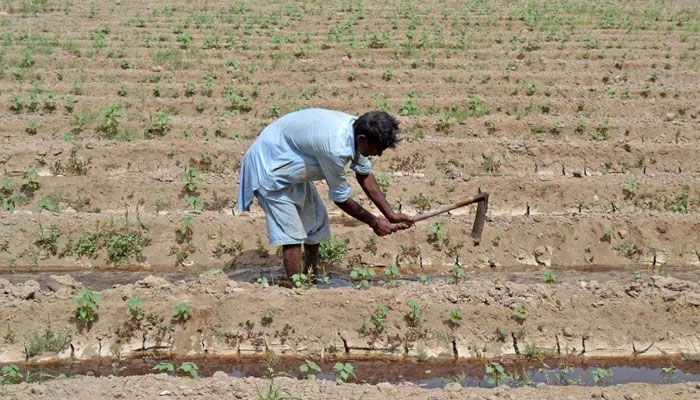
HYDERABAD: Farmers from the once prosperous fertile zone, known as Laar (lower Sindh), comprising of Badin and parts of Umerkot and Mirpurkhas districts, were experiencing water scarcity as well as the problem of dewatering, which hindered timely cultivation of wheat crop.
Reports gathered from farmers show that irrigation channels did not carry enough water to tail end areas in the month of November. As a result, many farmers were either not able to cultivate their wheat crops on time or needed water at the initial stage to save the crops.
For example, Phuleli being a non-perennial canal, starting from Kotri Barrage gets water for six months –from May till October. Farmers were aware of the system, but their reluctance to follow rules resulted in crop loss.
Farmers in Badin usually get water till the end of October for cultivating their crops. This time, because of surplus in canals, they assumed the water would continue for a longer period. But that did not happen. So, farmers who waited too long to cultivate the crop were now facing water scarcity in the early stages.
Sindh Growers Alliance (SGA) President Nawab Zubair Talpur said the government authorities should have informed farmers in advance about their plan so they might have saved their year in terms of cultivating wheat.
Currently, on one hand the canals have no water for tail end areas while on the other hand, some areas are still covered in rainwater flood.
Talpur pointed out that a wide area in Badin, Sanghar, Mirpurkhas, and Umerkot districts was under floodwater, where farmers could not.
All major canals, including perennial Nara canal, Akram Wah and Phuleli have not been flowing at full capacity, depriving farmers of their share. Besides agriculture, a major portion of the human population residing in nearby towns and villages also depended on the canals for drinking water. But they too were experiencing water shortage on account of poor water governance.
Pakistan requires 25-26 million tons of wheat for consumption. The government always set a target to procure up to 25-27 million tons wheat, but it does not achieve the target due to lack of planning and political manoeuvring.
Quoting reports from Punjab, Talpur said the federal and provincial governments have unanimously set Rs1,650/maund as support price. “It will not benefit producers, who spend Rs1,580 for producing each mound, utilising the amount for cultivation, maintaining, getting water and chemical input.”
He said the government had no realisation of the growers’ losses. “Many farmers are losing interest in cultivating valuable crops like wheat and sugarcane, which they believe are no longer as profitable because of manmade hindrances,” he added.
The SGA president accused the ruling PTI leadership of betraying farmers, as initially the prime minister promised to impose emergency in agriculture and assured to give relief to farmers in purchasing seed and fertiliser.
Muhammad Qasim Kumbhar, a farmer in Pangrio, Badin district is among a large number of growers, who could not cultivate wheat on their pieces of land because they could not manage to vacate their land for cultivation. “Some of the farmers hired dewatering machines, but faced resistance from other farmers, who refused to give space for draining out the floodwater.”
In some areas, farmers were preparing for cultivation but in vain, as the watercourses had stopped carrying water, he added.
Noor Hussain Khoso, also a tail end farmer from Badin district said they were expecting to sow wheat on time, but water scarcity made it impossible.
However, despite these challenges, Ghulam Hussain Khaskheli, a small scale farmer near Naukot narrated a success story. He said that traditional farmers in Naukot, had sown isabgol and mustard on their pieces of lands instead of waiting for wheat cultivation, which takes time and investment.
Naukot was the worst affected by recent rain flood, which destroyed all crops, mainly chilli and cotton. Traditional isabgol and mustard crops neither need more water nor do they need chemical input.
Naukot is known as the hub of isabgol production. Compared to wheat, he said isabgol has more value in the market. For example, in case a farmer gets 8-10 maund/acre product without any investment, they might sell it at Rs8,000-Rs12,000/maund and earn more income.
Otherwise, many farmers, who spent a big amount on wheat cultivation, including purchasing seed at Rs4,000/50kg bag, now fear that they would not be able to save the crop in case of sudden water scarcity.
Annual 15-day rotation period usually starts from January 6 to January 21 for de-silting of canals and its system to maintain capacity. Sometimes rotation continues for a longer time, disrupting the farming process and water supply mechanism to nearby towns and villages. But water scarcity this early has created uncertainty among a large number of farmers and water users.







-
 Dax Shepard Describes 'peaceful' Feeling During Near-fatal Crash
 -
 Steve Martin Says THIS Film Has His Most Funny Scene
 -
 Kensington Palace Shares Update As Prince William Continues Saudi Arabia Visit
 -
 Fugitive Crypto Scammer Jailed For 20 Years In $73m Global Fraud
 -
 Will Andrew Mountbatten-Windsor Finally Go To Jail Now That King Charles Has Spoken Out? Expert Answers
 -
 Melissa McCarthy Reveals Her Tried And Tested ‘corpse’ Night Time Routine That’s Lost Her 95lbs
 -
 Horrifying Pictures Of The Kidnapper Of Savannah Guthrie's Mother Released
 -
 Andrew's Ex-girlfriend Launches Brazen Attack On Epstein Victims On Piers Morgan Show
 -
 Andrew Mountbatten-Windsor 'on His Own' As Palace Gives Green Light To Law Enforcement
 -
 Kanye West's Tweet About Super Bowl Halftime Resurfaced After Bad Bunny's Show
 -
 'FBI' Star Juliana Aidén Martinez Tease Her Return To 'Law And Order: SVU' After Quitting
 -
 Cardi B's Emotional Words To Pal Amid Stefon Diggs Rumored Breakup Revealed
 -
 Princess Eugenie Breaks Cover Amid Explosive Family Scandal
 -
 Will Kate And Anthony Have 'Bridgerton' Spin Off? Revealed
 -
 Schoolgirl Eaten Alive By Pigs After Brutal Assault By Farmworker
 -
 King Charles’ Statement About Epstein Carries A Secret Meaning: Here’s Why It Can Be An Invite To Police