
The invisible
In Pakistan, national identity card is critical as it allows citizens to vote and access government benefits
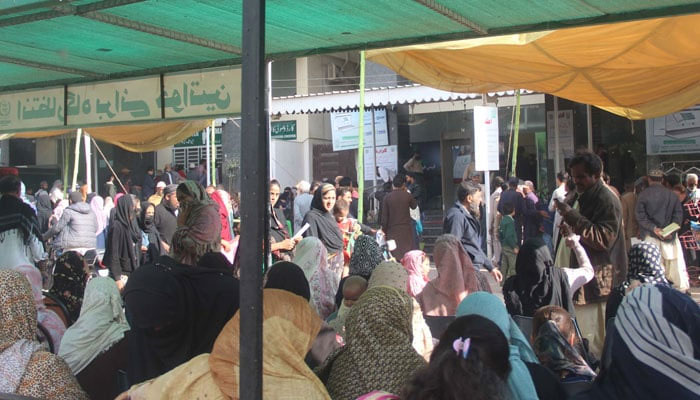
Millions of people in Pakistan, for one reason or another, remain unregistered with the National Database and Registration Authority (NADRA), and face serious hurdles in accessing essential services.
“I have never had a national identity card. Before my marriage, my parents said I should get it made after moving to my in-laws’ house, assuming my husband would take care of it”, 35-year-old Uzma Begum told me when she came to us seeking help for her daughter’s marriage.
“After our wedding, my husband questioned why I hadn’t gotten it earlier and dismissed the need for it, saying his ID card was sufficient. I didn’t understand the importance of having my ID card then. My husband’s ID card expired several years ago and he hasn’t renewed it either. Because of this, we couldn’t get birth certificates or B-forms for our children.”
In Pakistan, the national identity card is critical. It allows citizens to vote, access government benefits including public schools, healthcare, and poverty assistance programmes; open bank accounts, and apply for jobs.
Instituted in 2000, NADRA maintains the nation’s biometric database and has issued around 120 million Computerised National Identity Cards (CNICs) to 96 per cent of adults until 2022 in a country of nearly 242.8 million. A Pakistani CNIC includes a unique 13-digit ID, a photograph, a signature, and a microchip containing iris scans and fingerprints.
Yet, despite these efforts, hundreds of thousands of Pakistanis, including women, transgender persons, migrant workers, and nomadic communities, remain without a CNIC.
Uzma’s ordeal is a stark reminder of the consequences of this yawning gap in registration. Her parents, out of maybe lack of awareness or understanding, failed to register her with NADRA. Her husband too did not take the necessity of her having her ID seriously, believing his expired card was enough to deal with any identity-related issues. He rues the day he thought that.
A study by the Human Rights Commission of Pakistan (HRCP) on migrant workers in Karachi, published on October 1, 2022, found that women were more likely not to have a CNIC, making them extremely vulnerable to the devastating risks of destitution if their husbands die or desert the family.
That was Uzma’s plight when her 18-year-old daughter suddenly went down with a serious illness. Without ID cards, Uzma’s family had to run from pillar to post trying to get access to healthcare at government hospitals. Even though many charitable organizations and NGOs offer free medical care, Uzma couldn’t avail their services because of the CNIC crisis.
According to the World Bank, over a billion people worldwide have no way of proving their identity. While governments around the globe adopt digital ID systems to improve governance, the United Nations Special Rapporteur on Human Rights has warned that these systems can exclude marginalized groups and should not be prerequisites for accessing social protection schemes.
NADRA, which has also helped establish digital ID systems in countries like Bangladesh, Kenya, and Nigeria, has a dedicated registration department for women, minorities, transgender individuals, and unregistered persons.
The agency runs several women-only centres, particularly in Khyber Pakhtunkhwa and Balochistan and the Gilgit-Baltistan region, to overcome sociocultural barriers, prioritizing senior citizens and disabled individuals.
Children whose parents are not registered cannot get their birth certificates issued, and face a higher risk of trafficking and forced labour, according to the HRCP. The commission has advised more mobile registration units, extra workforce – especially female staff to assist vulnerable groups – simpler processes, and less rigorous documentation requirements to facilitate the registration process.
Uzma’s struggle is a testament to how important it is for parents to register their children with NADRA. Identity documents are more than just bureaucratic formalities; they are essential lifelines that open access to essential services and protections.
This sad tale warrants efforts by the government and the civil society to create awareness and reach out to marginalized and unregistered groups, ensuring no one faces the hardships endured by Uzma due to a lack of identification papers.
The writer is a former journalist, and director PR at the Alamgir Welfare Trust.







-
 BAFTAs 2026: Kerry Washington Makes Debut In Custom Prada Gown
 -
 Jennifer Lopez Gets Emotional As Twins Max And Emme Turn 18
 -
 Andrew Mountbatten Windsor Blunders Are Result Of 'conspiracy Of Silence'
 -
 Keith Urban Fires Entire Management Team After Divorcing Nicole Kidman
 -
 Kylie Jenner Marks Death Anniversary Of Hairstylist Jesus Guerrero With '222' Tribute
 -
 Daniel Radcliffe On How It's Like Seeing New Harry Potter Cast Years Later
 -
 Andrew Portrait Makes Unexpected Debut At Louvre Museum Over Epstein Protest
 -
 Italy: Skeleton Of Saint Francis Of Assisi’s Goes On Public Display For First Time After 800 Years
 -
 Hailey Bieber's Subtle Gesture For Eric Dane’s Family Revealed
 -
 Moment Prince William 'broke Down' And 'apologised' To Kate Middleton
 -
 Paul Mescal And Gracie Abrams Stun Fans, Making Their Romance Public At 2026 BAFTA
 -
 EU Rejects Any Rise In US Tariffs After Court Ruling, Says ‘a Deal Is A Deal’
 -
King Charles Congratulates Team GB Over Winter Olympics Success
-
 Meryl Streep Comeback In 'Mamma Mia 3' On The Cards? Studio Head Shares Promising Update
 -
 Woman Allegedly Used ChatGPT To Plan Murders Of Two Men, Police Say
 -
 James Van Der Beek's Widow Mourns Eric Dane Days After Husband's Death