
ECP can’t disqualify MP for lifetime: CJP
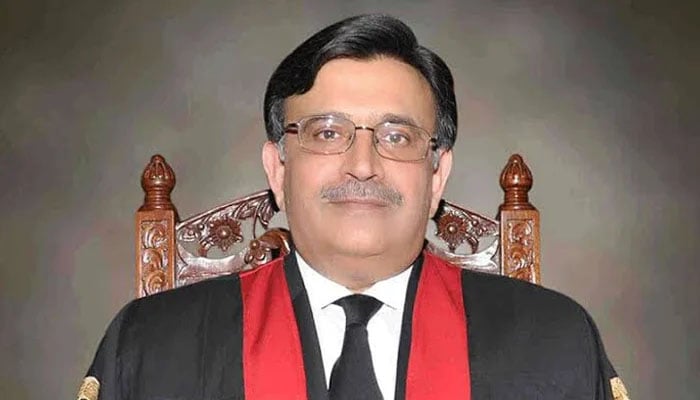
ISLAMABAD: The Supreme Court on Thursday ruled that it would review the order of the high court that upheld the election commission’s decision to disqualify Pakistan Tehreek-i-Insaf’s Faisal Vawda for a lifetime.
A three-member bench of the apex court, headed by Chief Justice Umer Ata Bandial and comprising Justice Syed Mansoor Ali Shah and Justice Ayesha A Malik, heard the appeal of PTI leader Faisal Vawda, challenging his lifetime disqualification. During the hearing, Chief Justice Umer Ata Bandial said that the election commission disqualified Faisal Vawda for a lifetime based on facts that were upheld by the Islamabad High Court. “But we will not go into the facts but examine if the verdict of the learned high court is right or wrong,” the CJP remarked.
The CJP observed that in his personal opinion the Election Commission of Pakistan (ECP) has no authority to disqualify a public representative for life under Article 62(1)(f) of the Constitution.
The court asked Barrister Waseem Sajjad, counsel for Faisal Vawda, to answer on the next date of hearing two questions: first, if the apex court could maintain the declaration of the learned high court under Article 62(1)(f) and second as to why not the Supreme Court invoke its jurisdiction under Article 187 of the Constitution in the light of the facts to provide complete justice.
It is pertinent to mention that Article 187 of the Constitution relates to the issue and execution of processes of the Supreme Court. It states that subject to clause (2) of Article 175, the Supreme Court shall have the power to issue such directions, orders, or decrees as may be necessary for doing complete justice in any case or matter pending before it, including an order to secure the attendance of any person or the discovery or production of any document.
Waseem Sajjad submitted that on the last date of the hearing, it was observed that an expired passport of the petitioner was submitted to the returning officer. He said that the expired passport was not submitted to the returning officer but its copy was mistakenly submitted to the Supreme Court. Justice Ayesha A Malik said that the petitioner had also submitted his expired passport to the returning officer. Waseem Sajjad said that after examining the record, he had returned the documents.
“But it is strange that the returning officer got the documents and then returned after going through them,” Justice Syed Mansoor Ali Shah said. The interesting aspect of the case is that the National Database and Registration Authority (Nadra) had signed the documents and National Identity Card of the petitioner but did not put the date. As per the Constitution, one has to renounce his/her dual citizenship while contesting elections instead of cancelling their passport. Later, the court adjourned the hearing until Nov 8.







-
 Dolly Parton's Rare Approach To Battle Grief Following Tragic Loss Of Late Husband Laid Bare
 -
 How Queen Elizabeth's Silence Impacted Diana And Meghan
 -
 Olivia Munn Raves About Her 'Your Friends & Neighbors' Costar James Marsden
 -
 Khloe Kardashian Gets Candid About Weight Loss Struggles
 -
 Jon Hamm Weighs In On ‘dark’ Modern Dating Culture: 'I Was Never Really Good At Dating Anyway'
 -
 Miley Cyrus Receives Heartfelt Praise From 'Love On The Spectrum's Logan Pereira
 -
 DeepSeek V4 Model Bets On Huawei Chips As Demand Surges
 -
 Ty Herndon Talks 'building A Future' With Partner Amid Memoir Release
 -
 'General Hospital' Star Sofia Mattsson Spills The Truth About 'Days Of Our Lives' Role
 -
 Ben Stiller Reveals Hidden Struggles Of Bro Bowlers
 -
 Brian Cox Launches Savage Attack On Johnny Depp
 -
 Pooh Shiesty, His Father Arrested Over Gucci Mane Kidnapping
 -
 Blake Lively 'devastated' After Legal Loss Against Justin Baldoni
 -
 Queen Elizabeth Ignored Warning Signs In Andrew Case To Protect Him?
 -
 'Hollyoaks' Star Keiron Richardson Confirms Speculation About Major Character Exit
 -
 King Charles, Harry Reconciliation: Royal Expert Reflects On 'work Going On Behind The Scenes'