This week You! features three inspirational stories of women from South Punjab, who started their small businesses with the help of USAID-PYWD project ...
This week You! features three inspirational stories of women from South Punjab, who started their small businesses with the help of USAID-PYWD project ...
In Pakistan, women entrepreneurship is presently considered a significant tool in enabling women empowerment and independence. The number of women entrepreneurs across the globe is rising, which is definitely good sign for families (especially poverty-stricken ones), communities and the economic development of Pakistan.
Sidra Abid, 27, wife of a fruit seller Muhammad Abid, 32, has an inspirational story to share. The couple lived in a rented place, situated down a narrow alley in Multan, with their three children. The family had extremely limited resources to meet their basic expenses and could only dream of breaking the shackles of poverty.
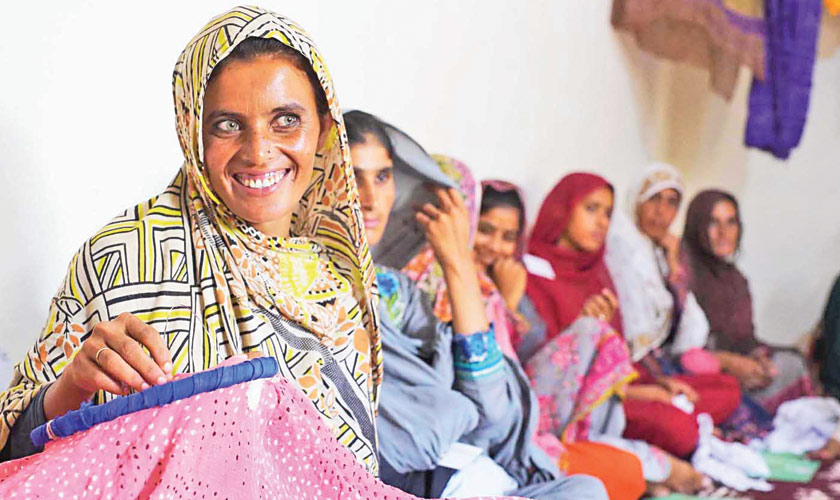
Abid’s income could only cover partial needs of the household so Sidra decided to step out of her house and spend long hours working as a housemaid. To supplement the household income further, she would do some shoe embellishment work on a contractual basis. The shoes in question are the traditional khussas - a specialty of South Punjab that has a ready demand all over the country and abroad. Despite putting long hours into this work, she would get peanuts in return and the lion’s share would go to the middleman and the shoe vendor with whom she did not have a direct contact. Adept at designing shoe-motifs and despite having market linkages as far as in Lahore, Sidra never had a chance to spare enough money to start her own business.
One fine day the long awaited breakthrough came for her in the form of an interest-free microfinance loan programme offered by USAID-funded Punjab Youth Workforce Development Program (PYWD) for eligible candidates to help them start small-scale businesses. This microfinance programme is jointly implemented by USAID-PYWD project and Akhuwat Foundation where 50 per cent of loan amount is contributed by USAID-PYWD project and the remaining 50 per cent comes from Akhuwat Foundation.
Sidra’s husband was reluctant initially as he suspected hidden charges in the loan offer, but once satisfied by the project team he encouraged his wife to go ahead with her plans. She applied for the loan and agreed to abide by the loan terms including participation in a specially designed five-day entrepreneurship training programme that every potential borrower must undertake before proceeding with the investment plan.
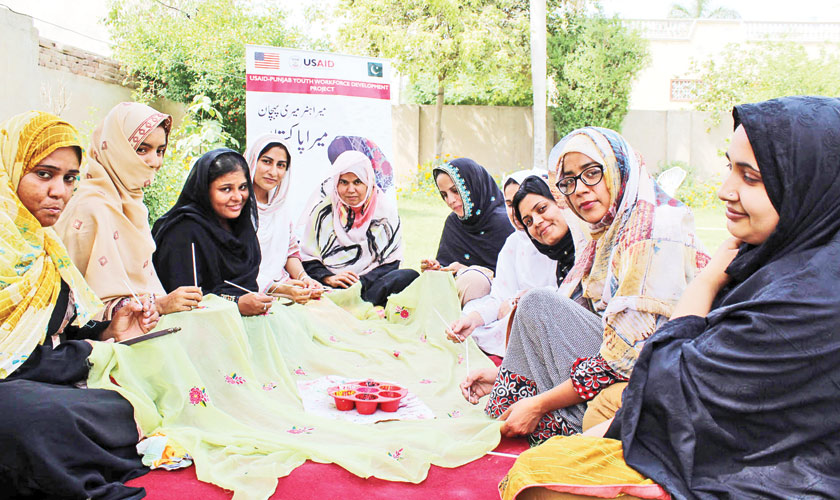
Once the required processes were complete, Sidra received Rs 50,000 loan payable in the form of Rs 3,500 monthly instalments. Her five-day training helped her plan her investment in a professional and efficient manner. She allocated significant amount for procurement of necessary tools and raw material during the very first month. The next month she landed her first independent order of 350 pairs of shoes (khussas). Soon, a bulk of orders started to pour in from as far as Lahore and Sidra decided to share her success with others as well.
First, Sidra invited the women of her neighbourhood to the trade, then started training them and eventually outsourced a portion of her consignments to them at reasonable rates. In the next six months, her neighbourhood became a hub of activities never witnessed before. Soon families associated with Sidra’s enterprise turned around their economic conditions for the better. Sidra and her husband bought a piece of land and built a house of their own on it. Their eldest son has started going to school and they will soon be enrolling others as well. Sidra’s story is not an ordinary one. She is a daring woman whose timely decision to avail a promising offer helped her as well as 30 other families.
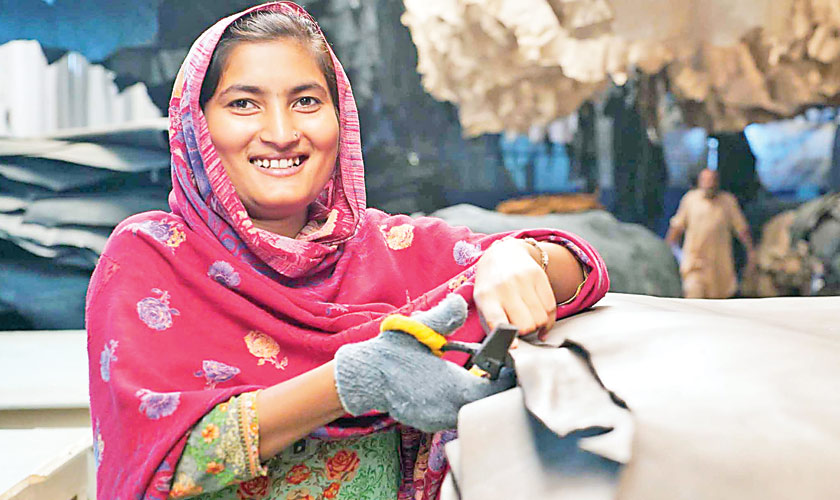
Another embodiment of resilience, struggle and self respect is Sumaira Majeed, a resident of Basti Umer Wali, Shah Jamal in district Muzaffargarh. She was seven years old when she was diagnosed with Thalassemia, an inherited blood disorder. Illness at such an early age barred her from going to school and she had to spend several nights in hospitals. Today, at the age of 22, she undergoes blood transfusion after every 15 days. After her diagnosis, Sumaira, the eldest of six siblings, watched her parents struggle to afford her treatment. Her father increased his working hours which increased his stress and adversely affected her health. However, luckily for her, Sumaira was identified, selected and also enrolled by the PYWD project’s team in the dress-making course at Umer Enterprises, a school uniform supplier based in her local community at Basti Umer Wali. She is happy that now she will no more be a burden on her parents but someone who could share their responsibilities. “I have learned a very important vocational skill which has enabled me to support my parents to pay for my medical bills. I want to become a role model for the sick and disabled people of my community to give the hope for a better future,” tells Sumaira. She was offered a monthly stipend of Rs 1,500 during on-the-job training and permanent employment at Umer Enterprises after that.
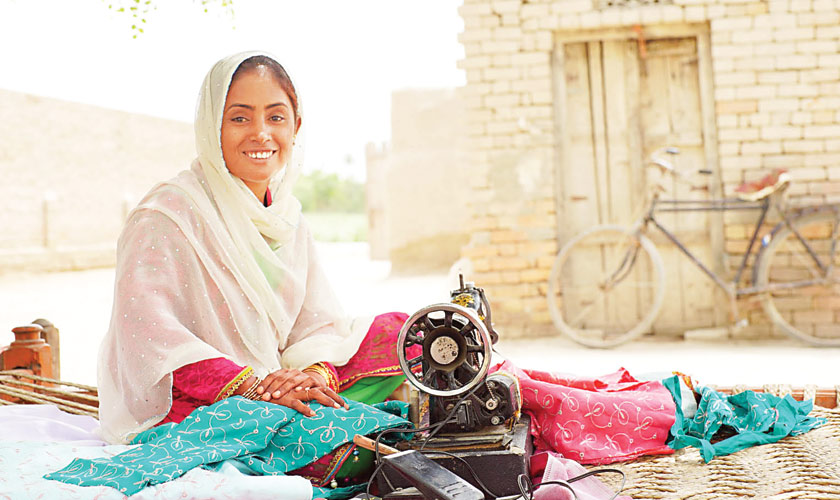
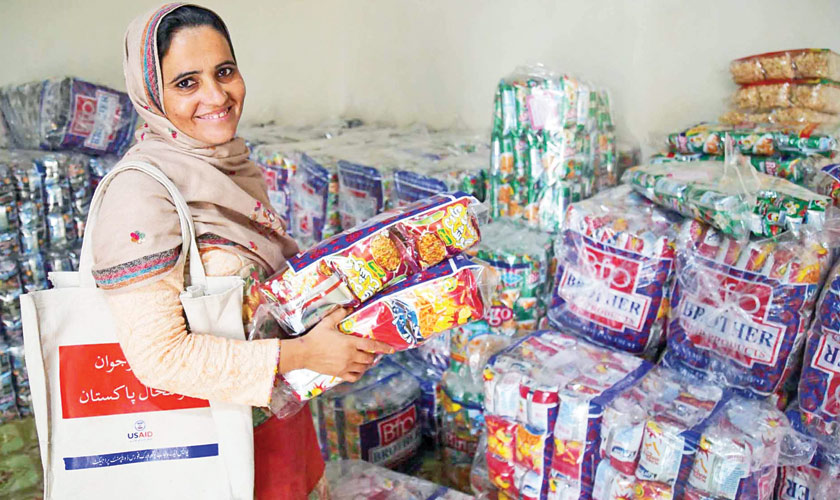
Sumaira Riaz, 27, is one such woman who lives in a small settlement near the Bahawalpur railway station. She had always wanted to set up a small provision store but was told that women could not run a business. Her husband is a porter (kuli) and does not earn enough to cover his household expenses. Sumaira says it is very hard to get a loan from banks because you must show a consistent flow of income or you must put a piece of land or your house or cattle ‘girwi’ (mortgage) to provide guarantee but they had none. Through the project’s microfinance scheme, Sumaira applied for a loan and started a small grocery store in her own house. She has also managed to create a bigger customer base because her shop is the first one owned by a woman in her area; and the local women and girls feel comfortable buying from her shop. Riaz, her husband helps her with inventory and stocking. Every morning before leaving for his work, he buys fresh vegetables and fruits for her shop from local farmers’ market at reasonable rates. Sumaira is now committed to expanding her small business and building a secure future for her children. “Now I want to be able to use my shop to create better lives for my children,” she hopes.
These cases are just three of the many where right steps taken at the right time, under the guidance of experts and with the support of development sector organisations, and these people transformed their lives and became an inspiration for others. Qaisar Nadeem, Chief of Party, USAID- PYWD Project takes pride in the fact that the project is transforming Pakistan’s young men and women from underprivileged backgrounds into an economic dividend. “The project has achieved at least 45 (against 35 per cent target) per cent female inclusion out of the total 10,000 youth through skills development, equal participation in decision-making, self-employment and microfinance opportunities. The project is a three-year youth-focused workforce development programme with a focus on four districts of South Punjab i.e. Multan, Muzaffargarh, Bahawalpur and Lodhran,” he informs.
Qaisar shares their overall aim is to support the federal government’s goal of eradication of poverty and elevate the status of under-privileged sections of society, especially women, by imparting technical and vocational market-driven skills and enabling them to stand on their own feet through self-employment and empowerment; thus contributing to a stable and prosperous Pakistan. He points out that transparency, innovation and inclusion are the hallmarks of the PYWD Project that especially encourages women, persons with disabilities, and minorities by providing them equal opportunities of demand-driven skills development and sustainable employment. “The PYWD project has partnered with the Punjab Skills Development Fund, Benazir Income Support Fund, public-private partner organisations, training providers, and business community to augment greater socio-economic opportunities, skills development, self-employment, gender equity, equal participation in decision-making, health and well-being and microfinance services for impoverished women of South Punjab,” he adds.
According to the project details, the reach of the initiative was increased by reaching out to the potential beneficiaries close to where they lived. The criteria laid out for the potential beneficiary was based on the following: age - the potential beneficiary was supposed to fall in the age bracket of 16-29 years; domicile - the beneficiary has to be a certified and active resident of the four focus districts of South Punjab; and Income level - the beneficiary is deemed as unemployed with limited to no resources of her own to get the required vocational training or to initiate any business of her own.
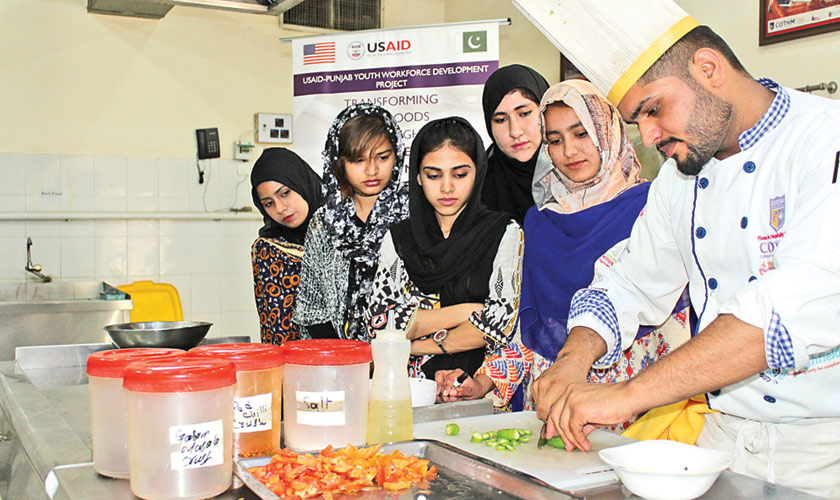
As mobility of girls is limited in many areas of the said districts, mobile training centres were established close to their houses in premises rented for a limited period. Once the local girls were trained, the premises were vacated and the project team moved on. This project also laid out a detailed community engagement strategy to identify and mobilise marginalised youth through community organisations (CO) already working at grass root level, key community influencers (religious and communal leaders) and none other than parents themselves. Moreover, a series of community awareness sessions were conducted which involved sensitising the youth about the potential ways they could turn their lives around.
The PYWD project is not only developing the skills but also providing employment opportunities either through wage employment or self-employment. For self-employment, the project provides required toolkit to the project-trained youth. The Skills for Market Linkages Program is a 12-month innovative initiative specially designed for the rural women. Through this initiative, the project in collaboration with Punjab Skills for Development Fund, has provided 4-month technical and vocational training, 2-month entrepreneurship training and 6-month market linkages to 1100 rural women in the project area. At the end of the training programme, required toolkits are provided so that trained women can continue their businesses. The toolkits provided to female beneficiaries of institutionalised training include: Beautician, Commercial Tailoring, Domestic Tailoring, Fashion Designing, Dress Making, Kashi Gari, Bridal Makeup, Khussa Making, Machine Embroidery, Hand Embroidery and Chunri Making.
There is no doubt that Pakistani women are hard workers and they just don’t rely only on luck to get success. All they need is a little assistance which these programmes provide, and they create their own destinies.