This week You! takes a look at the current scenario regarding the growing rate of C-sections in Pakistan...
This week You! takes a look at the current scenario regarding the growing rate of C-sections in Pakistan...
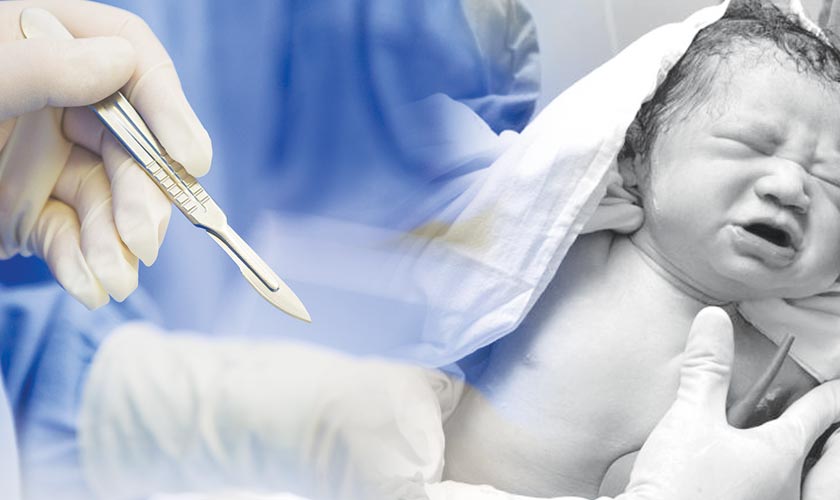
Caesarean section is one of the most common surgeries in the world, with rates continuing to rise, particularly in high and middle-income countries. Although it can save lives, caesarean section is often performed without medical need, putting women and their babies at risk of short and long-term health problems. A statement from the World Health Organization (WHO) underscores the importance of focusing on the needs of the patient, on a case by case basis, and discourages the practice of aiming for 'target rates'.
Since 1985, the international healthcare community has considered the 'ideal rate' for caesarean sections to be between 10 and 15 per cent. Since then, C-sections have become increasingly common in both developed and developing countries. When medically justified, a C-section can effectively prevent maternal and perinatal mortality and morbidity. However, there is no evidence showing the benefits of caesarean delivery for women or infants who do not require the procedure.
New studies reveal that when caesarean section rates rise towards 10 per cent across a population, the number of maternal and newborn deaths decreases. But when the rate goes above 10 per cent, there is no evidence that mortality rates improve. Sadly, Pakistan is one of the countries where the problem is prevailing and the percentage of C-section remains a little over the threshold.
C-section is a major abdominal surgery involving two incisions (cuts). It is only the operation that requires surgeons to cut on the same scar over and over again if a mother has a multiple caesareans. Postpartum complications such as haemorrhage and infection are by far the two most commonly found amongst the mothers. Less common complications include injury to the bladder or surrounding tissue. And babies delivered via Caesarean, face an increased risk of breathing problems, juvenile diabetes, allergies, and asthma.
Case in point here is of Amina Waqas, who delivered her baby girl in 2012 in a local hospital. Her reports were satisfactory till the time of delivery, and her doctor never suggested that she might go through C-section. But it happened anyway. She is not sure as yet about why it was done, as the doctor herself never provided a clear explanation. 'The baby was at risk' was all that the doctor vaguely explained. Amina is not the sole victim but you find many in the state of shock for going through the surgical procedures.
Dr Sarah Rafi, mother of two children, had to change her doctor at the last minute as her gynae wasn't present at the time of delivery. "You try to consult the best gynaecologists in the city, but unfortunately they are unable to tend to you at the time of delivery. So at that crucial time, any decision is possible," she laments. "There are a handful of gynaecologists who are devoted and willing to engage themselves for eight to twenty hours in the lag of the normal delivery, as it hardly takes 20 to 30 minutes for the caesarean operation." Sarah, being a medical professional herself, wisely chose Ghazala Agha, a gynaecologist in Lahore, who is well reputed for even running into the labour room at midnight to attend to her patients as she lives nearby. "One needs to be educated about these complications, so you can sort out the dilemmas attached to it," Sarah advises.
Unfortunately, there will be some doctors who will opt for C-section as it costs a good amount around of money (around 20,000 to 40,000); and is a profitable business for the hospitals, generating more revenue in a less time. Nowadays, doctors are working in different hospitals at a time which also limits their time in one place, compromising on the proper care of the patient at times. "Now it is not about the patient or her low risk pregnancy, but about the skill set of the doctor, his preference and mood, and most importantly, their availability," she adds. Unfortunately, major hospitals have refused to share the statistics to determine the ratio of normal delivery and C-section. "It is obvious when many cases around you seem to be dubious but the community of the doctors will never accept it so they don't defame themselves," Sarah tells.
Nevertheless, in a research journal available at Public Library of Science, Sarwat Mumtaz found that the rate of C-section has increased significantly from 2.7 per cent in 1990-1991 to 15.8 per cent in 2012-2013. Huge disparities were noticeable in the higher-income group of women (35.3 per cent in 2012-2013); whereas the lower income group tolled the lowest rate (5.5 per cent). So, a greater likelihood of having a caesarean section was observed in the richest, highly educated, and urban women.
"With the improvisation of the latest techniques in the ultrasound technology, the doctors are able to pick on minute details about the condition of the baby inside. Even when there is a low risk, the doctors will not want to endanger the lives of the baby and mother as it can aggravate the situation to its worse," explains Prof. Wasim Yusuf, former Chairman of Gynaecology at Lady Willingdon Hospital. He agrees that the rate in the government hospitals is higher because the women with complicated pregnancies come from far-fledged areas that are hardly supervised by the doctors. "Also, doctors at times are forced to fulfil the request for C-section if some patients from affluent backgrounds refuse to take any risk," he adds.
Dr Tahira Fatima, a gynaecologist at Fauji Foundation Hospital, did not want to be judgemental about the doctor's notorious actions, "It is not fair to be sceptical about a doctor's instinct before the delivery, as it is also the matter of doctor-patient confidentiality. However, it is quite a norm that patients tend to blindly trust a doctor with a good reputation, who is willing to take risks and ensure the health of both the mother and the child. There is also a lack of clear guidelines specifying the circumstances under which a C-section is medically necessary which leads to a wide variation in the prevalence of C-sections across the hospitals," she shares.
Dr Tahira further elaborates that under these circumstances, the doctors have to take prompt decisions as the room for argument widens if there is any delay. Also, the Department of Obstetrics and Gynaecology should reform evaluation system to know about the disposition of the doctors and their practices. "Yes there should be a monitoring body too that can examine and keep a check on the performance of the doctors," she emphasises.
It is an undeniable fact that some mothers opt for surgery intentionally to avoid labour pains, but the experts across the world believe it is not the biological need. While Amina Waqas' experience was not pleasant the first time around, this time, much aware, she delivered her second child normally. She believes that women should be conscious and knowledgeable about their condition in order to take decisions at this critical time of their lives.
When it comes to delivery, natural births are considered to be the best thing. However, with certain complicated pregnancies there can be risks such as tearing, haemorrhage and incontinence for the mother and injuries to the baby during labour; which requires a caesarean. However, if you are enjoying a normal pregnancy so far, it is worth taking steps to maximise the chances of proceeding towards the normal delivery. But remember, it takes some advance planning:
Educate yourself about labour and delivery: What are the terms and conditions when the doctor should not prolong the wait? Check out the websites and have a detailed conversation about your medical condition with your doctor. Show your curiosity from the assistant to the Ultrasound doctor.
Research about the hospital and doctor: Take some time to think about the doctor that would probably fight for your normal delivery. Keep your eyes and ears open for some sound knowledge.
Eat a balanced and healthy diet during pregnancy: Take care of your diet as obesity is one of the biggest risk factors that require caesarean. Also, you shouldn’t be underweight either as that can cause complications too.
Some exercise: Consult your doctor to know about the best physical activities for you but make sure you don’t exert yourself.
The importance of patient choice
Since women will value these risks differently, informing them of the merits of both options would empower them to decide what matters most to them. For some, that will be the opportunity to experience labour and the benefits of vaginal birth, for others it will be the option of a more controlled and predictable caesarean birth.