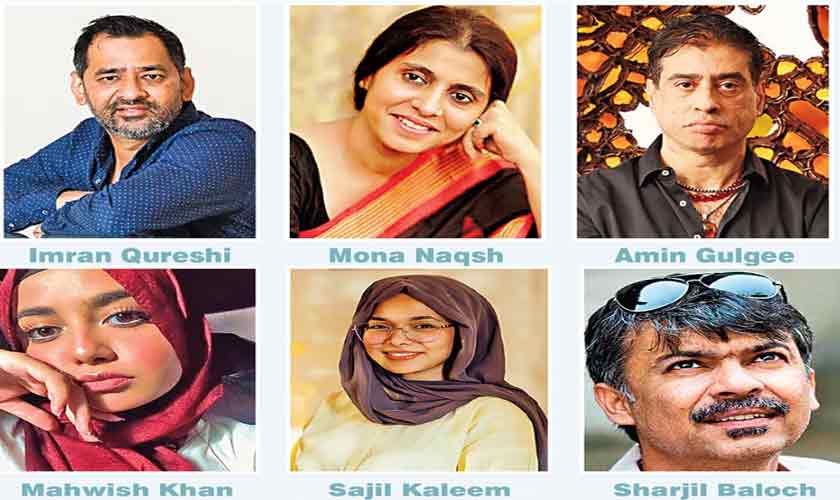
This week, You! spotlights six artists, some celebrated, others at the dawn of their journeys, each remarkable in their own right…
international artist day
Art carries meaning that words often cannot. It records emotion, belief, loss and faith, all through colour,
form and rhythm. On International Artist Day, which occurs on 25th October, we look at those who express what lies beyond language. From Karachi to Quetta to London, these six artists show how creativity
connects identity, spirituality and experience in ways that remain deeply human. Read on…
Imran Qureshi
Miniature meets modern reality
Imran Qureshi stands among Pakistan’s most acclaimed artists. He studied miniature painting at the National College of Arts in Lahore. What began as traditional training grew into an expansive practice of murals, installations and large-scale canvases that speak to the contemporary moment. Imran uses red as his signature colour. It flows across surfaces in a way that feels both beautiful and brutal. The red recalls life and loss, creation and destruction. He employs floral motifs drawn from Mughal miniature, yet they exist beside splatters and marks that recall wounds. His art carries tenderness and truth together, forcing reflection on how beauty and violence coexist in the world. His work has earned global recognition, including the Sitara-e-Imtiaz and the Medal of Arts from the US State Department. Yet, what remains most powerful is how he turns tradition into a living language. Through every mark and pattern, Imran redefines miniature painting for a time that demands both memory and renewal.
Mona Naqsh
Petals and patterns
Mona Naqsh grew up surrounded by creativity. The daughter of the late Jamil Naqsh, one of Pakistan’s most respected modern painters, she found her earliest lessons in her father’s studio in Karachi. “Even as a child, I knew our home was unlike any other,” she says. Her environment was filled with canvases, conversation and the hum of constant artistic work.
Over time, Mona built her own voice. Her floral compositions are calm yet expressive, detailed yet full of feeling. The flowers she paints seem alive with thought and memory. Mona’s canvases hold softness and strength together. They reflect discipline and emotion shaped through years of quiet observation. While her lineage connects her to Pakistan’s art history, her vision stands entirely her own. Through her petals and patterns, she creates a language of devotion and depth.
Amin Gulgee
The body, the material, the mystery
Amin Gulgee has worked across sculpture, performance and installation for over three decades. A graduate of Yale University, he brings thought and experimentation into conversation with form. Metal is his main medium, especially copper and bronze. He bends, welds and reshapes it into forms that seem at once solid and spiritual. For Amin, material carries meaning. Metal becomes a living surface that reflects light, age and energy. His sculptures often appear ritualistic, recalling ancient symbols and sacred geometry, while remaining distinctly modern. He also stages performances that blur the line between artist and audience, object and emotion. Each piece asks the viewer to engage not only with the artwork but with their own sense of self and connection to others. Amin’s world is one where art is experience. His Karachi gallery and performance space have become platforms for dialogue, experimentation and exchange.
Mahwish Khan
From science to spiritual geometry
For Mahwish Khan, art and spirituality exist in harmony. With a Bachelor’s degree in Fine Arts from University of Karachi, Mahwish uses precision and devotion to turn simple dots into intricate visual meditations. Her path began with science, a field defined by logic and order. Yet, she found her way to art where structure meets soul.
Her dots, repeated across canvas, build rhythm and reflection. Each point feels deliberate, as if guided by a higher thought. Through this technique, she explores the divine and transforms repetition into prayer. Viewers sense both method and mystery in her work. Mahwish invites them to look inward, to find their own connection with faith and meaning through patterns that breathe life into stillness. Her art is not about grand gestures but about presence. In every dot lies a world of contemplation.
Sajil Kaleem
Migration, memory and meaning
At a young age, Sajil Kaleem has already built a portfolio that crosses borders and identities. Originating from Karachi and a degree from Newcastle University, England, she works between cultures. Her family’s life across six countries has shaped her art in ways that few classrooms could. Sajil’s work explores migration and belonging. Her installations and paintings often draw from Islamic patterns and South Asian architecture, yet they speak of displacement and search. She turns personal experience into shared emotion, connecting her audience through stories of adaptation and endurance. She uses pattern to hold on to what shifts, to preserve pieces of identity that risk fading with distance. Based between Newcastle, Oxford and London, Sajil continues to develop her practice - turning the complexity of migration into visual poetry. She reminds us that home can be found in the act of creation itself.
Sharjil Baloch
Art that bears witness
Sharjil Baloch began his career in medicine before turning to art. Today, he is known as a painter, filmmaker and storyteller whose work reflects compassion and social awareness. For him, art must compel people to pause and reflect on life’s deeper realities. Sharjil’s paintings often depict rain, storms and blurred landscapes. These are not only scenes from nature but metaphors for human experience. His exhibition Strange Evening/Scattered Tears at Alliance Française, Karachi, captured moments of calm after chaos, echoing both environmental and emotional loss. His film work extends these concerns, focusing on identity and the human condition.
What stands out in his art is sincerity. He observes, records and reflects. His work moves between the personal and the collective, carrying the perspective of someone who listens before he speaks. In doing so, he transforms pain into empathy and image into understanding.