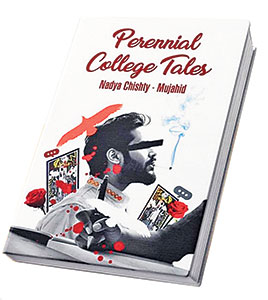
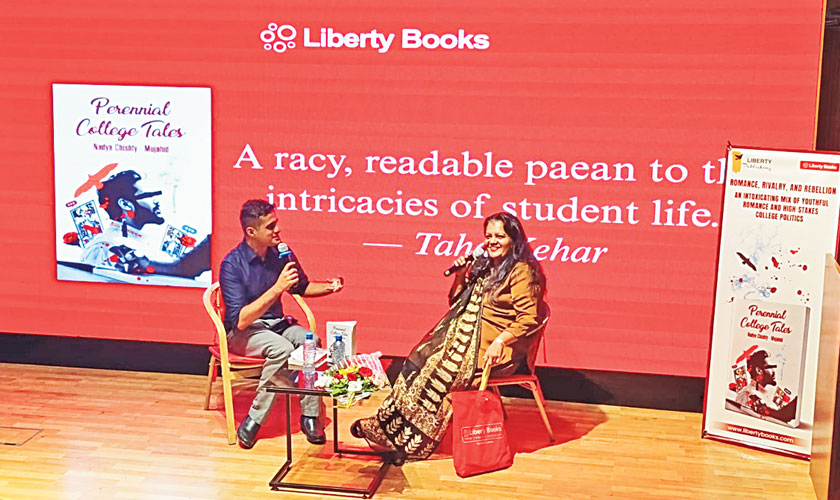
In an exclusive interview with You!, Nadya Chishty-Mujahid, author of ‘Perennial College Tales’ and ‘Timeless College Tales’ dicusses her realistic approach towards dialogue and characterisation. Read on...
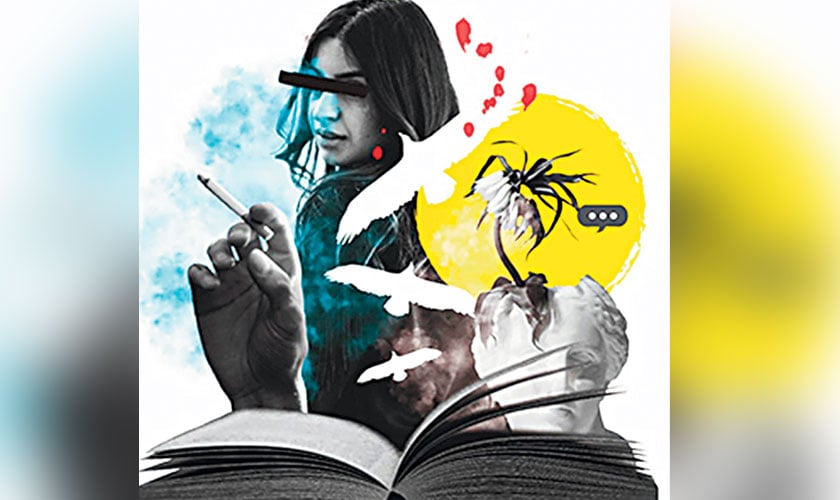
An associate professor at the Institute of Business Administration (IBA), Nadya Chishty-Mujahid teaches Creative Writing and English in the Department of Social Sciences and Liberal Arts. She has penned numerous scholarly monographs and book reviews. Her first collection of stories – ‘Timeless College Tales’ – drew critical acclaim for its evocation of university life in Pakistan and the gritty realities of student politics. Her dramatic play, ‘The Political Chess King’, serves as a prelude to the collection since it draws its creative thrust from the same milieu. Her second collection, ‘Perennial College Tales’, builds on a similar motif.
In this exclusive interview with You!, she discusses her realistic approach towards dialogue and characterisation, and her preoccupation with writing about twins.
You! Both Timeless College Tales and Perennial College Tales have filled a grave lacuna in Anglophone literature from Pakistan by tackling the concerns faced by students who attend local universities. Why do you feel it is important to explore student life in literature?
Nadya Chishty-Mujahid: My primary aim in writing these stories was to promote awareness of student-related issues, ranging from major problems such as violence to happier matters such as romance. College-level students are young adults, chafing against parental and administrative authority. It was time that someone brought these matters to the forefront of the literary world by means of fiction. High time, actually.
You! You primarily wrote these ‘campus chronicles’ for your students at IBA. I can imagine these narratives were a pleasing change from the dull, euro-centric text they would have encountered otherwise. How did the students react to these stories?
NCM: They were delighted because they had actually requested that I write such stories and teach them in my courses. They said rather artfully that since my English was naturally good (since I’m a highly-trained professor), I should write stories about them and teach those stories to them. I was a bit nervous as to whether things would get too close for comfort but they worked out very well. Fortunately.
You! The setting of your books is the fictitious Saeed School of Business (SSB), an elite university that isn’t insulated from the occasional political friction. Students who attend the institute aren’t stereotypical ‘rich brats’. Many of them belong to different ethnic groups and espouse a plethora of social and political beliefs. Tell us about how this fictitious setting came about?
NCM: Yes, it is elite, but it is rich enough to fund any student who has entered on the basis of merit. While the kids aren’t ‘rich brats’ they are in their own ways far more capable at handling power than their more wealthy counterparts. Because the primary focus of the tales is power and politics (barring those few pieces that dwell on love and romance), the students who can handle those things best dominate the stories. And political acumen at the student-level doesn’t relate to the social tier one comes from. It is more a question of personality.
You! Through the four student-led parties (Jazba, MKC, Laiq and Saathi) at the SSB, you draw attention to the murky realities of student politics. Student unions have remained critical yet controversial forces in Pakistan. What are your thoughts on this matter? Do you believe it merits a deeper exploration in fiction?
NCM: One of my students drily remarked once that no matter how much the administration of any institution tries to squash politics, it will keep rearing its head. And I think that’s very true, regardless of whether one is speaking about student unions or simply student groups (which is what the parties are). It certainly merits a deeper exploration in both fiction and non-fiction, I would say. The need and greed for power is a very fundamental one when it comes to political spheres. Even more so than the need for change and progress.
You! Although the students who appear in these stories are discerning adults, they are also somewhat impressionable and make a lot of mistakes. Tell us why you chose to create flawed characters who are portrayed as heroic?

NCM: It is far easier to relate to flawed characters than perfect ones, especially those flawed characters who have their admirable moments. And one must understand that these characters are flawed to some extent because of the very nature of politics. It can be both warped and filthy, and while very few of my characters are that despicable, all of them without exception are affected by the less than wholesome political milieu in which they find themselves.
Madeeha Sulaiman remains a force to reckon with in Timeless and Perennial (a famed English professor at SSB, emerges as an arbitrator, confidante and parental figure). Some would call her the students’ ‘guardian angel, confidante and unwanted trouble-shooter’. In one of the stories in Perennial, she even plays Cupid to two students. In another, she sings ghazals by Nayyara Noor. No one asks for her help, but she still decides to charge forward and ‘save the day’ after a scuffle breaks out at a concert.
You! Tell us more about some of her meddlesome ways. What do you think of her? Would you encourage educators to follow in her footsteps?
NCM: (laughs) I’ve grown so tired of her character. She was initially modelled on me, but then I felt she was turning out to be far sweeter than I, so I created her tougher, more hard-headed twin sister! Like Harry Potter, Madeeha has a ‘saving people thing’ (that’s what Hermione tells Harry once), and I must confess that I’ve saved a fair number of students from the disciplinary guillotine in my time. That fateful concert was one such point. But I think educators need to realise that Madeeha’s position is a thankless one. The problem is that she used to get roped into matters (such as in ‘The Pisces and the Black Queen’) and then once it was established that she would set off in her lifeboat to save students, she ended up meddling in things, much to Nafeesa Alam’s chagrin!
You! Many of your stories explore the affinities between twins. I believe you’ve written extensively on this subject as an academic as well. Why do you keep circling back to this subject?
NCM: Possibly because I have read 40,000 pages on twins to date! I mean, it has become such a major segment of my research that it was natural I suppose that some of that aspect of things would find its way into my short stories. As I just noted, I encapsulated the tougher facets of my personality in the character of Madeeha’s twin, Musaffa Sulaiman. I think she’s far grittier and cooler than Madeeha, who’s a bit sappy! Well, perhaps that’s cruel and not totally fair but my research did reveal that one twin is often tougher and stronger than the other, which is very much the case in Perennial College Tales.
You! In Timeless, women characters were actualised through romantic relationships but find subtle, strong means of making their presence felt. In Perennial, not all women characters are portrayed as ‘romantic interests’ of their male counterparts. For example, Hadia Furqan poses a counter to the patriarchal landscape of student politics at SSB. Tell us more about your approach to writing women characters, especially Hadia and Hansa Elham?
NCM: Female politicos are actually pretty die-hard breeds - they have to be, in order to survive within the parties. It’s a shame that they aren’t allowed to flourish as leaders due to the intensely patriarchal nature of the student politics. Hansa is objectified by Anwar Khan (and obviously by myself, since I am the author) because of her beauty. But she is a spunky, intelligent type of person, even if she does have to bow down to the dictates of her father. As for Hadia, she is indeed one of my stronger supporting characters. Ironically, she is the only major female character who isn’t portrayed as being in a romantic relationship; Sheeba, Hansa, and Ilham are all attached.
You! Male friendships assume centre-stage in most of your stories. However, these ‘masculine brotherhoods’ are far from superficial and are, in fact, rooted in intense emotional connections. Tell us more about your approach to exploring these friendships.
NCM: Homo-social relationships between men are the crux of both my books. In ‘The Terrace’ in ‘Timeless College Tales’ one does get a moving glimpse of the love that dare not speak its name. (That was the very first story I ever wrote, by the way.) But even strong friendships like that of Rumi and Tabani are firmly anchored in love. Brotherhoods tend to be rooted in very strict codes as well as very intense emotions. The implicit message of my books is that no one understands another man as much as his closest political soulmate does, regardless of whether one is thinking of Umar Kapadia/Salal Zahid, or Karim Rumi/Rehman Tabani. And you find variants of such couplings throughout the books - Sanaullah/Shamsi for example, or Asad Salman/Samee Khan. These relationships are the very fabric from which brotherhoods are made.
You! The dialogue in both Perennial and Timeless is quite authentic. How did you manage to capture the voice of the younger generations?
NCM: By hanging around them. And encouraging them to speak freely to me. After a while they dropped the verbal guards and defences, although they were rarely disrespectful, and that too only when very frustrated. It is important to be authentic on this front because student readers especially would expect a certain degree of authenticity in terms of dialogue and expression. It makes it easier for them to relate to what is going on in the stories.
You! Though many stories deal with SSB administration cleaning up the mess created by their students, there are a few standalone tales about love. These ‘love stories’ remind us of the vulnerabilities of some impressive, indestructible student leaders. Do you agree?
NCM: I certainly agree that love makes one very vulnerable, which is perhaps why Musaffa is so wary of the sentiment, and advises Soban Sanaullah to think with his head not his heart in ‘The Strong and the Sweet.’ I am a bit more cynical about romantic love so while I agree that it humbles both Anwar and Soban, they have to rally and move past disappointment because emotional indulgence is a luxury for a politico. Often a luxury which a hard-headed politico cannot afford. Sad but true.
You! Umar Kapadia was the spiritual core of Timeless. In Perennial, Soban Sanuallah seems to take his place. Which of these characters do you prefer?
NCM: This is a very difficult question, because like Madeeha Sulaiman, I am famously fair-minded and shouldn’t prefer one over the other. I think I take more pride in Umar Kapadia but I love Soban Sanaullah more. That about sums it up accurately. The former is very much a strong and commanding leader, while the latter heads a party ostensibly due to charm and the fact that he is well-liked (although he is obviously far more devious than he lets on).
You! The ‘SSB-verse’ has inspired two collections of stories and a play. Do you plan to write a novel set against this backdrop?
NCM: Oh God, no. Novelists can metaphorically pilot a literary jumbo jet of a project. I operate much smaller ‘planes.’ As Jane Austen said: “I work on two inches of ivory.” (Smiles) Works well.
The interviewer is the critically acclaimed author of ‘No Funeral for Nazia’ and ‘Typically Tanya’, and the co-editor of ‘The Stained-Glass Window: Stories of the Pandemic from Pakistan’.
He can be reached at tahakehar2@gmail.com