In 2024, Pakistan witnessed a troubling exodus of its youth, with more than 727,000 individuals leaving the country in search of better opportunities abroad....
COVER STORY
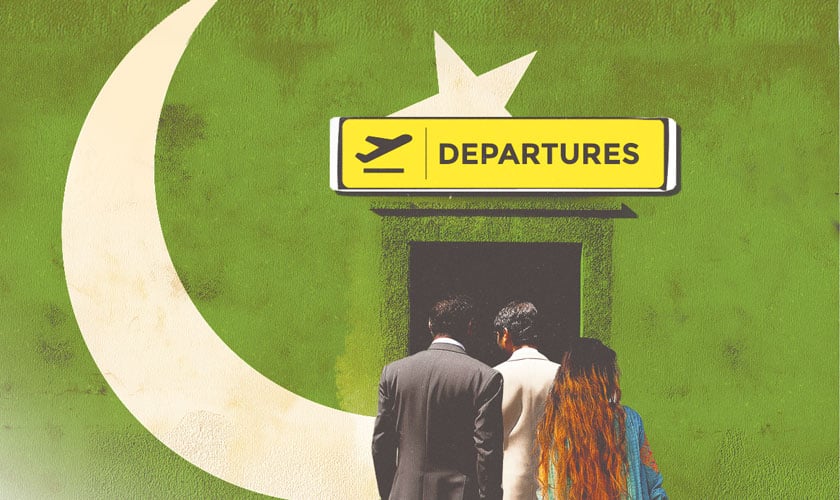
In 2024, Pakistan witnessed a troubling exodus of its youth, with more than 727,000 individuals leaving the country in search of better opportunities abroad. The trend has continued to escalate in 2025. In the first quarter alone, over 172,000 Pakistanis departed, with nearly 100,000 categorized as general labourers. This mass departure highlights the ongoing struggle faced by the nation's youth who are seeking employment elsewhere due to a lack of job opportunities and economic instability at home. Although this figure represents a 15 percent decline from the previous year, the sheer scale of migration paints a grim picture for Pakistan’s future.
The reasons behind this mass emigration are manifold, but they primarily stem from the country’s deteriorating economic conditions, rising unemployment, political instability and limited opportunities for young, skilled professionals. These challenges, coupled with the allure of foreign countries offering better job prospects, safer living conditions and higher wages, have created the perfect storm prompting Pakistan’s brightest minds to leave.

To understand this phenomenon, one need only look at the state of the country. In 2024, Pakistan’s inflation rate soared to 35.4 percent, triggering a steep rise in the cost of living. The spike in prices - particularly for essentials such as food and fuel - has made it increasingly difficult for young people to sustain themselves. Youth unemployment has climbed to an alarming 9.6 percent, with many graduates unable to secure jobs in their respective fields. Intense competition and a lack of meaningful opportunities have led to widespread frustration and the painful realization for many that their best options is to look elsewhere.
For years, Pakistani youth have struggled to find with employment challenges, but the crisis worsened in 2024 when the World Bank reported that youth unemployment in Pakistan ranked among the highest in South Asia. This issue hasn't been confined to those without higher education; many graduates in fields such as engineering, medicine and business administration have found themselves underemployed or entirely jobless. In fact, a study by the Pakistan Institute of Development Economics (PIDE) revealed that over 31 percent of university graduates, including those with professional degrees, are unemployed. The situation is particularly dire for women, with a 51 percent unemployment rate among female graduates.
Adeel, a 26-year-old business graduate from Lahore, had high hopes after completing his degree. “I spent four years studying, but when I graduated, I couldn’t find a job. I even did several internships, but they paid next to nothing. It felt like I had hit a dead end,” he said. In search of better prospects, Adeel applied for a student visa to Canada. “At least I’ll have a chance at a future there,” he added - a sentiment echoed by many young Pakistanis pursuing opportunities in Western countries like Canada, the United States, and the United Kingdom.

However, it’s not just the highly educated youth who are leaving. A growing number of under-skilled workers, particularly those with limited formal education, are heading to Gulf countries such as Saudi Arabia, Qatar and the UAE. These nations have become prime destinations for Pakistanis seeking employment that does not require specialized skills. In 2024, approximately 300,000 Pakistanis migrated to the Gulf, with many taking up jobs in construction, domestic service and hospitality sectors. These roles, while physically demanding, often pay better than average salaries in Pakistan and allow workers to support families back home.
For young men like Farhan, a 29-year-old from Karachi, the move to Qatar was a necessity. “I had no job here, and I couldn’t even pay my bills. My uncle in Qatar helped me get a construction job. The pay is decent, and I’m able to send money back to my family. It’s not glamorous, but at least I’m able to make a living,” he shared. Stories like Farhan’s are becoming increasingly common, as many under-skilled youth view the Gulf as a lifeline amid a stagnating domestic economy.
The migration of low-skilled workers to the Gulf is largely driven by the fact that these countries are willing to employ those who may not meet the qualifications required elsewhere. Qatar, for instance, continues to recruit foreign labour extensively, with expatriates making up around 90 percent of its population and nearly 30 percent of its workforce engaged in low-skilled labour. Similarly, Saudi Arabia, too, hires large numbers of Pakistani workers in booming sectors like construction and infrastructure, driven by rapid urbanization and mega development projects.

Though Saudi Arabia and Qatar remain the most common destinations, they are not alone in attracting Pakistan’s youth. Countries like Malaysia, Turkey - and even China - are becoming increasingly popular. This growing trend of labour migration has become a crucial economic pillar for Pakistan, with remittances from overseas workers playing a significant role in financial stability. In 2024, remittances reached a record $34 billion, the majority coming from Gulf nations.
While economic hardship remains a central reason for emigration, the situation is worsened by political instability. In 2024, Pakistan experienced repeated protests, violent demonstrations and political unrest. Tensions between the government and opposition parties grew significantly, leading to unrest in major cities like Karachi, Lahore and Islamabad. This ongoing instability, along with concerns about governance and transparency, has left many young people feeling disillusioned and overlooked. With political infighting continuing and the nation’s future hanging in the balance, increasing numbers of youth are seeking safer and more stable lives abroad.
Sara, a 28-year-old from Islamabad, shared her reasons for leaving: “It wasn’t just about not finding a job. It was about living in a country where everything seemed to be falling apart. There were riots, people were getting hurt, and nobody seemed to care. I decided it was time to leave, and I moved to Australia. At least I feel safe here and can build a future.”

Security concerns, particularly in regions such as Balochistan and Khyber Pakhtunkhwa, are also a major factor in the migration trend. These areas continue to face frequent terrorist attacks and militant violence. Incidents such as bombings, kidnappings and targeted attacks have posed ongoing security challenges, making it increasingly difficult for young people to lead normal lives. According to the Human Rights Commission of Pakistan, terrorist attacks in these regions rose by 15 percent in 2024 compared to the previous year, further heightening fear and insecurity among residents.
For many, leaving Pakistan is not just about better opportunities - it’s about survival. Young people from conflict-affected areas often have no choice but to seek safety elsewhere. A report by the UN High Commissioner for Refugees (UNHCR) noted that 27 percent of Pakistan’s youth cited personal safety as one of the top reasons for leaving the country. As the security situation continues to deteriorate, more young people are concluding that their only hope for a better future lies beyond their homeland.
Education is another significant factor influencing migration. Pakistan’s education system has long been plagued by poor infrastructure, outdated curricula and limited access. Only 5 percent of Pakistani youth have access to quality education, a stark contrast to the robust educational systems of countries like Canada, the UK and the US. Even for those who complete higher education, degrees are often not recognised internationally and may lack relevance in the modern job market. As one graduate from Karachi explained, “I studied engineering for four years, but when I looked for jobs, no one wanted to hire me. My degree isn’t recognised abroad, and there’s no demand for it here.”

The education system’s failure to prepare our youth for the global workforce is one of the key reasons many are seeking to study abroad. Many now aspire to study abroad, attracted by universities in countries like Canada and Australia, which offer scholarships, work-study options and pathways to permanent residency. In 2024, more than 50,000 Pakistani students were enrolled in universities overseas - a number that continues to rise annually.
The combination of economic distress, political turmoil, personal insecurity and educational shortcomings has created a perfect storm, compelling thousands of young Pakistanis to seek a better life abroad. Whether for career advancement, quality education or simply the desire to live in a safe and stable environment, the youth of Pakistan are increasingly convinced that their future lies far from home.