Academy is one of those words in English language whose different dictionary meanings, though related to each other, carry connotations that are poles apart for different people.
A c a d e m y
Academy is one of those words in English language whose different dictionary meanings, though related to each other, carry connotations that are poles apart for different people. A student in Grade XII might call his tuition centre an academy as would a cadet in the army, while a policymaker might take the word academia in a totally different sense. And then, of course, Leonardo DiCaprio wouldn’t be able to consider “academy” without “award”.
Despite the difference in the meanings of the word due to proper nouns in our century, what is common in all interpretations is the aura of respect and credibility that the word “academy” carries which, in fact, is not a surprise when we consider the historical perspective in which the word got popularised.
As you have already guessed it, the word has ancient origins. It was first used in the form we know it in ancient Greece - the Greece of Socrates, Aristotle, Plato and Alexander. Right now, we are more interested in Plato whose given name, by the way, was not Plato. In Greek, Plato meant “broad” and since he was a wrestler with strong build and a philosopher with wide range of knowledge, he got to be known as Plato.
So, Mr. Broad established a school for philosophical and scientific knowledge sharing in 387 BC, and chose a site just outside Athens which was called Akademia (after the Greek mythical hero Akademos). Plato’s school got famous and came to be known as Platonic Academy. A highly reputed institute as the Akademia was, many great scholars of the time were tutored there.
Plato believed that before birth, the soul exists in an ideal world in which it has knowledge of all forms, and all information gained after birth is a mere recollection. He further taught that all knowledge obtained from five senses is delusional, and the real knowledge is obtained from logic and reason alone. (Sounds like an ancient version of Descartes, no?)
These ideas that Plato taught for decades in the Akademia were challenged by none other than his own pupil, Aristotle. (Am I the only one reminded of Dumbledore and Tom Riddle here?) Having studied from Plato in the Akademia for 20 years, Aristotle had developed a firm understanding of the ideas cherished there, but he also had a questioning mind which didn’t just settle on what opinions it was fed with, believed to be true.
Aristotle developed his own school of thought according to which there are no innate ideas in human mind; the only real world is the world we can see, hear, smell, taste and touch, and all imagination and categorisation of information in our minds is the result of the sensory data.
With these conflicting ideas, Aristotle parted ways with Plato and decided to begin his own school for teaching Philosophy. His students met him at a temple dedicated to Apollo Lyceus, known as Lyceum. Aristotle’s was a peripatetic school which, according to legend, means that Aristotle used to walk as he taught.
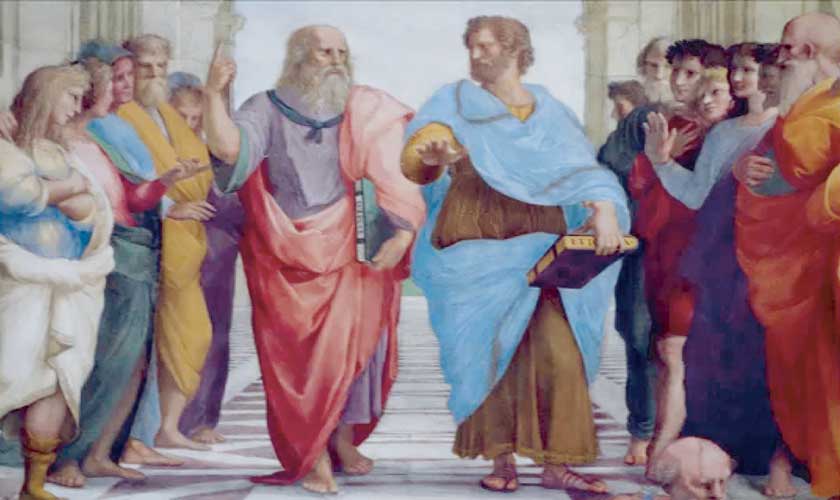
The famous painting “School of Athens” made in 16th Century is a visualisation of the Platonic Academy by the Renaissance maestro Raphael. While almost all ancient Greek philosophers are present in the fresco, the two figures of an old Plato and a younger Aristotle facing each other in the middle of the painting are the prominent ones, with Plato pointing upwards (signalling towards prominence of the heavens in his philosophy) and Aristotle gesturing towards the ground (implying the importance of the material world in his teachings).
The words Academy and Lyceum have come a long way since then. However, even today whenever they are spoken, two of the foremost institutes of learning in the West are remembered, which were founded by two of the most fertile minds humankind has ever produced: Plato (the first holistic philosopher) and Aristotle (al muallim ul awwal - The First Teacher - as the medieval Arab scholars called him).