Pakistan contributes one per cent of the global carbon footprint yet bears the greatest consequences of climate change. The country has been ranked as the fifth most climate-vulnerable nation by the Global Climate Risk Index, having lost close to 10,000 lives and suffered economic losses of $3.8 billion between 1999 and 2024.
RENEWABLE ENERGY
Pakistan contributes one per cent of the global carbon footprint yet bears the greatest consequences of climate change. The country has been ranked as the fifth most climate-vulnerable nation by the Global Climate Risk Index, having lost close to 10,000 lives and suffered economic losses of $3.8 billion between 1999 and 2024.
The devastating floods in August 2022 affected approximately 33 million residents, resulting in more than $15 billion worth of damage. Global warming and the effects of climate change have increased the frequency and severity of floods, which have been reported to exceed the average level or extent of previous floods, affecting entire neighbourhoods and leaving them submerged in water.
The impacts of climate change on Pakistan include changing seasonal weather patterns, increasing temperatures, inconsistencies in monsoons, melting glaciers in the north and natural calamities, among others. Since 2024, Pakistan has been experiencing extremely hot weather, with temperatures exceeding 49C in some areas. This has led to numerous health disasters and increased food insecurity, as crops are damaged. Water shortages have worsened as the country experiences an ongoing heatwave, which has also put a strain on its electrical grid, especially in urban locations such as Karachi, Multan, Faisalabad, Khuzdar, Lahore, Mardan, Quetta, Hyderabad and Peshawar.
By 2025, the thermal power sector continues to lead the pack with an installed capacity of around 55.7 per cent, whereas the combined electricity generation capacity of hydropower, nuclear and renewables amounts to around 53.7 per cent. The use of fossil fuels in such large quantities has also led to a significant increase in carbon emissions. In the 1990s, Pakistan generated electricity with approximately 5.5 million metric tons of CO2 emissions, whereas by 2025, the number had increased to around 52 million metric tons of CO2 emissions.
The advent of coal power plants has worsened carbon emissions. Not only does this change lead to an increase in carbon emissions, but it also causes the price of electricity to rise for consumers, making the cost of electricity one of the highest in South Asia. Pakistan is experiencing high levels of energy shortages due to its increasing population, which leads to higher energy needs during certain seasons, combined with increased air conditioning demands. Its energy infrastructure has been very weak, with rolling blackouts in January 2023.
Carbon emissions and power blackouts in Pakistan's energy sector exacerbate the effects of climate change, which in turn pose a threat to energy security. Higher temperatures and extreme weather events have led to increased and intensified climate disasters in Pakistan, which may result in energy supply chain and infrastructure failures.
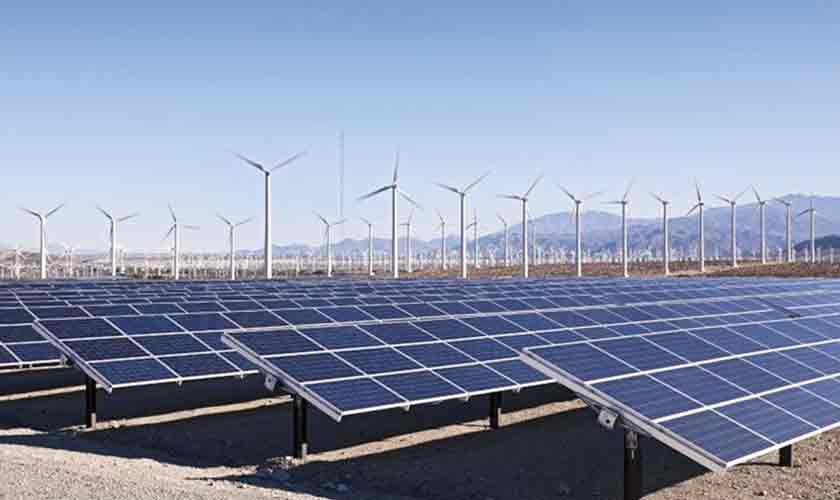
To mitigate future climate risks and achieve energy security, the government of Pakistan proposed the Alternative and Renewable Energy (ARE) policy in 2019, aiming to increase renewable energy capacity by 20 per cent by 2025 and 30 per cent by 2030
To mitigate future climate risks and achieve energy security, the government of Pakistan proposed the Alternative and Renewable Energy (ARE) policy in 2019, aiming to increase renewable energy capacity by 20 per cent by 2025 and 30 per cent by 2030. The government has also committed to banning coal imports. This transition is essential not only for reducing emissions but also for enhancing energy security and resilience against climate impacts.
In Pakistan, biomass, solar and wind potential exist in the majority; hence, these three renewable sources are being exploited to their full potential under the 30 per cent capacity of renewables target in the ARE policy for distributed generation development. Therefore, an energy plan encompassing the Low Emissions Analysis Platform (LEAP) is proposed in this article to assess future steps toward achieving a fully renewable energy system by 2050, which would support the equilibrium of energy supply and demand under the recently announced 2019 ARE policy.
The techno-economic and socio-economic parameters are taken into consideration on the basis of the main input parameters needed by the LEAP energy model in their forecasting of energy demand and production. LEAP energy demand and production module needed some crucial inputs of a region, which included population, gross domestic product of the country, rate of growth, transmission and distribution losses, historic pattern of energy consumption and also dealt with people in terms of sustainable and clean energy technology to utilise the power through domestic energy resources.
The domestic and industrial sectors will consume greater energy compared to the commercial and agricultural sectors. The ‘other sector’ category shows the energy consumption of street lighting or other public domain use of energy. The energy demand of Pakistan was 150.94 TWh in 2024, increasing to 241.42 TWh in 2030, 480.10 TWh in 2040, and 966.05 TWh in 2050.
Biomass, solar and wind energy sources have a greater share, while coal, natural gas, oil, nuclear, Liquefied Petroleum Gas (LPG) and hydro have a minimal percentage share in the total energy mix. The development of hydropower is not promoted due to the enormous capital investment costs, while imported and indigenous fossil fuels are banned in Pakistan. The total energy production was 211.53 TWh in 2024, increasing to 283.69 TWh in 2030, 564.16 TWh in 2040 and 1,135.20 TWh in 2050.
The modelling outcome prepared by the LEAP software, integrated with the ARE policy, suggested that renewable energy capacity (biomass, wind, and solar) would contribute 30 per cent to the total energy mix by 2030. If this trend continues until the year 2050, 378.80 TWh of biomass energy will be produced followed by 368.56 TWh of wind energy, 356.70 TWh of solar energy, and 13.82 TWh of hydropower, 8.83 TWh of coal energy, 6.45 TWh of LPG energy, 1.94 TWh of nuclear energy,0.88 TWh of natural gas energy, and 0.02 TWh of oil energy respectively.
The mix of renewable sources in the overall energy is 1117.08 TWh, whereas non-renewable sources will supply 18.12 TWh up to 2050. There is a projected generation of 8.85 million metric tons of carbon emissions and an investment cost of $1,482.46 billion needed to achieve the growth of additional biomass, solar, and wind energy until 2050. It is also inferred that the green energy generation is 1,135.20 TWh, which can be sufficient to satisfy the country's energy requirement of 966.05 TWh until the year 2050.
The writer is an assistant professor of electrical engineering at Mehran University of Engineering and Technology, Pakistan.