
James Webb telescope sets off on million-mile voyage
Webb intends to show humans what the Universe looked like even closer to its birth nearly 14 billion years ago
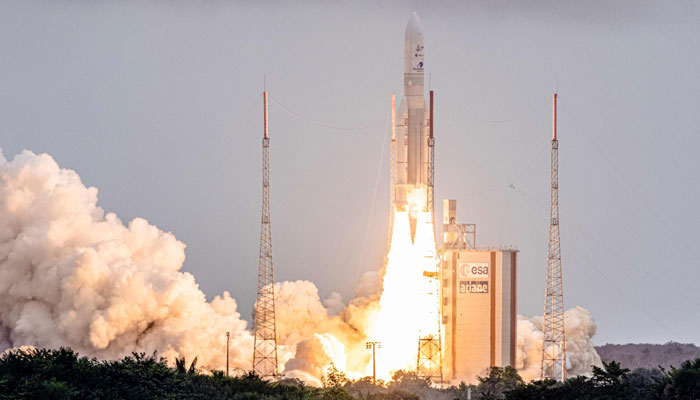
KOUROU: The world's most powerful space telescope on Saturday blasted off into orbit, headed to an outpost 1.5 million kilometres (930,000 miles) from Earth, after several delays caused by technical hitches.
The James Webb Space Telescope, some three decades and billions of dollars in the making, left Earth enclosed in its Ariane 5 rocket from Kourou Space Centre in French Guiana.
It is expected to take a month to reach its remote destination.
It is expected to beam back new clues that will help scientists understand more about the origins of the Universe and Earth-like planets beyond our solar system.
Named after a former NASA director, Webb follows in the footsteps of the legendary Hubble — but intends to show humans what the Universe looked like even closer to its birth nearly 14 billion years ago.
Speaking on social media, Webb project co-founder John Mather described the telescope's unprecedented sensitivity.
"#JWST can see the heat signature of a bumblebee at the distance of the Moon," he said.
All that power is needed to detect the weak glow emitted billions of years ago by the very first galaxies to exist and the first stars being formed.
'Exceptional measures'
The telescope is unequalled in size and complexity.
Its mirror measures 6.5 metres (21 feet) in diameter — three times the size of the Hubble's mirror — and is made of 18 hexagonal sections.
It is so large that it had to be folded to fit into the rocket.
That manoeuvre was laser-guided with NASA imposing strict isolation measures to limit any contact with the telescope's mirrors from particles or even human breath.
Once the rockets have carried Webb 120 kilometres, the protective nose of the craft, called a "fairing", is shed to lighten the load.
To protect the delicate instrument from changes in pressure at that stage, rocket-builder Arianespace installed a custom decompression system.
"Exceptional measures for an exceptional client," said a European Space Agency official in Kourou on Thursday.
The crew on the ground will know whether the first stage of the flight was successful about 27 minutes after launch.
Once it reaches its station, the challenge will be to fully deploy the mirror and a tennis-court-sized sun shield.
That intimidatingly complex process will take two weeks and must be flawless if Webb is to function correctly.
Its orbit will be much farther than Hubble, which has been 600 kilometres above the Earth since 1990.
The location of Webb's orbit is called the Lagrange 2 point and was chosen in part because it will keep the Earth, the Sun and the Moon all on the same side of its sun shield.
Webb is expected to officially enter service in June.





-
 Gas prices surge across UK, Europe after strikes on energy facilities in Qatar and Iran
 -
 Cesar Chavez’s legacy faces intense scrutiny following abuse allegations and misconduct
 -
 Trump issues stern warning to Iran following strikes on Qatari energy facilities
 -
 Aurora borealis: geomagnetic storm could bring northern lights to Vancouver this week
 -
 Lakeshore West fatality: police say boy went around barrier before deadly collision with GO train
 -
 Joseph Duggar arrested and charged in Florida case tied to alleged child abuse
 -
 Pierre Poilievre appears on Joe Rogan podcast amid push for tariff-free trade
 -
 Iran attack escalates with strikes on Saudi Arabia and Qatar after gas field hit in Persian Gulf