Russia says space station leak could be deliberate sabotage
MOSCOW: Russia launched checks Tuesday after its space chief said an air leak on the International Space Station last week could have been caused by deliberate sabotage.
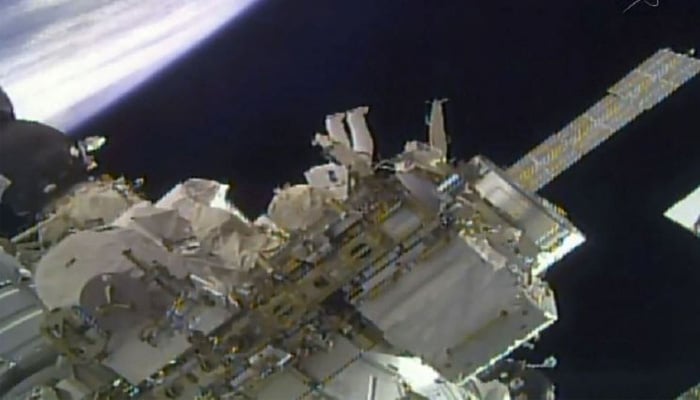
MOSCOW: Russia launched checks Tuesday after its space chief said an air leak on the International Space Station last week could have been caused by deliberate sabotage.
Space agency chief Dmitry Rogozin said the hole detected Thursday in a Russian space craft docked at the orbiting station was caused by a drill and could have been done deliberately, either back on Earth or in space.
Astronauts used tape to seal the leak after it caused a small loss of pressure that was not life-threatening.
"There were several attempts at drilling," Rogozin said late Monday in televised comments.
He added that the drill appeared to have been held by a "wavering hand."
"What is this: a production defect or some premeditated actions?" he asked.
"We are checking the Earth version. But there is another version that we do not rule out: deliberate interference in space."
A commission will seek to identify the culprit by name, Rogozin said, calling this a "matter of honour" for Russia´s Energiya space manufacturing company that made the Soyuz.
Previously Rogozin had said the hole in the side of the Soyuz ship used to ferry astronauts was most likely caused from outside by a tiny meteorite.
"We have already ruled out the meteorite version," Rogozin said late Monday.
The hole is in a section of the Soyuz ship that will not be used to carry astronauts back to Earth.
Energiya will check all its Soyuz and Progress cargo craft for possible defects, both at its production site outside Moscow and those awaiting launch at Baikonur cosmodrome in Kazakhstan, RIA Novosti state news agency reported Tuesday, citing a source in the space industry.
The ISS is one of the few areas of Russia-US cooperation that remains unaffected by the slump in relations between the countries and Washington´s sanctions.
Currently on the ISS are two cosmonauts from Russia and three NASA astronauts as well as one German astronaut from the European Space Agency


-
 Mysterious ‘phoenix planet’ found around the remains of a dying star
 -
 First possible evidence of Planet Nine found in infrared data
 -
 Elon Musk announces SpaceXAI rebrand to SpaceXSI following presidential order on 'Super Intelligence'
 -
 ISS Command changes hands in emotional ceremony
 -
 Moon water acts nothing like it does on Earth, study finds
 -
 Hawaii’s Hōlei sea arch collapses after centuries on Big Island: What happened
 -
 Solar system may have a much shorter lifespan than we thought
 -
 Singapore builds world’s ultra-precise clock outperforming US, China