Wildfires are polluting our environment more than we thought: Find out how
A new study shows wildfire pollution rivals human-made emissions, contributing 21% more than previously, which can have lasting and serious impacts on air quality and health
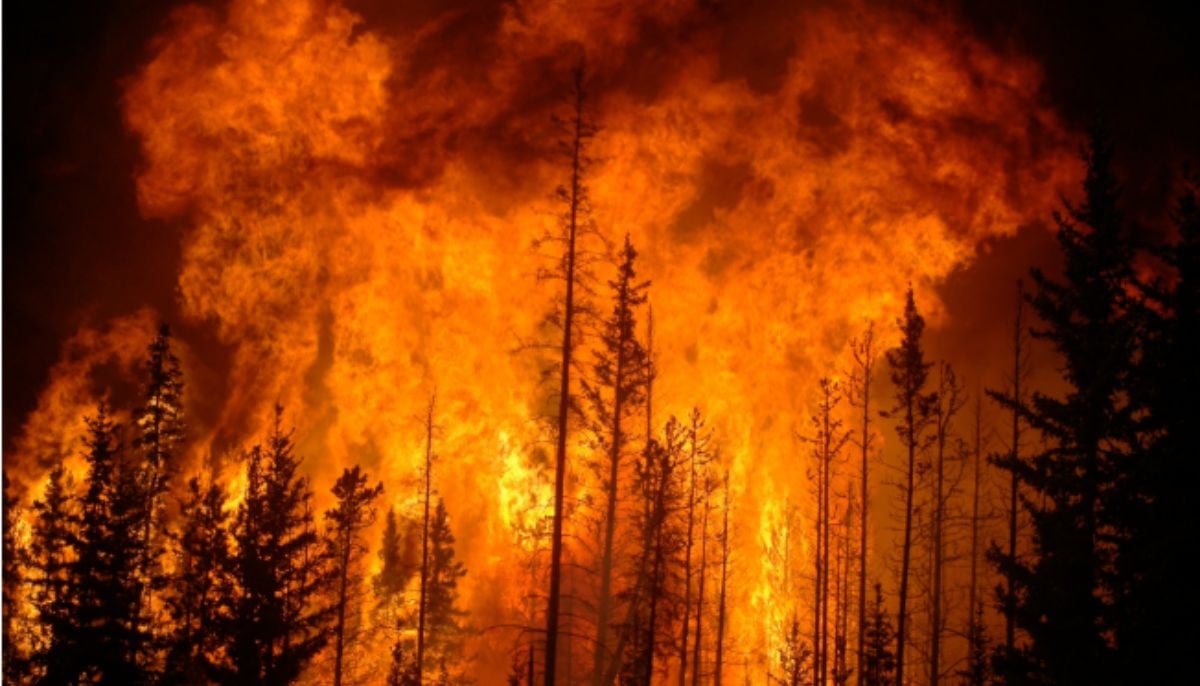
We always assume that industrial waste or harsh chemicals are polluting our environment but situation here is quite different then what we perceive.
As scientists informed that other factors can also contribute to poor air quality or unhealthy pollution in our environment such as wildfires.
A study found that wildfires around the world likely emit much higher levels of gases that contribute to air pollution than earlier estimates suggested and the findings revealed that smoke from fires can have lasting and serious impacts on air quality and health.
Scientists discovered that many of these hidden emissions can transform into fine particles that are dangerous to breathe.
How are wildfires polluting our environment?
Environmental experts' informed that Wildfires move across forests, grasslands, and peatlands, they release large amounts of gases and particles into the air.
The research highlights several regions where emissions from fires overlap with pollution from human activities, creating especially difficult air quality challenges.
"Our new estimates increase the organic compound emissions from wildland fires by about 21%," says Lyuyin Huang, the first author of the study.
"The inventory provides a foundation for more detailed air-quality modeling, health-risk assessment, and climate-related policy analysis."
_updates.jpg)
Each year, wildfires burn through vast areas of vegetation, sending a complex mixture of water vapor, ash, and carbon-based chemicals into the atmosphere.
Some of these chemicals are volatile organic compounds (VOCs), which readily exist as gases.
While others only evaporate and become gases at warmer temperatures and are classified as intermediate IVOCs and semi-volatile organic compounds SVOCs.
Once in the air, these partially volatile compounds more easily form fine particles that can be harmful if breathed in, compared with VOCs.
Team first examined a global database tracking burned land from forest, grass, and peatland wildland fires between 1997 and 2023.
They then gathered information on the VOCs, IVOCs, SVOCs, and other extremely low volatility organic compounds released as different types of vegetation burn.
The researchers estimated that wildland fires released an average of 143 million tons of airborne organic compounds each year during the study period.
The results concluded that the figure is about 21% higher than previous estimates.
According to the researchers, air pollution in the regions or shared emission hotspots, including Equatorial Asia, Northern Hemisphere Africa, and Southeast Asia is especially complex and will require different strategies to reduce emissions from both wildfires and human activities.
The study "Global Wildland Fire Emissions of Full-Volatility Organic Compounds from 1997 to 2023" was first published in the journal Environmental Science & Technology and the new research materials were provided by American Chemical Society.






-
 FCC approvals can transform Earth's night sky, experts warn
 -
 Double meteor shower peaks this week: Best time and tips to see celestial event
 -
 US-Russian space crew returns to Earth after eight-month mission on the International Space station
 -
 Viking 1 mars landing: 50 years since first photos
 -
 Four hidden dead stars found in Earth's backyard
 -
 What happened during SpaceX’s 13th Starship test? First upgraded Starlinks successfully deployed
 -
 Astronomers may have found the first moon beyond our solar system
 -
 Space datacenters could catastrophically pollute Earth, groups warn