How NASA’s DART mission successfully shifted an asteroid’s orbit for planetary defense
The new study notes that the crash didn't just transform the motion of Dimorphos around its larger companion; it also shifted the orbit of both asteroids around the Sun
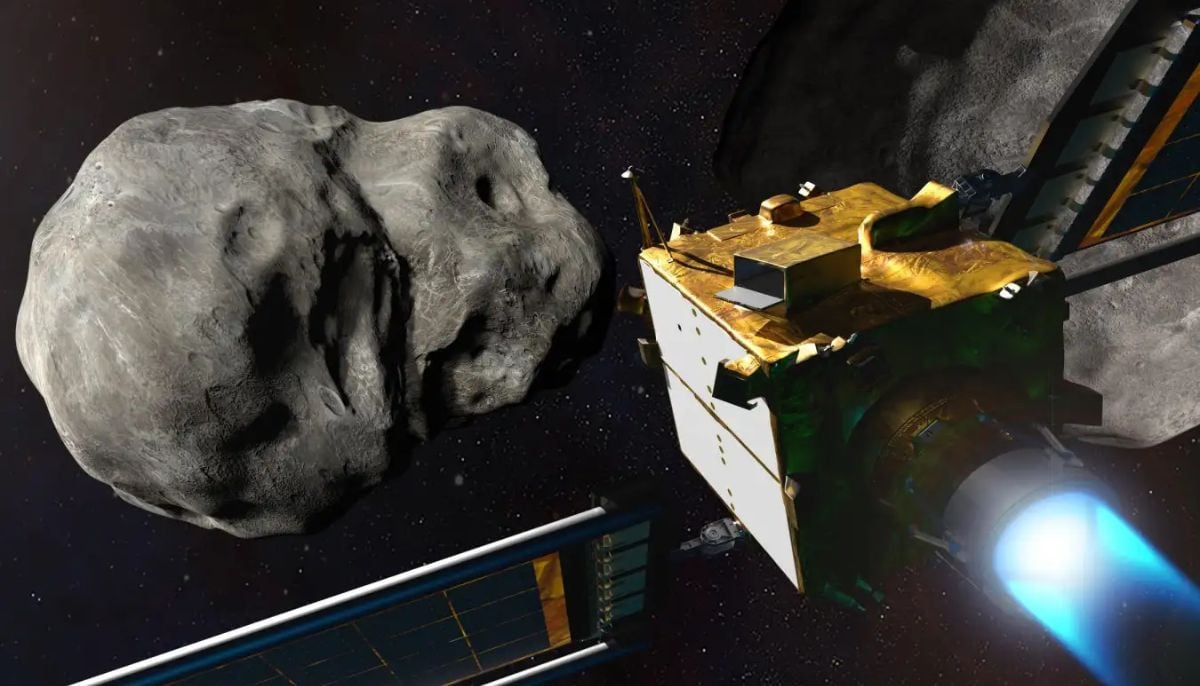
A surprising discovery has been revealed by NASA's DART (Double Asteroid Redirection Test), which aimed to significantly impact the asteroid moonlet Dimorphos. The mission did more than just transform the motion of Dimorphos around its larger companion; the crash also shifted the orbit of both asteroids around the Sun. According to details published in the journal Science Advances, observations of the pair’s motion revealed that the 770-day orbital period around the Sun changed by a fraction after the profound impact.
Analyzing the impact: NASA’s DART strikes Dimorphos
The impact expelled a large amount of debris into space, altering the shape of the asteroid, which measures 560 feet wide. The debris carried its own momentum away from the asteroid, giving Dimorphous an explosive thrust. This phenomenon gives scientists a clue calling the momentum enhancement factor. The new research suggests that the momentum enhancement factor for DART’s impact was about two, underscoring that the ejected debris loss doubled the punch created by the spacecraft.
In this connection, the study’s lead author at the University of Illinois Urbana-Compaign said: “The change in the binary system’s orbital speed was about 11.7 per second, or 1.7 inches per hour.”
This intriguing study of the changes in Didymos’ motion also helped the researchers to calculate the internal density structure of both asteroids. Dimorphos is slightly denser than previously estimated, supporting the theory that it formed from rocky debris shed by a rapidly spinning Didymos.
The DART spacecraft was designed and operated by the Johns Hopkins Applied Physics Laboratory (APL) in Laurel, Maryland on behalf of NASA’s Planetary Defence Coordination Office which oversees the agency's efforts in planetary defense. Furthermore, this groundbreaking discovery stems from humanity’s first mission to internationally move a celestial object, offering a unique perspective for the scientific community and the public alike.


-
 SpaceX IPO buzz intensifies as strategists debate $2 trillion valuation
 -
 New study suggests rapid weight loss may be more effective than gradual dieting
 -
 South Korea’s Bae Kyung-hoon calls for public share in ‘AI wealth’ amid Samsung labor dispute
 -
 Space X’s Starship vision could enable 10,000 launches a year, says Elon Musk
-
 China sends artificial embryos into space—Could humans reproduce in zero gravity?
 -
SpaceX IPO buzz intensifies as strategists debate $2 trillion valuation
-
 China to launch Shenzhou 23 crew to Tiangong space station
 -
 Antarctic blizzard sends fuel containers floating on an iceberg: Here’s why
 -
 SpaceX Starship test flight succeeds despite engine failures
 -
 Is this Earth 2.0? NASA’s James Webb telescope spots ‘rare’ giant exoplanet
 -
 SpaceX Starship launch delayed again: Here’s what went wrong
 -
 Why do scientists think Neptune’s moon Nereid survived violent cosmic collision?