Your AI shopping assistant may be quoting prices stores never posted
With record online spending forecast and AI-driven shopping surging, new research suggests chatbots fill pricing gaps with confident answers

Ask a chatbot what something costs, and it will almost always give you a number. That's the problem.
The habit is about to go mainstream. Adobe says AI-assisted traffic to US retail sites will rise 130% from a year ago this holiday season. It expects US shoppers to spend a record $275.1 billion online in November and December, up 6.7%.
October alone is expected to be $95.8 billion, marking an increase of 8% with deals from Cyber Week giving shoppers up to 30% discounts on the listed price.
Consumers tend to trust the advice. According to the Adobe survey of 5,000 customers, 77% of consumers who used AI for online shopping felt more confident about their purchase.
A recent study by Product.ai concluded that 86% of AI shopping queries created an identical factual dispute in ChatGPT, Claude, Gemini, and Perplexity. Of 913 verifiable price answers, just 85% answered correctly with the present listed price. If the answer was incorrect, the median error was $300.
The ‘invisible price tag’ problem
Similarly, a recent study suggests part of the cause sits on the retailer’s side of the screen. BeSeenByAI, a firm that tracks how brands appear in AI answers, audited 1,101 pricing pages for its “Invisible Price Tag” research. About one in three, 32.8%, showed no visible price to an automated reader.
Roughly four in ten of those were deliberate, with pricing reserved for a sales call or varying by usage or seats. About six in ten were accidental. In most of those cases the page simply didn’t contain a usable price. In a smaller share, about 13% in the study’s breakdown, the price loaded through JavaScript that a basic page fetch never runs.
The researchers took 136 websites where no price appeared anywhere and asked ChatGPT, Claude and Perplexity the same question, “How much does {Brand} cost?”, with web search on. About 78.5% of responses still stated a price. On a separate control sample of 50 pages that did show a price, 96.7% did.
Where the answers could be compared, about two in five sites (39.2%) got different price numbers from different assistants. The researchers hand-checked all 38 flagged cases.
Ten were a wrong number for the right company. Six were about a completely different business with the same name. Seventeen compared different plans or billing periods. Four were effectively identical figures, and one was the researchers’ own data error.
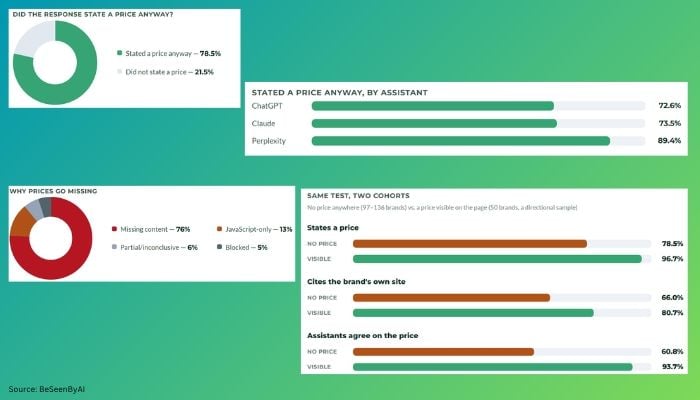
The official website often wasn’t the source. Across the 136 sites, about one in three answers (34%) didn’t cite the brand’s own domain. Review and comparison sites such as G2, Capterra and TrustRadius made up roughly a quarter of outside citations. Where the price was clearly visible, the assistants disagreed about six times less often.
The AI test covered 136 websites, with a 50-page control group, in a single run. BeSeenByAI also sells AI-visibility services, so treat its advice accordingly.
What to do before you click ‘buy’?
BeSeenByAI Co-Founder and CMO Ben Pines told the first step is simple.
"Before trusting the number, ask the chatbot where it came from. Then click through and check the price on the brand's own pricing page. If you can't find it there, don't trust it. LLMs can invent prices or take them from competitors," he said.
That's because, he explained, LLMs often pull prices from places other than the official pricing page:
- Outdated pages on the brand's own site
- Third-party sites
- Competitors
- Plain hallucinations
It also pays to check the plan, currency, billing period and region. That's where the study found many of the mismatches.
Who should fix it?
On asking whether brands or AI companies should fix the problem, Pines didn't hedge.
"Brands. AI companies are improving, but pulling from the wrong sources is part of how LLMs work. Brands can't wait for that to get fixed."
His advice to brands came in three steps:
- Know this is happening.
- Monitor it specifically. This is a technical problem, so prompt tracking is not enough. It shows you what the AI said, not why it said it.
- Fix the cause, for example by making sure AI crawlers can actually reach and read the pricing page.
Black Friday is about six weeks away, and the discount season hasn't properly started. If chatbots keep answering confidently while store pages stay silent, the price you're quoted may depend on which one you happen to ask.


-
 Inside Gemini 4 Argon: How Google's 1M-token flagship model changes enterprise AI
 -
 Google Photos tests shared camera for group events upgrade
 -
 FBI arrests OpenAI engineer accused of planting hidden recording device in office
 -
 Google’s flagship AI model Gemini 4 Argon is here: What developers need to know
 -
 Apple unveils new HomePod mini 2 colors: What to know
 -
 Apple debuts HomeView smart display and next-gen home devices powered by conversational Siri AI
 -
 Apple launches HomeView: Here’s what the $299 Siri AI smart home hub can do
 -
 Meta challenges UK online safety watchdog: Here’s why
-
 Character.AI files for bankruptcy, agrees to $20M disney asset sale
 -
Scott Kupor reveals how the ‘Super Intelligence’ task force will push AI safety
-
Geoffrey Hinton, Yoshua Bengio join 400 scientists calling for global AI oversight body
-
Can AI predict people's thoughts? Palantir CEO Alex Karp weighs in