Small asteroid to create fireball over ocean near Australia today: What to know
An asteroid has been discovered before it’ll hit Earth, entering the atmosphere just northwest of Australia

A newly discovered small asteroid is reportedly expected to enter Earth’s atmosphere near northwest Australia today.
The Mount Lemmon Observatory has spotted a new asteroid approximately 1 meter across, heading towards Earth. The intercept is expected near the upper atmosphere of northwest Australia; the skies should be dark so people in the area focus on a wider, illuminating light rather than a sharp spark.
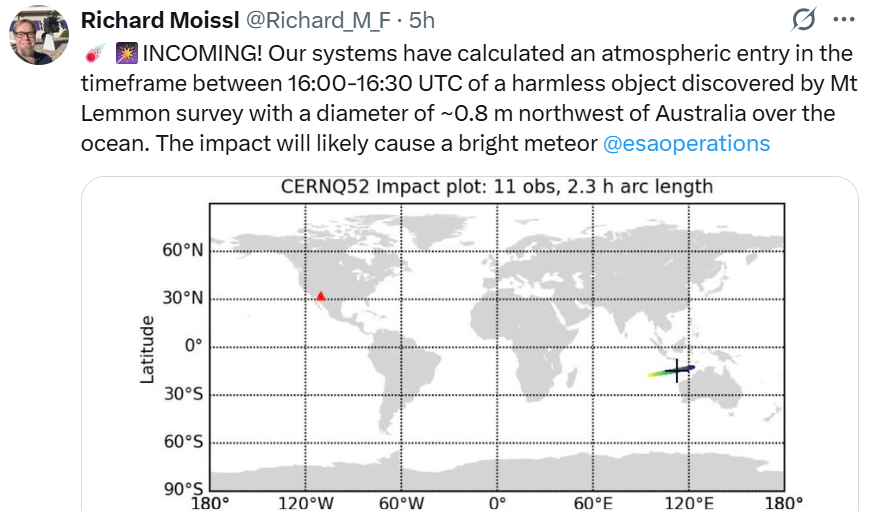
In this connection, Richard Moissl wrote on social media: “ Our systems have calculated an atmospheric entry in the timeframe between 16:00-16:30 UTC of a harmless object discovered by Mt Lemmon survey with a diameter of ~0.8 m northwest of Australia over the ocean. The impact will likely cause a bright meteor.”
A small asteroid's imminent impact will occur in the next few hours near northwest Australia. According to recent updates, the meteor should ablate in Earth’s atmosphere and pose no danger.
Nonetheless, while not a hazard, scenarios like this during the project were an invaluable test of our planetary defense capabilities to monitor for larger objects and predict significant impact threats.


-
 Elon Musk’s Mars colonization dream faces reality check from Nobel laureate
 -
 NASA competition model 2.0 cuts mission selection by 45%
 -
 A ‘neglected’ neutrino may hold the key to why the Universe exists
 -
 Can cancer drugs be made in space? Here’s what the new mission aims to find out
 -
 SpaceX Falcon 9 successfully launches Bandwagon-5 mission with 32 payloads
 -
 Europe launched 8 orbital rockets last year, can it rival Starlink?
 -
 Japan launches world’s first mission to bring sample back from phobos
 -
 Orionid meteor shower 2026: Peak date, viewing tips and what to expect