Samsung sees chip shortage lasting until 2028
Samsung expects chip shortages to worsen through 2028 after record chip profit offset its first-ever mobile division loss
Samsung Electronics said Thursday it expects memory chip shortages to worsen and stretch into 2028, countering investor fears that heavy AI spending by major tech firms could soon slow. Shares surged as much as 8% in Seoul before paring gains to close 1.1% lower.
"The supply shortage in 2027 is expected to worsen compared to this year, and it is expected to continue in 2028," said Jaejune Kim, executive vice president of Samsung's memory business, on a call with analysts.
It has reportedly entered into long-term supply deals with the top five data centre companies in the world and is close to signing similar contracts with five more unnamed parties.
The terms of those supply contracts include deals that will last for at least five years, take 60% to 70% of Samsung’s total capacity, involve upfront payments, and have a floor price to protect investments.
In an interesting contrast with how investors have been talking about semiconductors lately, analyst Ryu Young-ho of NH Investment & Securities described management’s remarks as "one of the more reassuring calls we've heard in quite some time".
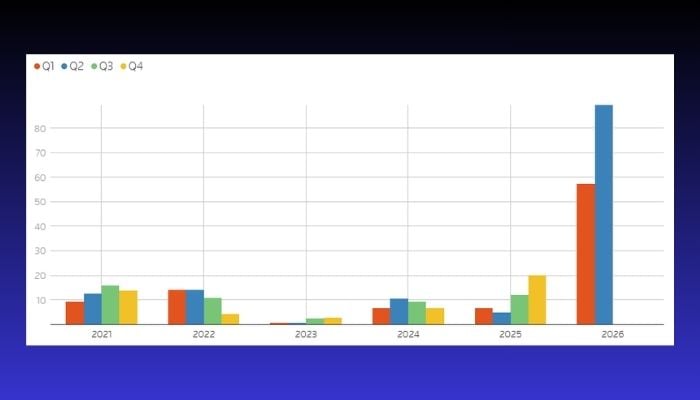
For the second quarter of 2023, Samsung's Semiconductor Division reported operating income of 89.2 trillion won ($61.7 billion).
That windfall came at a cost elsewhere: the mobile division posted a 700 billion won loss, its first quarterly loss on record, as rising chip costs squeezed margins.
"The chips enriching one side of Samsung are now hurting the other, leaving the group more exposed than ever to memory pricing and the durability of hyperscaler demand," said Josh Gilbert, an analyst at eToro.
As a result of being able to secure customers like Nvidia and AMD for their HBM memory, Samsung sees a more than tripling of revenues from HBM4 in Q3 and a narrowing of the gap between the company’s HBM share and its DRAM share of the market in the second half of the year.
The foundry division of Samsung was expected to recover soon, as the utilisation rate of the company’s fabs and their wafer prices have increased, with Samsung stating that its plant in Taylor, Texas, would start operating this year with a second fab aiming at producing wafers in 2030.
Samsung CFO Park Soon-cheol stated that the company does not see the need to conduct an IPO in the US after SK Hynix’s ADR listing due to its steady cash flow.
With Nvidia and AMD among its HBM customers, Samsung expects HBM4 revenue to more than triple in the third quarter, bringing its HBM share closer to its overall DRAM market share in the second half.
Samsung also said its foundry business, which competes with TSMC and Intel, should turn around "in the near future" as factory utilisation and chip prices rise, and confirmed its Taylor, Texas plant will begin operations this year, with a second fab targeting 2030 production.
CFO Park Soon-cheol said Samsung has no plans to pursue a US listing following SK Hynix's recent ADR debut, citing stable cash generation across its business.


-
 Google Cloud introduces Gemini agent for work
 -
 Amazon launches premium Alexa tablets to challenge iPad: What to know
 -
 Italy, EU launch probe into Microsoft-owned gaming companies
 -
 Andrew Garfield says playing Sam Altman left him scared of AI
 -
 TikTok strengthens AI transparency & safety efforts to help navigate AI-generated content
 -
 ASOS data breach: What hackers accessed from customer accounts revealed
 -
 Nestlé CEO says AI skills go far beyond writing good prompts
 -
 WhatsApp Status double speed is finally coming to Android