China takes major step toward reusable rockets with sea-based booster recovery test
Recent test marked China's first-ever successful retrieval of an orbital-class rocket after US
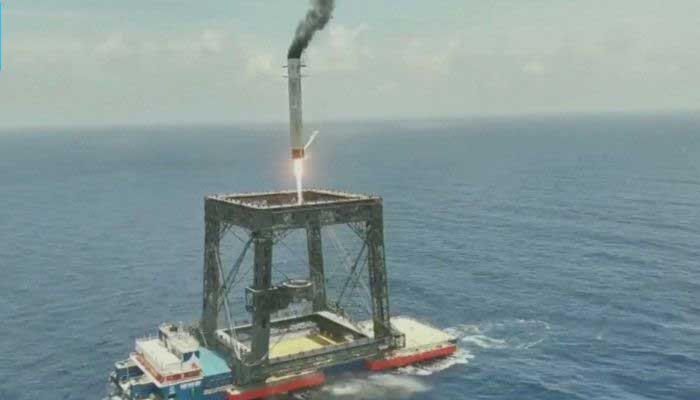
China has tested an experimental rocket retrieval system and successfully landed a reusable booster at sea, aiming to challenge the US dominance in reusable rockets.
According to the state media CCTV, the lift-off of the Long March 10B rocket took place at 12:15 p.m. (0415 GMT) on Friday from the Hainan commercial space launch site in southern China.
After 6 minutes of its separation from the booster, it returned vertically. The authorities successfully recovered the system on the offshore platform. This successful retrieval of an orbital class rocket is highly significant for China, pushing the country one step closer to developing reusable rockets and breaking the dominance of the United States in this competitive landscape.
The test also has seen an effort to take an aim on SpaceX as the Long March 10B has been compared to SpaceX's Falcon 9 used for medium-lift rockets. Falcon 9 is designed to transport satellites and the Dragon spacecraft into Earth orbit and beyond. Long March 10B can carry at least 16 metric tons to low-Earth orbit.
Recognized as the world’s first orbital-class reusable rocket, it has ability to recover and refly the first-stage booster. Unlike Falcon 9, Long March 10B does not achieve landing on ground pad through deployable legs. In fact, in the recent test, the landing took place through “landing hooks to catch the net attached to the sea platform.”
China has been striving over a decade to develop reusable rocket technologies, marked by “early low-altitude hover tests to orbital-class booster recovery attempts.”
Such technologies will reduce launch costs for China. Moreover, the recent test is also a part of China’s growing lunar ambition as the country to reach the moon by 2032.
Last year, China also suffered setbacks as private Chinese firm LandSpace and state-owned China Aerospace Science and Technology Corporation failed to complete the crucial final step of landing and booster recovery.


-
 China’s bold Mars plan: Map entire Red Planet by 2028
 -
 Swiss drought reveals Roman secrets that could redraw ancient maps
 -
 SpaceX’s Starship engine failure raises questions over NASA’s moon mission
 -
 SpaceX Starship Flight 14 reaches orbit after successful insertion burn
 -
 Asteroid Bennu: NASA samples reveal how it was born from fire and ice
 -
 Harvard scientists detect mysterious radio signal from planet outside our solar system
 -
 Scientists may have found a way to grow food on Mars
 -
 Why Earth’s 24-hour day isn’t quite as fixed as you think