Space babies: Can humans really reproduce beyond Earth?
The study also explores effects of microgravity on reproduction
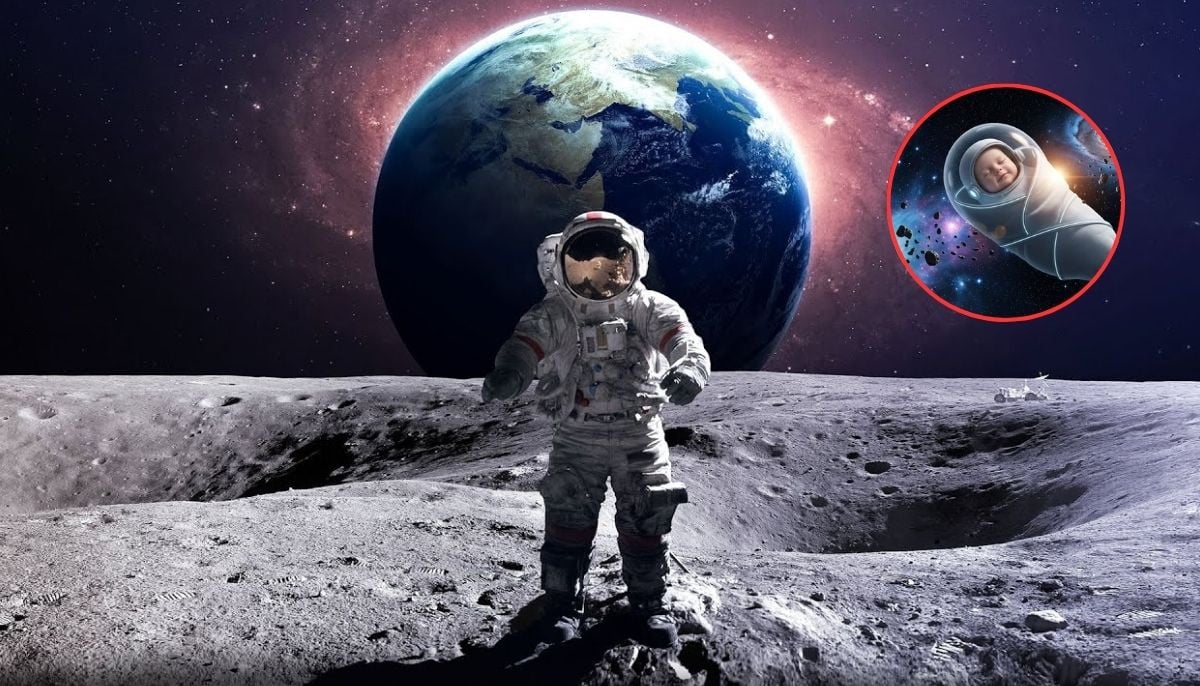
Space has always been a centre of attention among the scientific community. Even the tech moguls are racing to build AI-powered data centers in space.
Elon Musk has envisioned the expansion of human civilization beyond Earth by making them interplanetary species. For this to happen, one question holds a significant importance: Can humans conceive in space?
This is the big question the scientists are trying to answer. In a recent study, the researchers in Australia have explored this possibility.
By using a “plastic obstacle course” that mimics the female reproductive tract, scientists at Adelaide University tested human and mouse sperm in simulated space conditions to find out if sperm would struggle to “navigate” during sex in space.
Nicole McPherson, a researcher at Adelaide University, said, “Sperms need to actively find their way to an egg, and this study is the first to put that ability to the test under space-like conditions.”
According to study findings published in the journal Communications Biology, some resilient sperms were able to navigate the course, highlighting the possibility of conceiving children in space.
On the other hand, the sperm were 50 percent worse at navigating the simulated reproductive tract compared to Earth’s gravity.
The difficulty in navigating the course led to a roughly 30 percent drop in successful fertilization rates.
And the successful sperm which completed the course were of high-quality, capable of producing the highly-suitable embryos.
The recent study suggests that the stress of microgravity acted as a filter, allowing effectively only the most capable sperm in the running”, McPherson explained.
Key challenges
The study is not without challenges. The most critical challenge appears to be the first 24 hours after fertilization, where embryo development significantly declines in quality and quantity without Earth's gravity.
“The results reversed sharply, with fewer embryos formed, and those that did were of poorer quality,” she said.
Implications for space colonization
The study suggests that protecting embryos from weightlessness during the "critical first hours" will be essential for successful reproduction on the Moon or Mars.
While organizations like NASA and SpaceX (Elon Musk) aim for interplanetary life, experts emphasize that more research is needed to unravel the mystery of reproduction in space, adding “fertilisation was “one small piece of a very long and complex puzzle.”
Ms McPherson added, “We are still a long way from seeing the first space baby.”





-
 Scientists found 'super-puff' planets 1,110 light-years away
 -
 Scientists find ancient microbial life in places it shouldn't exist
 -
 Why Marijuana is suddenly sending thousands of dogs to hospitals in US?
 -
 36 years on, Hubble shows how stars actually change over time
 -
 Hidden magma beneath Mars? Scientists' 'unexpected' discovery raises new questions about alien life
 -
 Rare 3,200-year-old coral blue hole discovered in South China Sea
 -
 What happens at black hole’s event horizon? Scientists find the first-ever clue
 -
 Scientists discover evidence of fires used by humans 1.8 million years ago
-
 Did NASA just uncover evidence of ancient life on Mars? Key discoveries explained
 -
Four powerful earthquakes strike three continents within hours: Scientific link or coincidence?
-
Mysterious interstellar comet passing our solar system may be 12 billion years old, scientists say
-
When do we really become adults? Science has an answer