Astronomers spot nearly invisible galaxy packed with dark matter
Scientists say the faint object could offer a rare window into how dark matter behaves in isolation
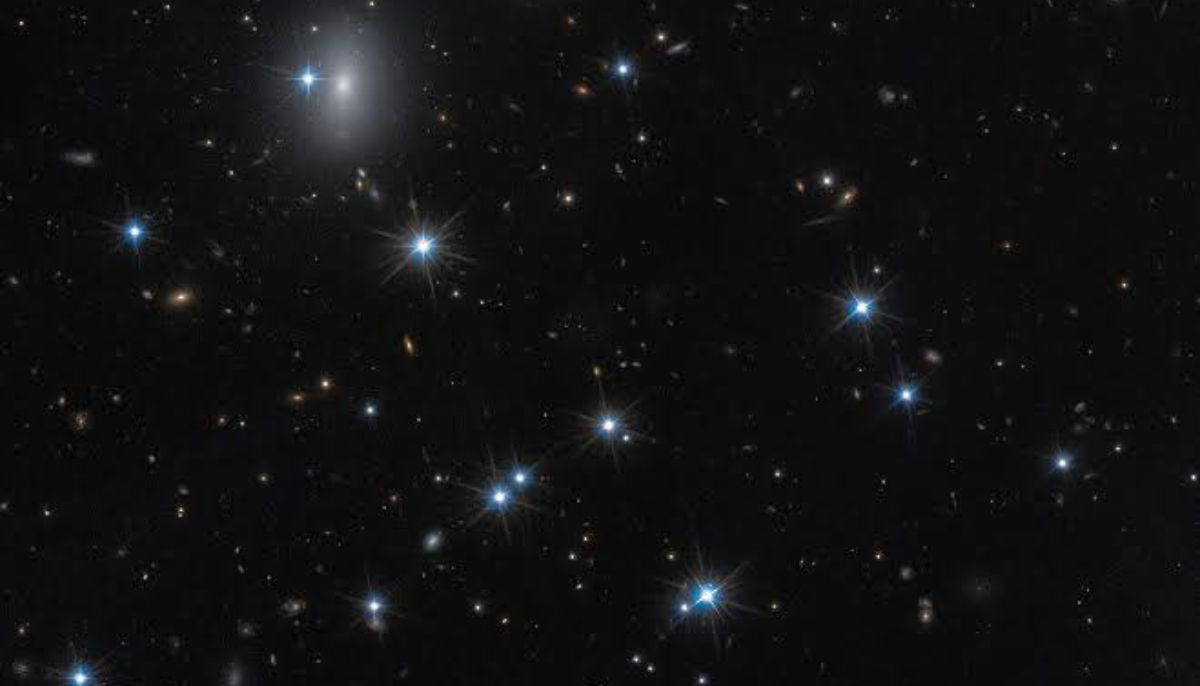
Astronomers discovered a dim, nearly undetectable galaxy which exists as a dark matter-dominated celestial body through their study of Hubble Space Telescope and other observatories' data. The object called Candidate Dark Galaxy-2 or CDG-2 exists at a distance of approximately 300 million light-years from Earth within the Perseus Cluster.
The researchers from the University of Toronto and other institutions published their findings in The Astrophysical Journal Letters. The researchers discovered the galaxy through their study of globular clusters and its gravitational effects, which provided new evidence about dark matter galaxies and cosmic evolution.
Scientists state that CDG-2 consists of 99.9% dark matter. Dark matter exists in an invisible state which people cannot see yet it creates gravitational forces that determine how galaxies and the universe get structured. The substance exists in quantities that exceed ordinary matter by a factor of five.
University of Toronto Postdoctoral Fellow Dayi Li classified the object as an "almost-dark galaxy." He said that CDG-2 exists at the highest level of low surface brightness galaxies because it does not show any visible stars. The Milky Way has a brightness level which exceeds his brightness level by 20000 times.
How did scientists find CDG-2?
Researchers used data from the Hubble Space Telescope, the European Space Agency’s Euclid observatory and the Subaru Telescope in Hawaii. The researchers used globular clusters, which form tight groups of ancient stars, as their search target instead of using hydrogen gas as their search target. The researchers located four clusters which appeared with a faint halo that indicated a hidden galaxy.
Scientists believe that larger galaxies took away the gas which CDG-2 needed to create new stars while leaving behind only its dark matter halo and a few clusters.


-
 Hunter’s Moon 2026: When and how to watch October’s full moon
 -
 Elon Musk’s Mars colonization dream faces reality check from Nobel laureate
 -
 NASA competition model 2.0 cuts mission selection by 45%
 -
 A ‘neglected’ neutrino may hold the key to why the Universe exists
 -
 Can cancer drugs be made in space? Here’s what the new mission aims to find out
 -
 SpaceX Falcon 9 successfully launches Bandwagon-5 mission with 32 payloads
 -
 Europe launched 8 orbital rockets last year, can it rival Starlink?
 -
 Japan launches world’s first mission to bring sample back from phobos