Scientists unveil new robotic mission for the moon
According to scientists, a trio of smart robots may be the key to unlocking hidden lava tunnels and future bases on the Moon and Mars
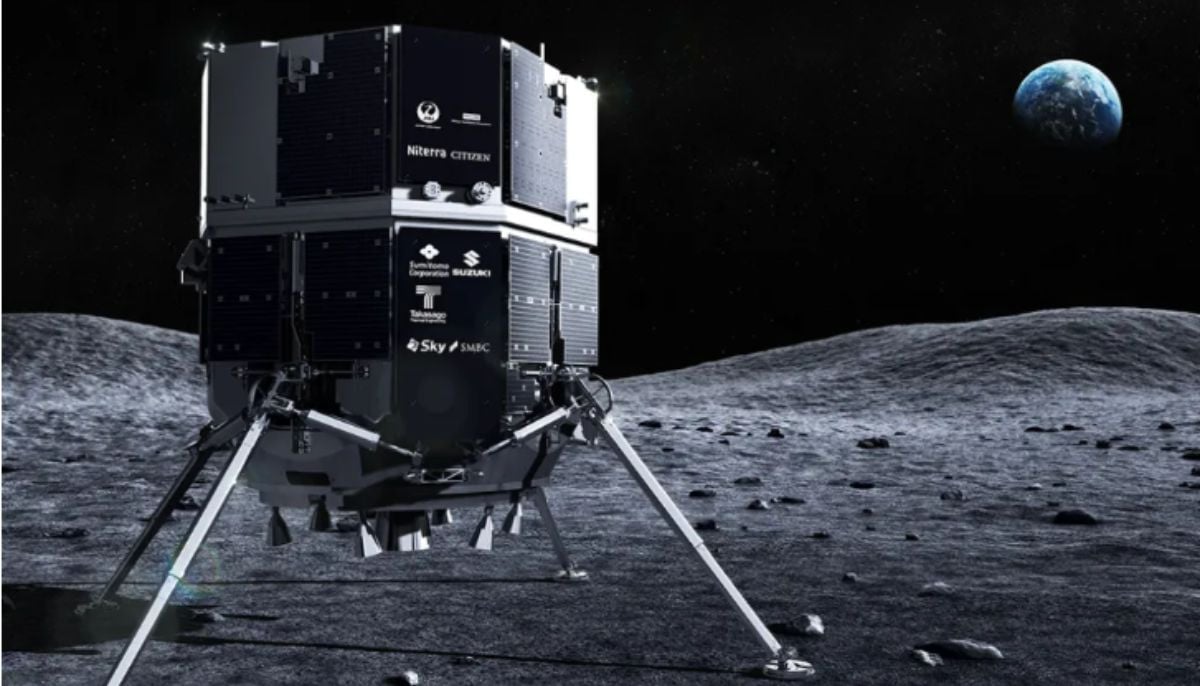
Robots and robotic technology have taken over the globe in recent years, and now they aim for new goals to excel in space missions.
In a latest update, a few European scientists have unveiled a 'new robotic mission' for the moon.The team of researchers believes that robot technology can ease future space missions.
Moreover, researchers from the Space Robotics Lab at the University of Malaga participate in this project, testing and validating three robots on the volcanic island of Lanzarote, Spain.
The team unveiled a bold new mission concept using different robots working together to explore these extreme underground environments autonomously.
According to scientists, a trio of smart robots may be the key to unlocking hidden lava tunnels and future bases on the Moon and Mars.
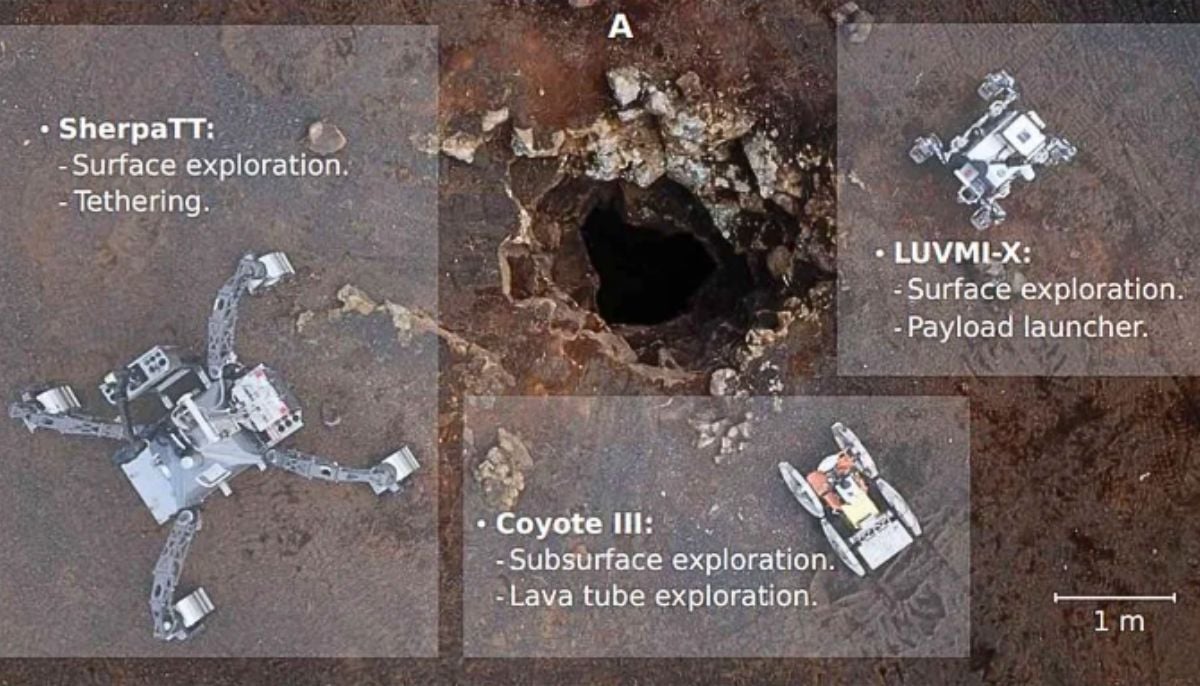
The recently tested system maps cave entrances, deploys sensors, lowers a scout rover, and creates detailed 3D maps of the interior.
They observed lava tunnels on nearby planetary bodies are increasingly seen as strong candidates for future base camps and informed that these underground structures can naturally shield astronauts from harmful radiation and frequent meteorite impacts.
Despite their promise, reaching and studying these environments is extremely challenging due to rough terrain, limited entry points, and dangerous conditions.
Researchers introduced a pattern of four phases of autonomous exploration
The proposed mission unfolds in four carefully planned stages.
•First, the robots cooperatively map the area around the lava tunnel entrance.
•Next, a sensorized payload cube is dropped into the cave to gather initial measurements.
•A scout rover then rappels down through the entrance to reach the interior.
•In the final stage, the robotic team explores the tunnel in depth and produces detailed 3D maps of its interior.
The trial highlighted the technical capabilities of the consortium led by the German Research Center for Artificial Intelligence DFKI, with contributions from the University of Malaga and the Spanish company GMV.
The results confirmed that the mission concept is technically feasible and demonstrated the broader potential of collaborative robotic systems.
The findings suggest that teams of autonomous robots could play a key role in future exploration missions to the Moon or Mars.
The new work was recently published in the journal Science Robotics.
While the study also supports continued development of advanced robotic technologies for planetary exploration.
Additionally, space scientists aim to explore more unique techniques to accelerate space missions with more accuracy in the future.


-
 Elon Musk’s Mars colonization dream faces reality check from Nobel laureate
 -
 NASA competition model 2.0 cuts mission selection by 45%
 -
 A ‘neglected’ neutrino may hold the key to why the Universe exists
 -
 Can cancer drugs be made in space? Here’s what the new mission aims to find out
 -
 SpaceX Falcon 9 successfully launches Bandwagon-5 mission with 32 payloads
 -
 Europe launched 8 orbital rockets last year, can it rival Starlink?
 -
 Japan launches world’s first mission to bring sample back from phobos
 -
 Orionid meteor shower 2026: Peak date, viewing tips and what to expect