M87 black hole’s jet origin finally mapped by astronomers
New observations finally link the famous black hole image to powerful jet seen stretching across its galaxy
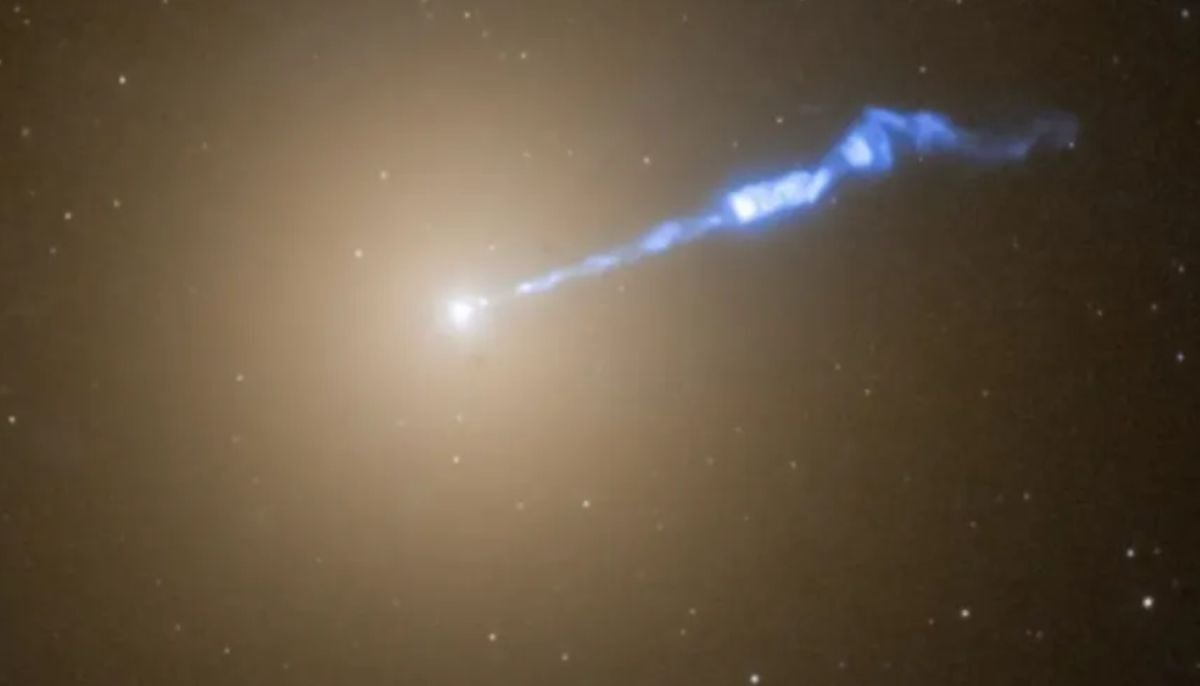
Astronomers have identified the origin of the enormous plasma jet emerging from the supermassive black hole at the heart of galaxy M87. Using updated data from the Event Horizon Telescope, scientists have now directly connected the black hole’s shadow to the base of a jet that stretches nearly 3,000 light-years into space.
M87 is 55 million light-years away from Earth and made history in 2019 as the first black hole to be photographed. Interestingly, the black hole weighs 6.5 billion suns.
For a long time, scientists were able to see the bright ring and the distant jet of the black hole, but the link between the two was unclear.
How scientists linked jet to black hole?
New research using Event Horizon Telescope data obtained in 2021 has filled in the gaps to complete the picture. The data set has also included data with mid-range baselines, enabling researchers to observe both the compact ring and the jet structure simultaneously.
Additional radio emission has also been detected, apart from what the ring structure formed by the black hole emits. The additional emission comes from a compact object located only 0.09 light-years from the black hole, on one end of the jet structure.
Lead Researcher Saurabh said that the identification of the jet's origin provides significant information regarding the flow of energy through vast distances within black holes. The images captured by the Hubble Space Telescope indicate that the jet of the M87 galaxy reaches up to 3,000 light-years from the centre of the galaxy.


-
 New study explains 364-day Qumran calendar puzzle
 -
 Why does time feel faster as you age? Science explains
 -
 Scientists name newly discovered snake after Guns N' Roses' Slash
 -
 SpaceX secures three new NASA crew flights: What to know
 -
 Sovereign AI fund in talks to back Political Sciences: What to know
 -
 What recent discovered Moon Crater Means for Future Astronauts
 -
 Scientists discover new wild cat species in Bolivia for the first time in a century
 -
 SpaceX turns to failed startups for AI training: Here’s why