NASA’s Hubble sparks viral buzz with bird-shaped illusion in deep space
Striking NASA Hubble image from 2008 is gaining fresh attention for revealing slow and dramatic meeting of two distant galaxies
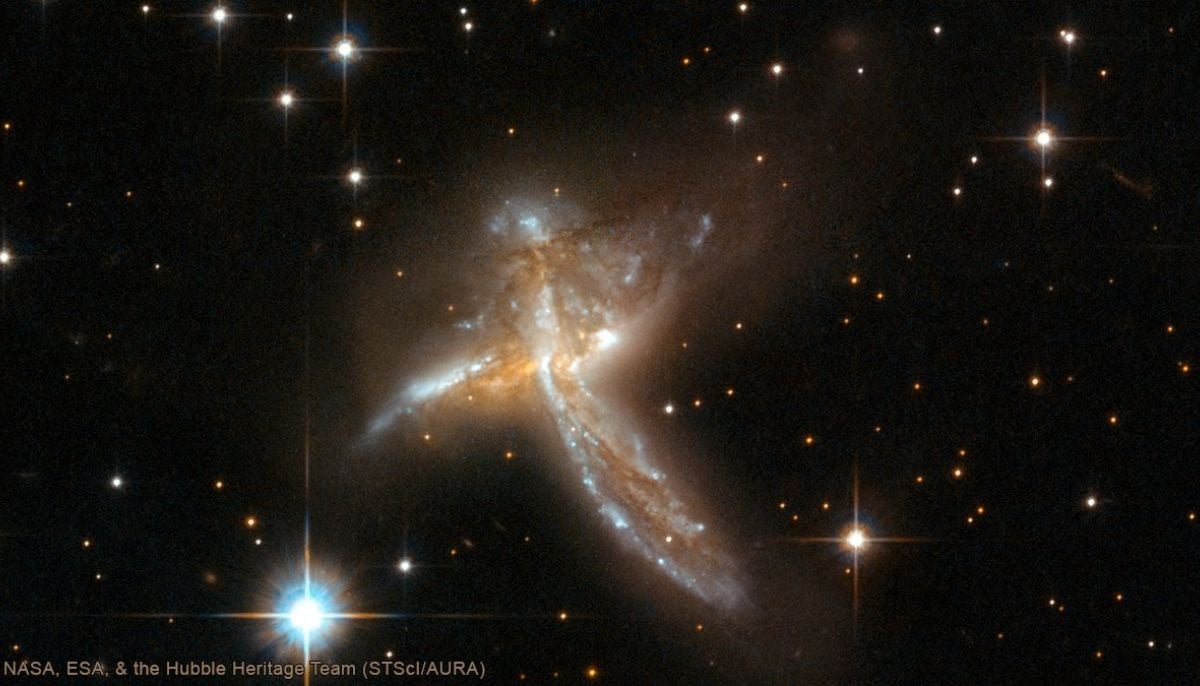
A very rare and beautiful occurrence of two galaxies has again made headlines with the re-emergence of a picture taken by the Hubble Space Telescope on the social media platform X. The picture, which was posted by NASA recently, was actually taken in 2008.
The position of these galaxies is located 650 million light years away and can be found in the constellation of Sagittarius. This phenomenon involves NASA, the Hubble Space Telescope, distant galaxies, deep space, and a slow process involving gravity, which is still taking place.
Viral bird illusion in space
The system is known by the name ESO 593-8 and is regarded as one of the most classic instances of a galaxy interaction that has ever been observed. Instead of a collision, the image captures a slow process of a galaxy encounter that is a result of gravity. One of the galaxies is feather-like as it passes through the other.
This form gives us the illusion that we are seeing a pair of wings floating in space. According to NASA, this phenomenon is taking place over millions of years, giving us a slow-motion effect.
According to astronomers, the peculiar form we see in ESO 593-8 results from a phenomenon known as tidal forces. These are forces that alter the form of galaxies when two galaxies are near each other. According to NASA, when two galaxies are near each other, it can lead to star formation. The two galaxies are eventually expected to merge into a single galaxy.
The Hubble Space Telescope has taken many pictures of space, but this picture stands out due to its clarity. Even after many years since it was taken, it continues to help us learn more about space.


-
 New study explains 364-day Qumran calendar puzzle
 -
 Why does time feel faster as you age? Science explains
 -
 Scientists name newly discovered snake after Guns N' Roses' Slash
 -
 SpaceX secures three new NASA crew flights: What to know
 -
 Sovereign AI fund in talks to back Political Sciences: What to know
 -
 What recent discovered Moon Crater Means for Future Astronauts
 -
 Scientists discover new wild cat species in Bolivia for the first time in a century
 -
 SpaceX turns to failed startups for AI training: Here’s why