Rare comic discovery: Hidden star found in unexpected dust zone
Kappa Tucanae A is located 70 light-years away from the Earth
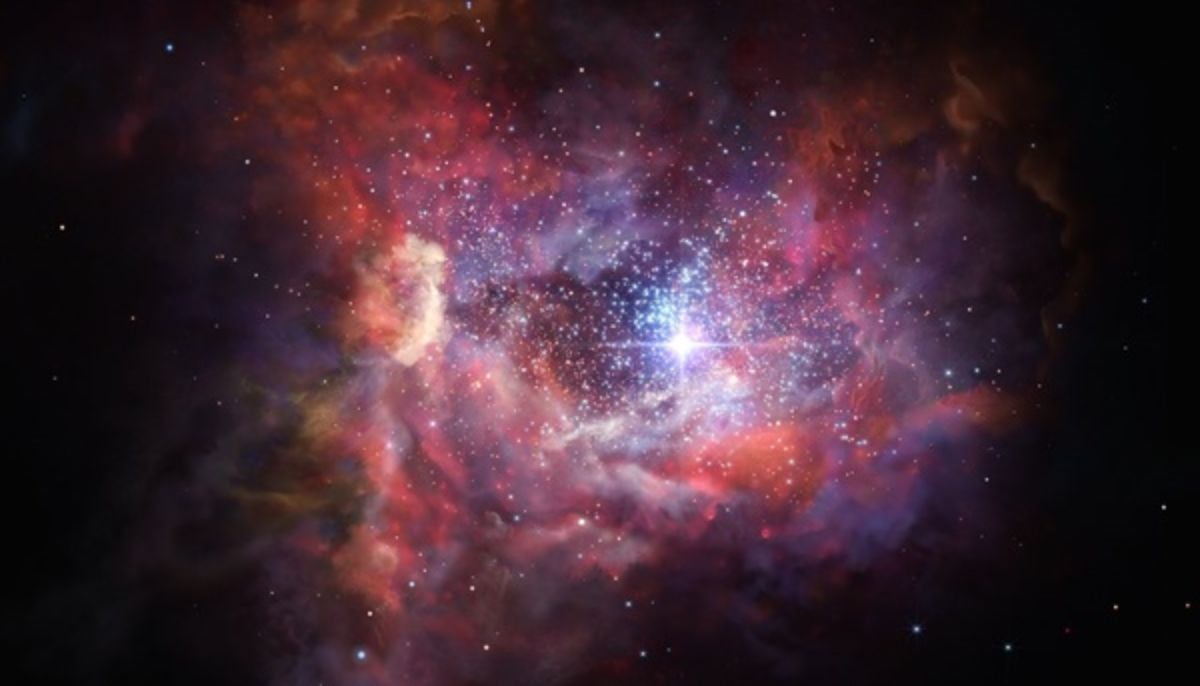
Scientists in a record-breaking discovery have found a hidden star in a region where dust should not exist.
Kappa Tucanae A has long been an enigma for astronomers. The region is surrounded by dust whose temperature has reached more than 1,000 degrees Fahrenheit.
Under such extreme conditions, the existence and survival of dust has been a mystery for astronomers. It should either evaporate or be pushed away by the star’s radiation.
Researchers from the University of Arizona’s Steward Observatory have detected a stellar companion star orbiting Kappa Tucanae A which is located 70 light-years away from the Earth by using the MATISSE instrument.
This recent discovery published in The Astronomical Journal gives researchers a rare but natural laboratory for deeply analyzing hot exozodical dust as this type of dust acts as a major hindrance in the search for Earth-like planets around the stars.
Such hot and exozodical dust also poses a major problem for NASA’s future Habitable Worlds Observatory (HWO), planned for the 2040s.
"If we see dust in such large amounts, it needs to be replaced rapidly, or there needs to be some sort of mechanism that extends the lifetime of the dust," Thomad Stuber, the lead author of the study said.
The record-setting finding also reshapes how scientists view the entire system. Instead of being a simple mystery, Kappa Tucanae A now serves as a foundation for studying extreme stellar interactions.
According to Steward Observatory Associate Astronomer Steve Ertel, a co-author of the study, “There's basically no way that this companion is not somehow connected to that dust production. It has to be dynamically interacting with the dust.”
Besides the exploration of new planets, the Kappa Tucanae A system paves the way for understanding the cosmic dust, its origins, composition and star’s interaction with the dust.
“Considering the Kappa Tucanae A system was observed many times before, we did not even expect to find this companion star,” Stuber said.
He continued, “This makes it even more exciting to now have this unique system that opens up new pathways to explore the enigmatic hot exozodiacal dust.”


-
 Scientists find ancient microbial life in places it shouldn't exist
 -
 Why Marijuana is suddenly sending thousands of dogs to hospitals in US?
 -
 36 years on, Hubble shows how stars actually change over time
 -
 Hidden magma beneath Mars? Scientists' 'unexpected' discovery raises new questions about alien life
 -
 Rare 3,200-year-old coral blue hole discovered in South China Sea
 -
 What happens at black hole’s event horizon? Scientists find the first-ever clue
 -
 Scientists discover evidence of fires used by humans 1.8 million years ago
 -
 Did NASA just uncover evidence of ancient life on Mars? Key discoveries explained
-
 Four powerful earthquakes strike three continents within hours: Scientific link or coincidence?
 -
Mysterious interstellar comet passing our solar system may be 12 billion years old, scientists say
-
When do we really become adults? Science has an answer
-
Strawberry Moon peaks June 29: When and where to watch