Discovery of 40,000 near-Earth asteroids could pose threat to Earth: Here’s how
The 40,000th near-Earth asteroid has been successfully catalogued
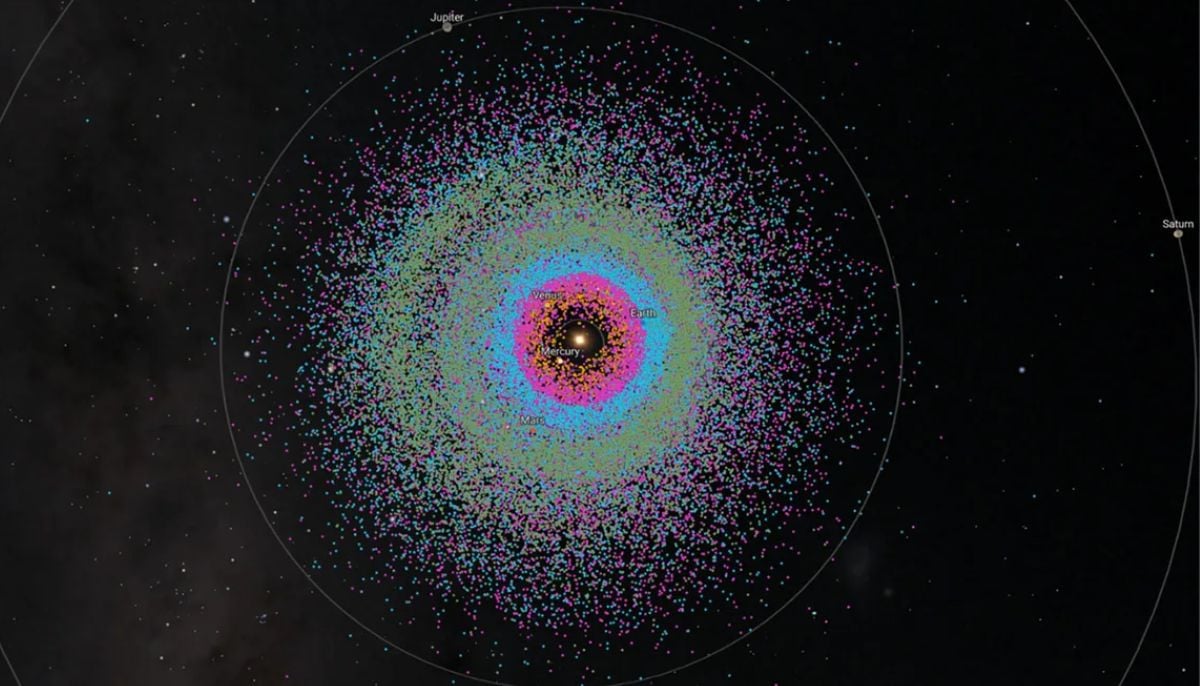
A surprising discovery has been unveiled by astronomers as they have categorized the 40,000th near-Earth asteroid.
The recent announcement marks a significant milestone in the detection of space rocks that orbit close to Earth, and scientists underline the threat posed by space rocks to our home planet.
According to the BBC, the near-Earth asteroids can be just a few meters to several kilometers across and travel on orbits that bring them relatively close to Earth.
The recent development brings immense interest to both scientists and planetary defense experts.
Why do we watch the near-Earth asteroids?
An asteroid is a relic left over from the Solar System’s formation over 4 billion years ago. It has been observed that most asteroids in our Solar System reside in the main asteroid belt between Mars and Jupiter.
A near-Earth Asteroid has an orbit that brings it within about 45 million kilometers of Earth’s orbit.
The dedicated asteroid survey telescopes increased the total number of known nearby space rocks in the 1990s and 2000s.
The year 2025 is well-known as the count of near-Earth asteroids exceeded 40,000, with around 10,000 of those found in three years.
A flurry of discoveries
The number of discoveries is expanding aggressively, from one thousand at the beginning of the century to 15,000 in 2016 and 30,000 in 2022.
Once a discovery has been made, scientists work to analyze its path using all data assembled on the objects across distinct observatories.
The computer software is used to analyze an asteroid’s orbit, even decades into the future to show what's likely to hit Earth.
Paving the way for new challenges
The European Space Agency (ESA) claimed that the largest near-Earth asteroids are easiest to detect. This revelation would cause global damage if they hit Earth, but scientists are confident that the vast majority has already been discovered.
The current focus is on the mid-sized objects, which are 100-300 meters across and are difficult to spot, but could cause regional damage.
The frequent analysis of data by scientists will help to learn about these nearby space rocks, as this research provides a crystal-clear picture of the potential threat to our planet and how to protect ourselves.




-
 European Space Agency to negotiate with NASA on future lunar missions
 -
 SpaceX AI satellites plan raises doubts after Microsoft setback
 -
 NASA Artemis II lifts off, sending cubesats into deep space study
 -
 Could there be life on Mars? NASA Jared Isaacman claims chances are 90%
 -
 NASA Artemis II Moon mission set for liftoff today: Here’s what to know
 -
 Did the Big Bang happen differently? New theory challenges origin of Universe
 -
 April’s Pink Moon 2026: How to see the full moon in all its glory
 -
 First-ever primordial black hole discovery? Scientists reveal breakthrough